 BUTTER-C
Face care
Micellar water OEM/ODM manufacturing
Micellar Cleansing Water · OEM/ODM
Micellar water is a dilute solution of very mild surfactants at a concentration above the micelle-forming threshold: the micelles surround oil and makeup, which are then wiped away with a cotton pad. Because the actives are at low concentration and the product is not rinsed off, the margin between "clean" and "stinging eyes" is very narrow — choosing the surfactant and its concentration is almost the entire challenge. Butter-C offers full-service manufacturing, from formula development to labeled finished goods and the cosmetic product notification.
Formula base
The micellar surfactant system — eye comfort comes first
Purified water makes up more than 90% of the formula; total surfactant content is usually only 0.5–3%. At such low levels, choosing the wrong surfactant cannot be fixed by adjusting ratios. The three groups below are the directions Butter-C works with.
Typical nonionics
Poloxamer 184, Poloxamer 188, PEG-6 Caprylic/Capric Glycerides. Form micelles well, produce almost no foam and are gentle on the eyes. The base of most commercial micellar waters.
Amphoterics
Disodium Cocoamphodiacetate, Cocamidopropyl Betaine at low levels. Boost cleansing while staying gentle; need rebalancing so they do not foam when wiped.
Glucosides
Decyl Glucoside, Coco-Glucoside. Plant-derived, used for a "PEG-free" positioning; base odor and clarity must be managed.
What to weigh when choosing
Eye comfort, ability to remove long-wear makeup, a "PEG-free" positioning, and water quality — in an all-water system, water matters more as a raw material than in any other format.
Key technical points
Concentration and pH — balancing cleansing against eye comfort
With the same surfactant system, a change of just a few parts per thousand in concentration changes the outcome entirely. This is optimized through standardized makeup removal tests, not estimates.
Critical micelle concentration
The formula must be far enough above the micelle threshold to cleanse, yet low enough not to sting the eyes. The optimum is set through removal tests on matte lipstick, mascara and sunscreen.
pH range
Kept at 5.5–6.5, close to tears; lightly buffered with citrate so the pH does not drift over the shelf life.
When long-wear makeup must be removed
Add 1–5% light esters (Isohexadecane, Caprylic/Capric Triglyceride) for a shake-before-use bi-phase, or use a solubilizer (PEG-40 Hydrogenated Castor Oil) to keep a single clear phase.
Preservation and soothing
The system is almost entirely water, so preservative challenge testing is mandatory: Phenoxyethanol or Sodium Benzoate at a sufficiently low pH, with EDTA as a chelator. Glycerin, Betaine, Panthenol and Allantoin restore moisture because the product is not rinsed off.
Three formulation directions
One principle, three different experiences
Single-phase micellar
A clear, uniform solution that needs no shaking. The most common format, suited to removing light to medium makeup.
Oil–water bi-phase
Shake well before use. Removes heavy makeup and sunscreen; needs a clear bottle to show the two layers.
Single phase with solubilized oil
Oil is solubilized into the water with a solubilizer. Cleanses more strongly than standard micellar water with no need to shake.
Packaging must be planned with the formula
Formulas with esters need compatible bottle and gasket materials; flip-cap or pump bottles are chosen according to how users wet the cotton pad.
Parameters we monitor
What our R&D lab measures on every sample
Below are the parameters Butter-C monitors during formula development and scale-up to production. Specific limits are agreed with you on the approved sample and then written into the product's in-house specification.
- Sensory profile & clarity
- Color, odor, clarity; for bi-phase products, redispersion after shaking is checked. Compared with the reference sample in the R&D lab.
- pH
- Measured directly at 25°C. pH drift monitored across stability time points.
- Density & conductivity
- Two quick batch-identification parameters for all-water systems that reveal mixing errors.
- Surface tension
- Assesses the activity of the surfactant system at low concentration — a direct reflection of its ability to form micelles.
- Makeup removal performance
- Standardized tests on matte lipstick, mascara and sunscreen following an internal procedure, compared with a control sample.
- Eye comfort
- Eye irritation assessed using alternative methods; tested on volunteers when the target market requires it.
- Stability
- Accelerated aging at 40°C and freeze–thaw cycling; monitored for haze at low temperature, color change and odor change.
- Microbiology & preservative challenge
- Tested at a GLP / ISO 17025-accredited laboratory; preservative efficacy (challenge) test per ISO 11930 — mandatory for all-water systems.
- Packaging compatibility
- Filled into the actual bottle, cap and gasket to be used; monitored for permeation, material odor and deformation.
Manufacturing specifications
Available capabilities
- Textures
- Single-phase liquid or oil–water bi-phase, clear or with a light tint.
- Formats
- Flip-cap bottles, pump bottles or screw-cap bottles. Fill volume agreed when choosing packaging.
- Minimum order quantity
- Agreed per order — depends on the formula direction and the chosen format.
- Testing
- Performed at a GLP / ISO 17025-accredited laboratory; a certificate of analysis is delivered with every batch.
- Documentation
- Product Information File (PIF) and cosmetic product notification prepared by Butter-C.
- Packaging
- Label design, printing and packing run in parallel with formula development.
Reference product
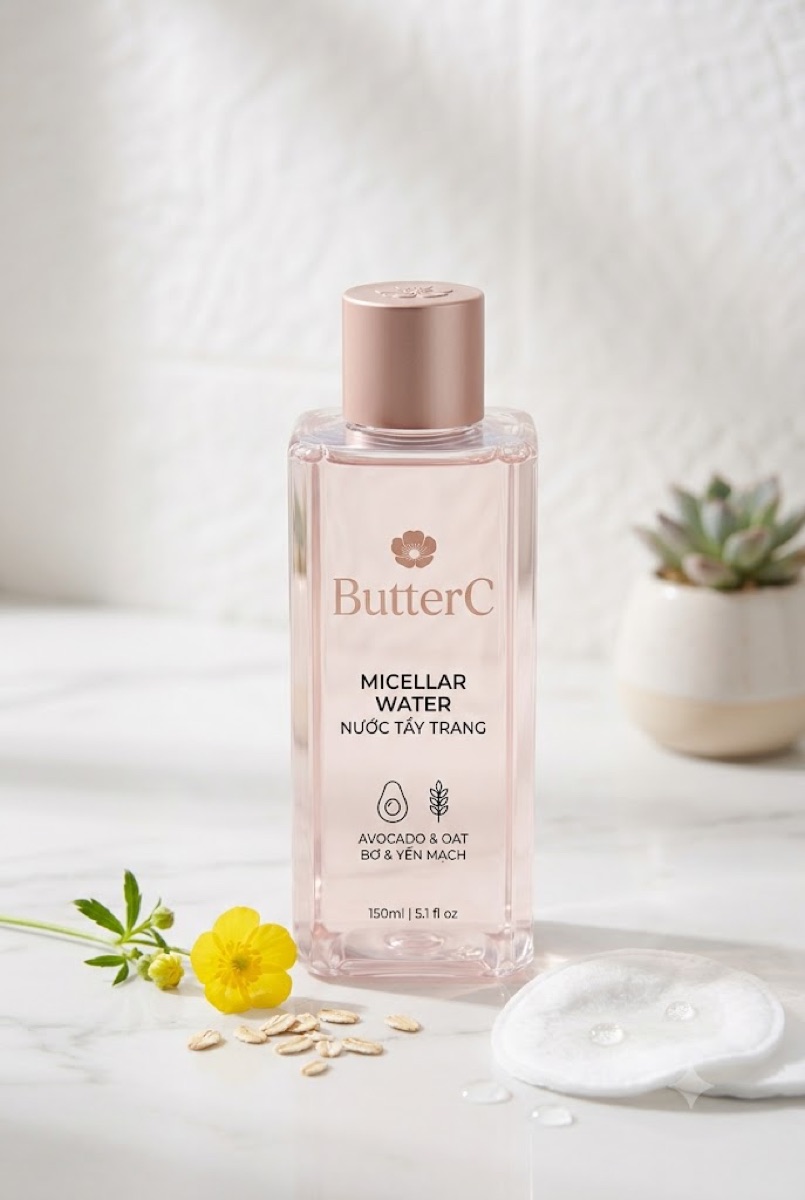
Micellar Water
A sample Butter-C currently manufactures, shown here to help you picture a specific formula direction. Your brand is free to choose a different direction — this is simply a starting point for discussion.
Avocado extract
A moisturizing direction that helps limit the dry feeling after removing makeup.
Oat
A soothing direction, often chosen for reactive skin.
Single-phase format
A clear solution with no need to shake before use.
150 ml format
Clear bottle with a screw cap that shows the color of the solution inside.
Customization options
What you can specify
The same product type can serve very different customers depending on the brand. Tell us your requirements in the areas below, and our team of pharmacists will develop a matching formula.
Surfactant system
PEG-based or PEG-free — determines eye comfort, the ingredient list and price.
Cleansing strength
Single phase for light makeup; bi-phase or solubilized oil for heavy makeup and sunscreen.
pH range
Chosen according to skin type and the next care step in the product range.
Active groups
Soothing, moisturizing, care for acne-prone skin — safety-assessed before being added to the formula.
Fragrance and color
Scented or fragrance-free; color from extracts or left uncolored.
Ingredient positioning
Alcohol-free, fragrance-free, PEG-free, paraben-free — please tell us at the outset so we can select suitable raw materials.
How we work
From idea to finished batch
Eight steps and three milestones signed off by both sides: approved sample, notification number, finished batch. Step-by-step details (in Vietnamese) →
Get started
Tell us about the product you plan to launch
Send us your product direction and expected volume. Our team will get back to you during business hours (Vietnam time, GMT+7).
Head office: Huu Le village, Dai Thanh commune, Hanoi · Factory: Thanh Oai Industrial Cluster, Binh Minh commune, Hanoi, Vietnam
Hotline +84 987 964 764 · [email protected] · Privacy policy ← Full catalog