 BUTTER-C
Face care
Facial cleanser OEM/ODM manufacturing
Facial Cleanser · OEM/ODM
A cream cleanser is a surfactant solution with an added conditioning phase — unlike a gel, it cleanses while leaving some lipids on the skin. These two goals pull in opposite directions: the stronger the surfactant, the cleaner the skin but the more lipids it strips; the more conditioning phase, the milder the product but the harder it is to foam and to stabilize. A good formula is a balance point chosen deliberately for the target skin type. Butter-C offers full-service manufacturing, from formula development to labeled finished goods and the cosmetic product notification dossier.
Formula base
Surfactant system — choose it first, everything else follows
Surfactants make up 8–18% of the formula but determine almost everything: cleansing strength, foam quality, after-wash feel, and even how the product is thickened. The three groups below are the directions Butter-C works with; a formula usually pairs one primary surfactant with one or two secondary ones.
Sulfate-based anionics
Sodium Laureth Sulfate, Sodium Lauryl Sulfate. Strong foam, easy to thicken with salt, low raw material cost. They remove more lipids, so a conditioning phase is needed to compensate.
Amino acid-based
Sodium Cocoyl Glycinate, Sodium Lauroyl Sarcosinate, Sodium Cocoyl Glutamate. Fine, creamy foam, a natural pH close to skin, less drying. Harder to thicken and more costly than sulfates.
Co-surfactants
Cocamidopropyl Betaine, Coco-Glucoside, Decyl Glucoside. Not used alone; added to reduce irritation from the primary surfactant, improve foam stability and adjust viscosity.
What to weigh when choosing
Total active surfactant, primary/secondary ratio, compatibility with the conditioning phase, "sulfate-free" positioning and cost difference — usually the deciding factor in the end.
Key technical points
Conditioning phase and pH — what decides whether skin feels tight and dry
With the same surfactant system, changing the conditioning phase and pH completely changes the after-wash feel. These are two items you should decide early, as they constrain both the ingredient list and the thickening approach.
pH range
The formula is kept at about 5.0–6.0, close to the skin's physiological pH. Amino acid systems naturally sit in this range; sulfate systems need adjustment with citric or lactic acid and buffering.
Conditioning phase
Light esters and oils at 1–5% (Caprylic/Capric Triglyceride, Glyceryl Stearate, shea butter) with humectants such as Glycerin at 3–8%, Betaine and Panthenol. Overdo it and the foam collapses and the emulsion separates easily.
Thickening system
Salt works only with sulfate systems and follows a "salt curve" — add too much and the product thins out again. Amino acid systems need polymers: Acrylates Copolymer, PEG-120 Methyl Glucose Dioleate, Xanthan Gum.
Preservation and chelation
Phenoxyethanol/Ethylhexylglycerin, or Sodium Benzoate/Potassium Sorbate when the pH is low enough. Disodium EDTA maintains foam in hard water and supports the preservative system.
Three formulation directions
One principle, three different experiences
Cream cleanser
An opaque white emulsion with a high conditioning phase and moderate foam. Skin feels soft after washing; suited to dry and sensitive skin.
Light lotion cleanser
Less conditioning phase, rinses easily, moderate foam. A popular format for normal and combination skin.
High-foaming cleanser
A higher surfactant level with rich, fine foam. Suited to oily skin and markets used to a "squeaky clean" feel.
Packaging designed with the formula
Tubes need a viscosity high enough not to run when squeezed; pump bottles need a lower one. Choose the format before setting the viscosity, not after.
Parameters we monitor
What our R&D lab measures on every sample
These are the parameters Butter-C monitors during formula development and scale-up to production. Specific limits are agreed with you on the approved sample and then written into the product's in-house specification.
- Appearance
- Color, odor, homogeneity, no separation. Compared with the reference sample kept in the R&D lab.
- pH
- Measured neat or on a 10% solution at 25°C. pH drift is tracked across stability checkpoints.
- Viscosity
- Measured with a rotational viscometer, with spindle and speed recorded. Directly tied to the tube or pump bottle format.
- Foam height & stability
- Ross–Miles method in standard hard water. Initial height and height after 5 minutes are recorded.
- Active surfactant content
- Two-phase titration. A batch identity parameter that detects blending deviations.
- Stability
- Accelerated aging at 40°C, freeze–thaw cycling and centrifugation; monitored for phase separation, color and odor change, and pH drift.
- Packaging compatibility
- Product filled into the actual tube/bottle and liner to be used; monitored for deformation, permeation and material odor.
- Microbiology & preservative challenge
- Tested at a GLP / ISO 17025-accredited laboratory; preservative challenge test per ISO 11930.
- Irritation assessment
- Skin and eye testing as required by the target market, performed before the formula is finalized.
Manufacturing specifications
Current capabilities
- Dosage form
- Gel, cream, or foaming format. Chosen according to the skin feel your brand wants to leave.
- Format
- Tube, pump bottle or flip-top bottle. Volume agreed during packaging selection.
- Minimum order quantity
- Agreed per order — depends on the dosage form and chosen format.
- Testing
- Performed at a GLP / ISO 17025-accredited laboratory; a certificate of analysis is delivered with every batch.
- Documentation
- Product Information File (PIF) and cosmetic product notification prepared by Butter-C.
- Packaging
- Label design, printing and packing run in parallel with formula development.
Reference product
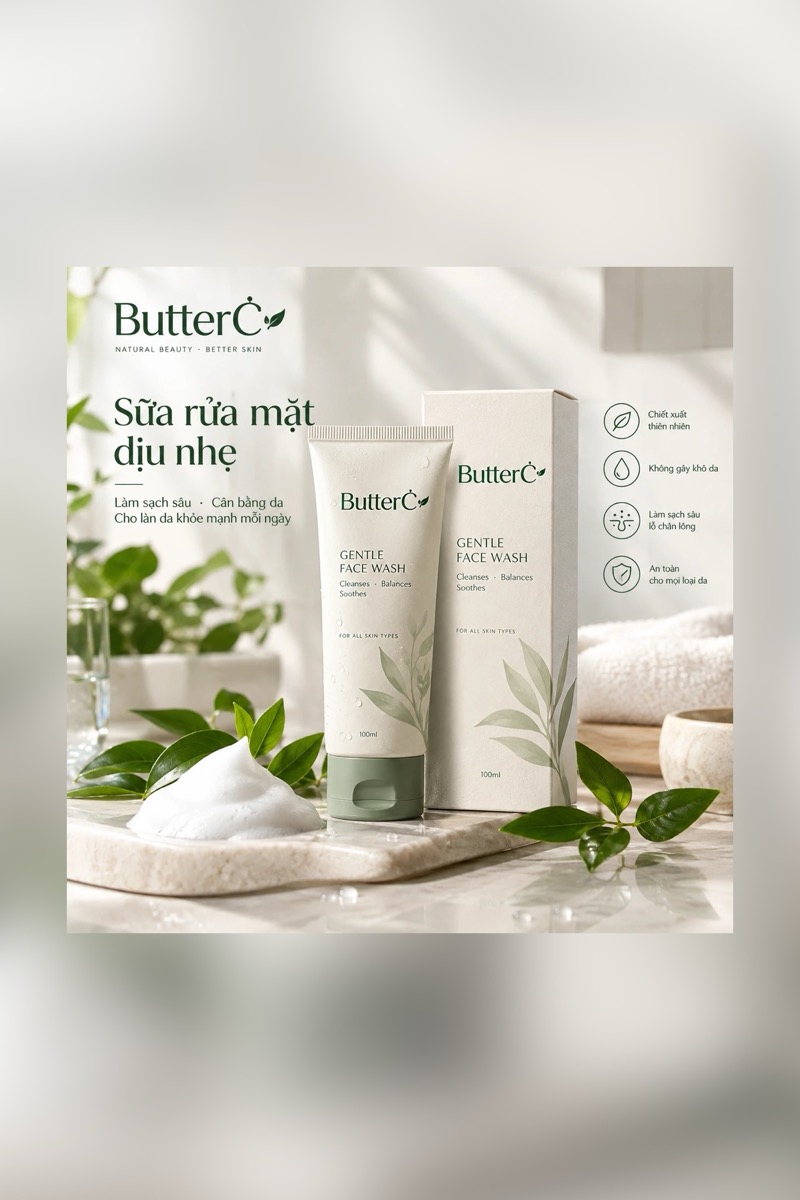
Gentle Face Wash
A sample Butter-C currently produces, shown here to help you picture one specific formula direction. Your brand is free to choose a different direction — this is only a starting point for discussion.
Mild surfactant system
Moderate foam that cleanses without leaving skin feeling tight and dry — designed for all skin types.
Natural extracts
A soothing and balancing group, safety-assessed before inclusion in the formula.
Skin balance
pH kept close to physiological pH; a light conditioning phase replenishes moisture lost during washing.
100 ml format
Tube with paper carton — a familiar format for retail facial cleansers.
Customization options
What you can specify
The same product format can serve very different customer groups. Tell us your requirements in the areas below and our team of pharmacists will develop a matching formula.
Surfactant system
Sulfate, amino acid or glucoside-based — it determines skin feel, cost and the ingredient list.
Foam level
High, moderate or almost no foam; tied to the chosen surfactant system.
pH range
Chosen according to skin type and the next step in the product range.
Conditioning phase and actives
Esters, plant butters, humectants and extracts; safety-assessed before inclusion.
Fragrance and color
Scented or fragrance-free; the natural color of the ingredients or adjusted to match the label.
Ingredient positioning
Vegan, sulfate-free, paraben-free — please specify at the outset so suitable raw materials can be selected.
How we work
From idea to finished batch
Eight steps and three milestones signed off by both sides: approved sample, notification number, finished batch. Step-by-step details (in Vietnamese) →
Get started
Tell us about the product you plan to launch
Send us your product direction and expected volume. Our team will get back to you during business hours (Vietnam time, GMT+7).
Head office: Huu Le village, Dai Thanh commune, Hanoi · Factory: Thanh Oai Industrial Cluster, Binh Minh commune, Hanoi, Vietnam
Hotline +84 987 964 764 · [email protected] · Privacy policy ← Full catalog