 BUTTER-C
Face care
Vitamin C serum OEM/ODM manufacturing
Vitamin C Serum · OEM/ODM
Vitamin C is one of the actives brands request most, and also one of the hardest to keep stable: in water it gradually oxidizes, the solution turns yellow and then brown, and its content drops. So the biggest decision in making a vitamin C serum is not the percentage, but which form of vitamin C to use — pure or derivative, water-soluble or oil-soluble. The chosen form drives the pH, the formula base, the packaging and even the shelf life. Butter-C offers full-service manufacturing, from formula development to a finished, labeled product with its cosmetic product notification.
Formula base
Three forms of vitamin C — choose the form first, everything else follows
On the label they are all called vitamin C, but in formulation terms these are different raw materials with different INCI names and different requirements.
Pure Ascorbic Acid
Water-soluble and the most widely studied form. It needs a pH below 3.5 to be stable and is typically used at 5–20%. Oxidizes easily and can sting — suited to an intensive positioning.
Water-soluble derivatives
Sodium Ascorbyl Phosphate, Magnesium Ascorbyl Phosphate, Ascorbyl Glucoside, 3-O-Ethyl Ascorbic Acid. Stable at pH 5–7, more color-stable and gentler — the basis of serums for all skin types.
Oil-soluble derivatives
Ascorbyl Tetraisopalmitate, Ascorbyl Palmitate. Used in oil bases or emulsions, stable against water and air, with a smooth, silky feel.
What to weigh when choosing
A "pure vitamin C" or a "gentle and stable" positioning; the percentage stated on the label; tolerance of the target skin group; raw material cost, with derivatives considerably more expensive than Ascorbic Acid.
Key technical points
Protecting the antioxidant itself from oxidation
A vitamin C serum meets the requirement when it still holds its color and content on the last day of its shelf life, even after the consumer has had it open for weeks.
Oxidation and discoloration
Tocopherol and Ferulic Acid are combined to protect Ascorbic Acid; chelating agents bind metal ions; filling is done with limited oxygen exposure. Color index is measured periodically, not just checked by eye.
pH and stinging
Ascorbic Acid requires pH 2.5–3.5, so it can sting; a buffer system and soothing agents help skin tolerate it better. Derivatives allow a pH of 5–7, close to the skin's physiological pH.
Formula base
A water base is simple but less stable. Low-water or anhydrous bases (glycols, silicones), emulsions, or powder-to-mix formats all extend the life of the active.
Period after opening
Every opening lets air in. An in-use simulation test shows how long the product holds up after opening — the basis for the period-after-opening statement and for choosing the fill size.
Three formulation directions
One active, three different experiences
Low-pH Ascorbic Acid serum
Ascorbic Acid with Tocopherol and Ferulic Acid in a water or low-water base. An intensive direction for skin already used to actives; requires light-tight, airtight packaging.
Stable derivative serum close to skin pH
Ascorbyl Glucoside or Ethyl Ascorbic Acid with Hyaluronate and Panthenol. Gentle, color-stable, for all skin types — readily becomes the core seller of a line.
Oil-based vitamin C serum
Ascorbyl Tetraisopalmitate in an ester and squalane base. Water-free and therefore very stable; a smooth, silky feel suited to dry skin.
Packaging is designed together with the formula
Dark or coated glass, airless pumps, small fill sizes so the product is used up before it oxidizes. Clear bottles show off the color but need a light-blocking carton and a color-stable formula.
Parameters we monitor
What our R&D lab measures on every sample
Below are the parameters Butter-C monitors during formula development and scale-up to production. Specific limits are agreed with you on the approved sample and then written into the product's in-house specification.
- Sensory profile & color index
- Color, odor, clarity; color index measured periodically to detect discoloration early.
- pH
- Measured directly at 25°C; for Ascorbic Acid, pH drift is the most closely monitored parameter.
- Viscosity
- Measured with a rotational viscometer, recording spindle and speed. Tied to the choice of dropper or pump.
- Vitamin C content
- Assayed by HPLC on every batch; the figure on the label must match this result.
- Remaining content after aging
- Re-assayed at each accelerated aging time point — the basis for setting shelf life.
- In-use simulation
- The container is opened and product dispensed on a set cycle, then color and content are re-measured — the basis for the period-after-opening statement.
- Stability
- Accelerated aging at 40°C, freeze–thaw cycling and light exposure; monitored for discoloration, crystallization and separation.
- Packaging compatibility
- Checked for airtightness, light transmission, and gasket reaction with the low-pH base.
- Microbiology & safety
- Tested at a GLP / ISO 17025-accredited laboratory; preservative efficacy (challenge) test to ISO 11930; irritation and stinging tests.
Claims
Writing claims within the cosmetic scope
With vitamin C serums, two things often go wrong: claims that go beyond the cosmetic scope, and an ingredient name and percentage on the label that do not match the formula. Butter-C reviews both while preparing the notification dossier.
Helps skin look radiant and even-toned
Instead of: skin whitening, instantly whiter skin.
Helps fade the look of dark marks
Instead of: treats melasma, erases dark spots.
Antioxidant, helps protect skin from environmental stressors
Instead of: sun protection, replaces sunscreen.
Helps skin look firmer and smoother
Instead of: boosts collagen production, rejuvenates skin.
Ingredient name on the label
Use the correct INCI name of the form used. If the label says "pure vitamin C", the ingredient must be Ascorbic Acid, not a derivative.
Percentages and figures
The percentage on the label must match the formula and the assay result; efficacy figures are stated only when measured on the product itself.
Manufacturing specifications
Available capabilities
- Format
- Water-based serum, low-water serum, light emulsion or oil-based serum; colorless to orange-yellow depending on the formula.
- Packaging format
- Glass bottles with a dropper, or airless pump bottles. Fill size agreed when selecting packaging.
- Minimum order quantity
- Agreed per order — depending on the formula direction and the packaging selected.
- Testing
- Performed at a GLP / ISO 17025-accredited laboratory, including vitamin C assay; a certificate of analysis is supplied with each batch.
- Documentation
- Product Information File (PIF) and cosmetic product notification dossier prepared by Butter-C.
- Packaging
- Label design, printing and packing run in parallel with formula development.
Reference product
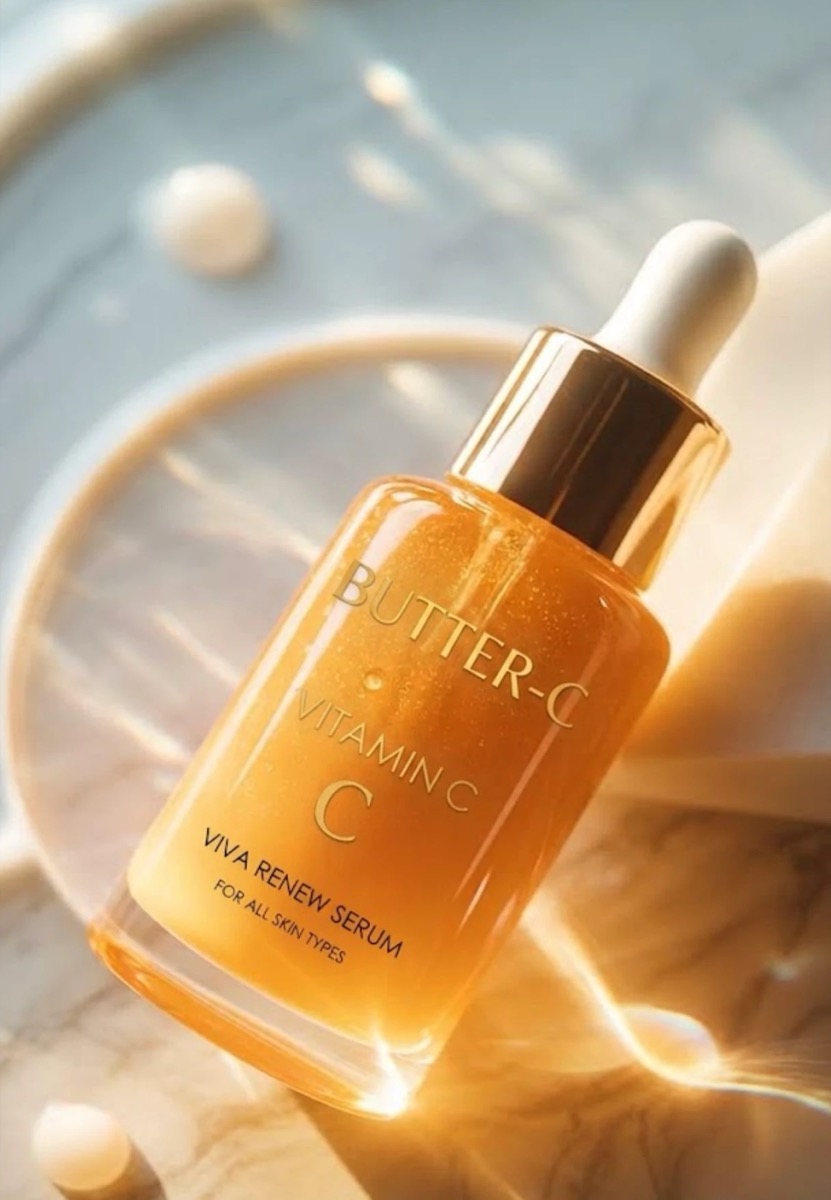
Butter-C Vitamin C — Viva Renew Serum
A product Butter-C currently manufactures, shown here to illustrate one specific formula direction. Your brand is free to choose a different direction — this is simply a starting point for discussion.
Stable vitamin C
The key active; derivatives are preferred to hold color and suit all skin types.
Orange-yellow with shimmer
Base colorant and shimmer particles from the list permitted in cosmetics keep the product's appearance consistent throughout shelf life.
For all skin types
pH set close to physiological pH, with soothing and moisturizing agents to limit stinging.
Dropper bottle format
Glass bottle, metal cap and dropper; supplied in a paper carton to block light.
Customization options
What you can specify
The same product type can target very different customers depending on the brand. Tell us your requirements in the areas below, and our team of pharmacists will develop a matching formula.
Vitamin C form
Pure Ascorbic Acid, a water-soluble derivative or an oil-soluble derivative.
Concentration
Chosen according to positioning and tolerance; this figure will be stated on the label and verified by testing.
Formula base
Water, low-water, emulsion or oil base — this determines stability and skin feel.
Supporting actives
Vitamin E, Ferulic Acid, Niacinamide, Hyaluronate; safety-assessed before inclusion.
Fragrance and color
Fragranced or fragrance-free; colorless, pale yellow or orange-yellow with shimmer.
Ingredient positioning
Vegan, fragrance-free, alcohol-free, silicone-free — please state these at the outset so suitable raw materials can be selected.
Further reading
Related topics
Brightening serum manufacturing
When vitamin C is combined with Niacinamide, Tranexamic Acid and Arbutin.
Managing skin pigmentation: dark patches, freckles and post-acne marks
Why skin tone becomes uneven and the actives commonly used (in Vietnamese).
How actives feel on skin
Why pure vitamin C and its derivatives feel different on skin (in Vietnamese).
SPF: what it means, ISO test methods and where to test
Vitamin C used in the morning always goes with sunscreen (in Vietnamese).
How we work
From idea to finished batch
Eight steps and three milestones signed off by both sides: approved sample, notification number, finished batch. Step-by-step details (in Vietnamese) →
Get started
Tell us about the product you plan to launch
Send us your product direction and expected volume. Our team will get back to you during business hours (Vietnam time, GMT+7).
Head office: Huu Le village, Dai Thanh commune, Hanoi · Factory: Thanh Oai Industrial Cluster, Binh Minh commune, Hanoi, Vietnam
Hotline +84 987 964 764 · [email protected] · Privacy policy ← Full catalog