 BUTTER-C
Face care
Foaming cleanser OEM/ODM manufacturing
Foaming Cleanser · OEM/ODM
A self-foaming facial cleanser is a surfactant solution with a viscosity close to water; the foam forms at the pump head as air is mixed into the liquid through a mesh. Foam quality is therefore the result of three things working together: the surfactant system, the viscosity and the pump type — change one and the foam changes. The formula cannot be thickened to mask flaws, so any batch-to-batch variation shows up clearly. Butter-C provides full-service manufacturing, from formula development to labeled finished goods with the cosmetic product notification.
Formula base
Surfactant system — chosen for foam generated at the pump, not in the palm
Here the foam is created mechanically, so total active surfactant is lower than in gels and lotion cleansers, typically 5–12%. The solution must be completely clear and free of haze at low temperatures. The three groups below are the directions Butter-C works with.
Amino acid-based
Sodium Cocoyl Glycinate, Potassium Cocoyl Glycinate, Sodium Lauroyl Sarcosinate. Creamy, fine and stable foam with a skin-friendly pH. The most common choice for self-foaming cleansers.
Amphoteric
Cocamidopropyl Betaine, Sodium Cocoamphoacetate. Refines the foam and reduces the irritation potential of the primary surfactant; almost always present in a supporting role.
Glucoside
Decyl Glucoside, Coco-Glucoside. Plant-derived and mild; the foam is slightly coarse, so they are used in blends rather than on their own.
Selection considerations
Complete solubility at low temperatures, the salt and electrolyte load they carry (there is no thickening system to compensate), cost and ingredient positioning.
Key technical points
Viscosity and pump — two decisions made together
With a gel or lotion cleanser, you can finalize the formula first and choose packaging later. Not with a self-foaming cleanser: the pump only works when the liquid is thin enough, and each pump type produces a different foam.
Viscosity limit
The solution must be close to water, usually below a few tens of mPa·s. Above the pump's limit, pumping becomes stiff, the foam turns coarse or the pump clogs after a few dozen actuations.
Pump type
Single or double mesh, 0.4–1.6 ml per actuation. Whether the foam is dense and creamy or light and airy depends on the mesh and air ratio — R&D samples are always sent with the exact pump that will be used.
Electrolyte control
With no thickening polymer, salts and charged actives directly affect viscosity and clarity. Glycerin and Betaine at 2–5% help refine the foam and reduce dryness.
Preservation in a dilute system
A high-water system with low surfactant activity makes a preservative challenge test mandatory. Phenoxyethanol/Ethylhexylglycerin or Sodium Benzoate; EDTA or GLDA as chelator.
Three formulation directions
One principle, three different experiences
Dense creamy foam
A high proportion of amino acid surfactants gives foam as fine as shaving cream that breaks down slowly. Suited to East Asian markets and normal skin.
Light airy foam
Lower total actives, foam that collapses quickly and rinses off fast. Suited to oily skin and morning use.
Foam with actives
Added Niacinamide, soothing extracts or mild acids. Each addition must be retested for clarity and viscosity, since there is no polymer to compensate.
Packaging is planned with the formula
Foam pump bottles cost more than standard pump bottles and also determine the foam quality. Choose the pump first, then adjust the formula to it.
Parameters we monitor
What our R&D lab measures on every sample
Below are the parameters Butter-C monitors during formula development and scale-up to production. Specific limits are agreed with you on the approved sample and then written into the product's in-house specification.
- Solution appearance
- Must be completely clear, with no haze or precipitate. Compared against a reference sample kept in the R&D lab.
- pH
- Measured directly at 25°C. pH drift is tracked across stability time points.
- Viscosity
- Measured with a rotational viscometer at high speed. The upper limit is set according to the selected pump.
- Foam quality through the actual pump
- Foam weight per actuation, expansion ratio and foam collapse time — measured on the exact pump to be used.
- Surfactant active content
- Two-phase titration. A batch identity parameter that detects blending errors.
- Stability
- Accelerated aging at 40°C and freeze–thaw cycling, with particular attention to haze and precipitation at low temperatures.
- Pump compatibility
- Number of consecutive actuations without clogging or leaking; actuation force must not increase after aging.
- Microbiology & preservative challenge
- Tested at a GLP / ISO 17025-accredited laboratory; preservative efficacy (challenge) test per ISO 11930.
- Irritation assessment
- Skin and eye testing as required by the target market, carried out before the formula is finalized.
Manufacturing specifications
Current capabilities
- Texture
- Thin liquid, clear or slightly opaque. Foam forms at the pump when dispensed.
- Format
- Foam pump bottle. Volume agreed during packaging selection.
- Minimum order quantity
- Agreed per order — depends on the pump type and the degree of formula customization.
- Testing
- Performed at a GLP / ISO 17025-accredited laboratory; a certificate of analysis is delivered with every batch.
- Documentation
- The Product Information File (PIF) and cosmetic product notification are prepared by Butter-C.
- Packaging
- Label design, printing and packing run in parallel with formula development.
Reference product
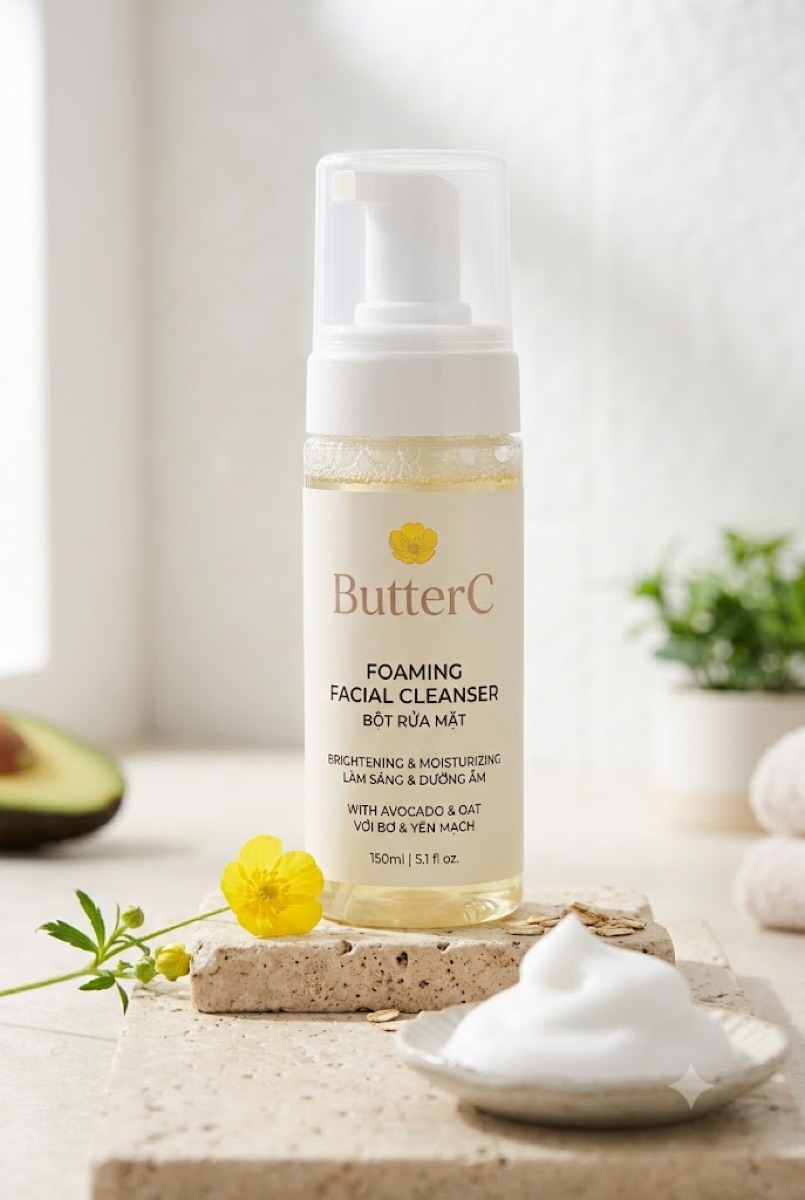
Foaming Facial Cleanser
A product Butter-C currently manufactures, shown here to give you a concrete formula direction. Your brand can take a completely different direction — this is simply a starting point for discussion.
Avocado extract
A moisturizing direction, replenishing the moisture often lost after cleansing.
Oat
A soothing direction, often chosen for reactive skin.
Product positioning
Brightening and moisturizing — aimed at customers who want to cleanse without feeling dry and tight.
150 ml format
Clear bottle that shows the color of the liquid, with a white pump.
Customization options
What you can specify
Within the same product type, each brand targets a different customer group. Tell us your requirements in the areas below, and our team of pharmacists will develop a matching formula.
Surfactant system
Amino acid, amphoteric or glucoside — determines foam quality, after-wash skin feel and the ingredient list.
Foam quality
Dense creamy foam or light airy foam — chosen together with the pump type.
pH range
Selected according to skin type and the next step in the product routine.
Actives
Soothing, moisturizing, brightening support — safety-assessed and retested for clarity before being added.
Fragrance and color
Fragranced or fragrance-free; color from extracts or left uncolored.
Ingredient positioning
Vegan, sulfate-free, paraben-free — please state this from the outset so suitable raw materials can be selected.
How we work
From idea to finished batch
Eight steps and three milestones signed off by both sides: approved sample, notification number, finished batch. Step-by-step details (in Vietnamese) →
Get started
Tell us about the product you plan to launch
Send us your product direction and expected volume. Our team will get back to you during business hours (Vietnam time, GMT+7).
Head office: Huu Le village, Dai Thanh commune, Hanoi · Factory: Thanh Oai Industrial Cluster, Binh Minh commune, Hanoi, Vietnam
Hotline +84 987 964 764 · [email protected] · Privacy policy ← Full catalog