 BUTTER-C
Face care
Cleansing oil OEM/ODM manufacturing
Cleansing Oil · OEM/ODM
Cleansing oil works on the principle that oil dissolves oil: the oil phase lifts makeup, sunscreen and sebum off the skin surface, then the emulsifier system in the formula turns everything into an oil-in-water emulsion that rinses away. It is a demanding cleanser to formulate — the oil phase and the emulsifier system have to be selected together, never separately. Butter-C offers full-service manufacturing, from formula development to labeled finished product with its notification dossier.
Formula base
The oil phase — choose the base first, everything else follows
The oil phase makes up 70–90% of the formula, so it shapes almost the entire user experience: viscosity, spreadability, residual shine and even the base odor. The three groups below are the directions Butter-C works with; a single formula usually combines two or three of them.
Light synthetic esters
Ethylhexyl Palmitate, Isopropyl Myristate, Caprylic/Capric Triglyceride. Low viscosity, fast spreading, nearly odorless, oxidation-stable. The base of most commercial cleansing oils.
Plant oils
Jojoba (structurally a wax ester, close to skin sebum), grapeseed, sunflower, rice bran, almond. They carry a brand story and an attractive ingredient list, in exchange for their own base odor and a greater need for antioxidant protection.
High-stability group
Hydrogenated Polyisobutene, pharmaceutical-grade mineral oil. Strong at dissolving long-wear matte makeup, with almost no change in color or odor over time — suitable when long shelf life is the priority.
What to weigh when choosing
Iodine value and oxidative stability, the base odor of plant oils, comedogenic potential, compatibility with bottle materials, and the raw material cost difference between groups — often the deciding factor.
Key technical points
The emulsifier system — what decides whether the oil rinses clean
With the same oil phase, changing the emulsifier system changes the product entirely. This is a decision you should make early, because it locks in both the ingredient list and the cost.
PEG-based system
PEG-20 Glyceryl Triisostearate, PEG-8 Glyceryl Isostearate, PEG-40 Hydrogenated Castor Oil. Fast emulsification, clean rinse, little oily film left behind, reasonable raw material cost.
PEG-free system
Polyglyceryl-4 Oleate, Polyglyceryl-10 Laurate, Sorbeth-30 Tetraoleate. For natural-ingredient positioning. Requires higher levels and usually gives a thicker emulsion — overall viscosity has to be rebalanced.
HLB range and level
Emulsifiers are chosen around HLB 10–14 so the product forms an oil-in-water emulsion on contact with water. Levels usually fall between 8–20% depending on the oil phase: too little leaves an oily film, too much feels drying and is more likely to sting the eyes.
Supporting additives
A small amount of co-solvent gives a clearer emulsion; antioxidants (tocopherol, BHT) protect the oil phase; oil-soluble actives such as vitamin E, squalane and ceramides are added to match the product direction.
Three formulation directions
One principle, three different experiences
Classic liquid oil
The most common format. Low viscosity, poured into the hand or pumped directly, emulsifies when water is added.
Gel-to-oil
A gelling polymer is added to the oil phase. The gel melts into oil on the skin. A more premium feel, with less dripping when dispensing.
Foaming oil
Uses a foaming pump. A gentler cleansing step, suited to customers who dislike the oily feel of cleansing oils.
Packaging is planned with the formula
Cleansing oil stays in direct contact with plastics and gaskets for a long time. Bottle material, pump type and gaskets are compatibility-tested together with the formula, not afterwards.
Parameters we monitor
What our R&D lab measures on every sample
These are the parameters Butter-C monitors while developing the formula and scaling it up to production. Specific limits are agreed with you on the approved sample and then written into the product's in-house specification.
- Sensory profile
- Color, clarity, base odor. Compared against the reference sample retained in the R&D lab.
- Density & refractive index
- Measured at 20°C. Two quick identity checks that reveal blending deviations between batches.
- Viscosity
- Measured with a rotational viscometer, with spindle and speed recorded. Determines how the product feels when dispensed and spread.
- Acid value & peroxide value
- Track oxidation of the oil phase — the most important parameter for formulas high in plant oils.
- Emulsification time
- Seconds from adding water until the mixture turns fully milky. A direct measure of how well the emulsifier system works.
- Residual film after rinsing
- Assesses the oil left on the skin after rinsing with water — the parameter users notice most.
- Makeup removal performance
- Tested on matte lipstick and sunscreen following an internal procedure, compared with a control sample.
- Stability
- Accelerated aging at 40°C, freeze–thaw cycling and centrifugation; separation, color change and odor change are monitored.
- Microbiology & safety
- Tested at a GLP / ISO 17025-accredited laboratory. Skin and eye irritation assessment according to the requirements of the target market.
Manufacturing specifications
Current capabilities
- Textures
- Liquid oil, gel-to-oil or foaming oil; clear or with a natural tint from the raw materials.
- Formats
- Pump bottles, screw-cap bottles or foaming pump bottles. Volume is agreed when choosing packaging.
- Minimum order quantity
- Agreed per order — depends on the formula direction and chosen format.
- Testing
- Performed at a GLP / ISO 17025-accredited laboratory; a certificate of analysis is delivered with each batch.
- Documentation
- The Product Information File (PIF) and the notification dossier are prepared by Butter-C.
- Packaging
- Label design, printing and packing run in parallel with formula development.
Reference product
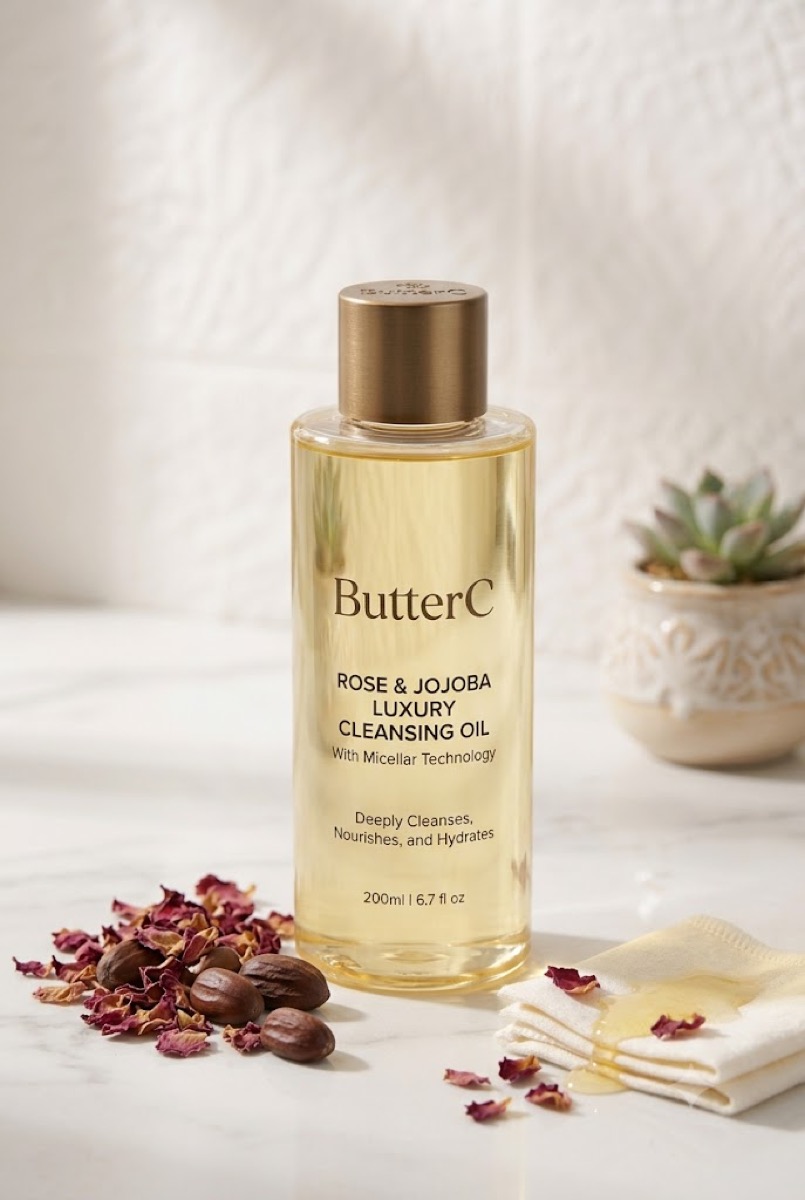
Rose & Jojoba Luxury Cleansing Oil
A Butter-C product currently in production, shown here to give you a concrete formula direction. Your brand is free to take a different direction — this is simply a starting point for discussion.
Jojoba base
A wax ester structurally close to skin sebum, with higher oxidative stability than most other plant oils.
Micellar approach
The emulsifier system lets the oil rinse off with water without a noticeable oily film.
Rose
Provides the base scent and the product story, suited to premium positioning.
200 ml format
A clear bottle that shows off the oil color, with a metal cap — signaling the product's tier.
Customization options
What you can specify
The same product type can serve very different customer groups depending on the brand. Tell us your requirements in the areas below and our team of pharmacists will develop a matching formula.
Base oil group
Synthetic esters, plant oils or the high-stability group — this determines both the feel and the ingredient list.
Emulsifier system
PEG-based or PEG-free, depending on the product's ingredient positioning and budget.
Viscosity
From a fast-spreading liquid oil to a thick gel — directly affects how much product is used each time.
Oil-soluble actives
Vitamin E, squalane, ceramides, oil-soluble extracts; safety-assessed before being added to the formula.
Fragrance and color
Fragranced or fragrance-free; the oil's natural color or adjusted to match the label.
Ingredient direction
Vegan, PEG-free, mineral oil-free, fragrance-free — please tell us at the outset so suitable raw materials can be selected.
How we work
From idea to finished batch
Eight steps and three milestones signed off by both sides: approved sample, notification number, finished batch. Step-by-step details (in Vietnamese) →
Get started
Tell us about the product you plan to launch
Send us your product direction and expected volume. Our team will get back to you during business hours (Vietnam time, GMT+7).
Head office: Huu Le village, Dai Thanh commune, Hanoi · Factory: Thanh Oai Industrial Cluster, Binh Minh commune, Hanoi, Vietnam
Hotline +84 987 964 764 · [email protected] · Privacy policy ← Full catalog