 BUTTER-C
Face care
Cleansing balm OEM/ODM manufacturing
Cleansing Balm · OEM/ODM
A cleansing balm is essentially a cleansing oil in solid form: the oil phase is structured with waxes, butters and solid esters into a soft mass that melts at skin temperature, turns back into oil as it is massaged in, and then emulsifies on contact with water. Compared with a liquid oil, the extra challenge is texture — soft on the skin but not melting in the warehouse, not separating and not turning grainy when the butters recrystallize. In a tropical climate, this is a format where the melting point has to be settled before anything else. Butter-C offers full-service manufacturing, from formula development to labeled finished goods and the cosmetic product notification dossier.
Formula base
Oil phase and structuring system — the two halves of a balm
The liquid part determines the application feel and base odor; the solid part determines hardness and melting point. The two cannot be chosen separately: change the oil and the waxes must be rebalanced. The three groups below are the directions Butter-C works with.
Liquid oils and esters (50–70%)
Ethylhexyl Palmitate, Caprylic/Capric Triglyceride, Isopropyl Myristate; jojoba, sunflower and rice bran oils. This is the part that melts during application — it sets spreadability, residual shine and base odor.
Plant butters
Shea, mango and cocoa butters. They carry the brand story and a soft feel; the trade-off is graininess, because butter crystals have several forms and readily recrystallize after thermal shock.
Structurants (8–20%)
Solid esters and waxes: Cetyl Palmitate, Hydrogenated Vegetable Oil, beeswax, candelilla wax, microcrystalline wax; or oil-gelling polymers such as Dextrin Palmitate. They determine hardness and melting point.
What to weigh when choosing
A melting point suited to warehouse and shipping temperatures in Vietnam, oxidative stability of plant oils, vegan positioning (no beeswax), and the cost difference between natural butters and synthetic esters.
Key technical points
Melting point, emulsification and graininess — three things that decide whether a balm sells
With the same oil phase, changing the structurant or the cooling process changes the product entirely. The three items below should be settled before discussing fragrance, color or actives.
Melting point window
The balm must soften at skin temperature (about 32–35°C) yet hold its shape at storage temperature. Formulas for tropical climates usually need a higher melting point than temperate ones, at the cost of a heavier feel — settled using real warehouse and shipping temperature data.
Emulsifier system
The same family as cleansing oils: PEG-20 Glyceryl Triisostearate, Sorbeth-30 Tetraoleate, or polyglyceryl esters for a PEG-free direction, at 8–18%. Liquid emulsifiers soften the balm, so every addition must be offset with more structurant.
Preventing graininess and oil separation
Controlled cooling — continuous stirring through the crystallization range, then filling at a set temperature; blending butters with solid esters to stabilize crystals; avoiding thermal shock in transit. Grains and oil sweating on the surface are the first defects users notice.
Preserving an anhydrous system
With no water, the main risk is oxidation rather than microbes: tocopherol or BHT protects the oil phase. Still, the jar is opened and scooped by hand, so microbiology is still tested and a spatula is recommended.
Three formulation directions
One principle, three different experiences
Classic balm
Butters and waxes, an opaque, soft mass that melts slowly on skin. A clearly nourishing feel; suited to dry skin and natural positioning.
Sorbet texture
Light solid esters and oil gels, a fluffy mass that melts quickly with little shine. A modern feel; suited to oily skin and East Asian markets.
Balm stick
Higher melting point, packed in a twist-up tube and applied directly to the face. Travel-friendly; requires tighter hardness control than the other two formats.
Packaging designed with the formula
Balm is hot-filled into jars and shrinks as it cools — a sunken or cracked surface comes from the filling and cooling process, not the formula. Jars, lids, liners and spatulas are tested together with the sample.
Parameters we monitor
What our R&D lab measures on every sample
These are the parameters Butter-C monitors during formula development and scale-up to production. Specific limits are agreed with you on the approved sample and then written into the product's in-house specification.
- Appearance & surface
- Color, odor, a flat surface with no sinking, cracking or pooled oil. Compared with the reference sample in the R&D lab.
- Melting point
- Drop point by a standard method. The parameter that decides whether the product survives warehousing and shipping.
- Hardness
- Measured with a needle penetrometer at 25°C and 35°C — two points that reflect scooping the product in an air-conditioned room and at room temperature.
- Acid value & peroxide value
- Track oxidation of the oil phase — important for formulas rich in butters and plant oils.
- Melt and emulsification time
- Seconds for the balm to melt into oil on skin, and seconds from adding water to full emulsification.
- Residual film & makeup removal
- Oil left on skin after rinsing; removal of matte lipstick, mascara and sunscreen tested following an internal procedure.
- Stability
- Freeze–thaw cycling to catch graininess, separation and oil sweating; storage at 40°C and 45°C to define the melting limit.
- Packaging compatibility
- Hot-filled into the actual jar to be used; monitored for shrinkage, jar deformation, lid liners and material odor after aging.
- Microbiology & safety
- Tested at a GLP / ISO 17025-accredited laboratory. Skin and eye irritation assessed as required by the target market.
Manufacturing specifications
Current capabilities
- Texture
- Classic soft balm, sorbet or stick; opaque or tinted by the raw materials themselves.
- Format
- Screw-cap jar with spatula, or twist-up tube for the stick. Volume agreed during packaging selection.
- Minimum order quantity
- Agreed per order — depends on the formula direction and the chosen format.
- Testing
- Performed at a GLP / ISO 17025-accredited laboratory; a certificate of analysis is delivered with every batch.
- Documentation
- Product Information File (PIF) and cosmetic product notification prepared by Butter-C.
- Packaging
- Label design, printing and packing run in parallel with formula development.
Reference product
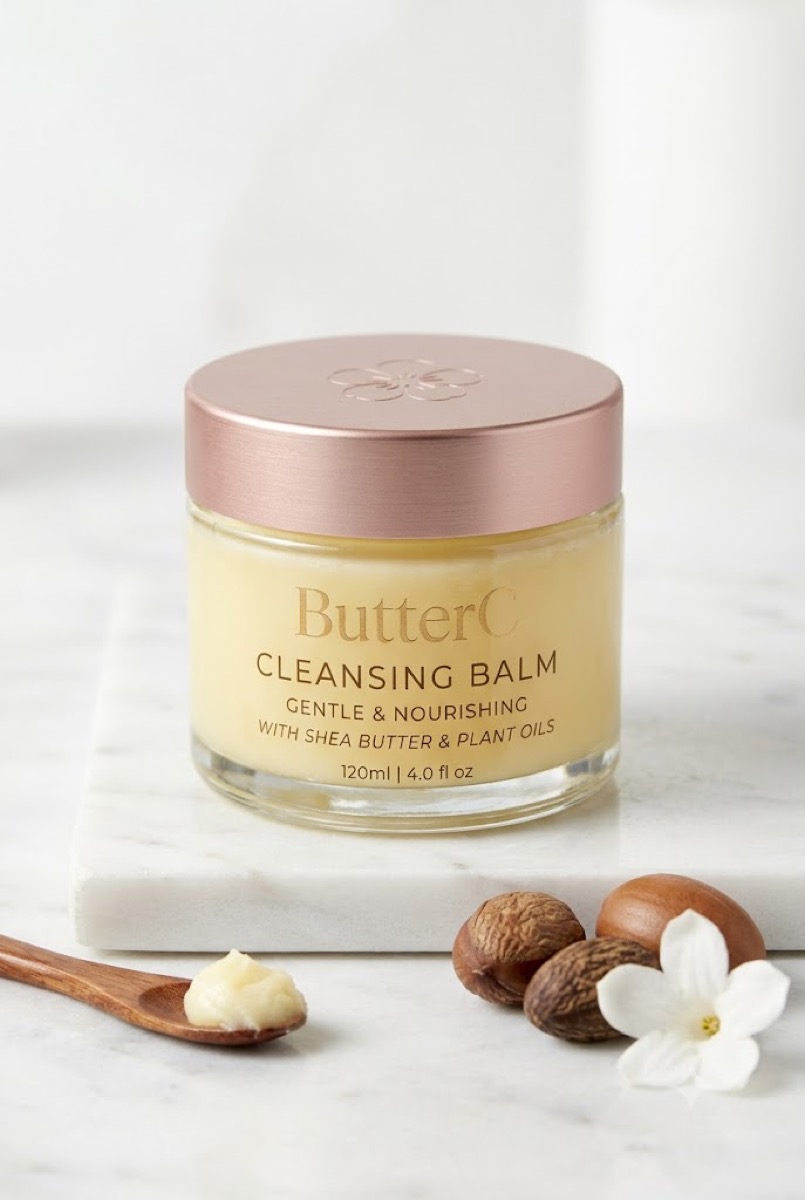
Cleansing Balm — Gentle & Nourishing
A sample Butter-C currently produces, shown here to help you picture one specific formula direction. Your brand is free to choose a different direction — this is only a starting point for discussion.
Shea butter base
Plant butter forms the soft part of the balm; the melting point is raised for a tropical climate.
Plant oils
The part that melts during application, bringing a natural base scent and a nourished feel after rinsing.
Gentle and nourishing direction
Positioned for dry and sensitive skin, with an emulsifier system balanced to avoid a noticeable greasy film.
120 ml format
Glass jar with a metal lid — signals a premium segment and withstands hot filling.
Customization options
What you can specify
The same product format can serve very different customer groups. Tell us your requirements in the areas below and our team of pharmacists will develop a matching formula.
Base oils and butters
Synthetic esters, plant oils or butters — they determine skin feel, base odor and the ingredient list.
Hardness and melting point
Chosen for the target market and storage conditions; directly tied to the jar or stick format.
Emulsifier system
PEG-based or PEG-free, depending on ingredient positioning and product budget.
Oil-soluble actives
Vitamin E, squalane, ceramides, oil-soluble extracts; safety-assessed before inclusion.
Fragrance and color
Scented or fragrance-free; the natural color of the butters and oils or adjusted to match the label.
Ingredient positioning
Vegan (no beeswax), PEG-free, mineral oil-free — please specify at the outset so suitable raw materials can be selected.
How we work
From idea to finished batch
Eight steps and three milestones signed off by both sides: approved sample, notification number, finished batch. Step-by-step details (in Vietnamese) →
Get started
Tell us about the product you plan to launch
Send us your product direction and expected volume. Our team will get back to you during business hours (Vietnam time, GMT+7).
Head office: Huu Le village, Dai Thanh commune, Hanoi · Factory: Thanh Oai Industrial Cluster, Binh Minh commune, Hanoi, Vietnam
Hotline +84 987 964 764 · [email protected] · Privacy policy ← Full catalog