 BUTTER-C
Face care
Gel cleanser OEM/ODM manufacturing
Gel Cleanser · OEM/ODM
A gel cleanser is a surfactant solution thickened into a gel, with almost no oil phase. The technical challenge lies in three areas: choosing a surfactant system that is mild enough at a concentration that still cleanses well, thickening without losing clarity, and keeping the pH stable throughout shelf life. For oily and acne-prone skin — the main users of gel cleansers — even small changes in pH or surfactants are noticeable. Butter-C offers full-service manufacturing, from formula development to a finished, labeled product with its cosmetic product notification.
Formula base
The surfactant system — clarity, cleansing and mildness pull in different directions
In a gel, the surfactant system determines not only how well it cleanses but also whether the gel can be clear and how it can be thickened. The three groups below are the directions Butter-C works with.
Sulfate system
Sodium Laureth Sulfate combined with Cocamidopropyl Betaine. Fully clear, rich foam, can be thickened with salt, low cost. Removes more lipids, so it suits oily skin better than dry skin.
Amino acid system
Sodium Cocoyl Glycinate, Sodium Lauroyl Methyl Isethionate, Sodium Methyl Cocoyl Taurate. Mild, close to skin pH, creamy foam. Harder to thicken, with a cloud point that must be planned for.
Glucoside system
Coco-Glucoside, Lauryl Glucoside. Plant-derived, very mild, low foam. Prone to cloudiness and hard to thicken if not blended in the right ratio.
What to weigh when choosing
Clarity (each surfactant has its own cloud point), thickening ability, "sulfate-free" positioning and the raw material cost difference between groups.
Key technical points
Thickening while staying clear — and holding a low pH
This is where a gel differs from a cream cleanser. Thickening polymers are often sensitive to low pH and to salt, while acne-prone skin calls for a low pH and actives that carry electrolytes. The thickening system has to be chosen with both in mind.
Thickening system
Table salt only works with sulfate systems. Carbomer and Acrylates/C10-30 Alkyl Acrylate Crosspolymer give clear gels but need neutralizing and are sensitive to electrolytes; electrolyte-tolerant Acrylates Copolymer and Sodium Polyacrylate are more robust with actives.
pH range
Kept at 5.0–5.5 for oily and acne-prone skin. Many polymers lose viscosity in this range, so the polymer and the pH must be locked in together, not separately.
Water-soluble actives
Salicylic Acid (at levels within regulatory limits, requiring a solubilizing solvent), Niacinamide, Zinc PCA, Panthenol, centella and green tea extracts. Each one affects clarity and viscosity.
Preservation and chelation
Phenoxyethanol/Ethylhexylglycerin or Sodium Benzoate at low pH. Disodium EDTA or GLDA protect the preservative system and maintain clarity in hard water.
Three formulation directions
One principle, three different experiences
Classic clear gel
Fully clear, medium viscosity, moderate foam. The most common format for oily and combination skin.
Slightly opaque gel
A small conditioning phase or pearlizing agent is added. A softer after-wash feel; a direction for combination skin leaning dry.
Gel-to-foam
A higher surfactant ratio, so the gel turns into a fine foam on contact with water. A direction for markets used to a distinctly clean feel.
Packaging is designed together with the formula
Pump bottles need low enough viscosity for an easy pump; tubes need higher viscosity so the product does not run. Packaging format is decided before viscosity is locked in.
Parameters we monitor
What our R&D lab measures on every sample
Below are the parameters Butter-C monitors during formula development and scale-up to production. Specific limits are agreed with you on the approved sample and then written into the product's in-house specification.
- Sensory profile & clarity
- Color, odor, and clarity measured by turbidity. Compared with the reference sample retained in the R&D lab.
- pH
- Measured directly at 25°C. pH drift is monitored — a key parameter for formulas containing acids.
- Viscosity
- Measured with a rotational viscometer, recording spindle and speed. Directly tied to the type of pump.
- Foam height & stability
- Ross–Miles method in standard hard water. Initial height and height after 5 minutes are recorded.
- Active content
- Surfactant titration; Salicylic Acid assayed by HPLC. Used as a batch identity parameter.
- Stability
- Accelerated aging at 40°C, freeze–thaw cycling and centrifugation; with particular attention to clarity after cold storage and pH drift.
- Packaging compatibility
- Filled into the actual bottle and pump to be used; monitored for pump strokes, pump clogging, deformation and material odor.
- Microbiology & preservative efficacy
- Tested at a GLP / ISO 17025-accredited laboratory; preservative efficacy (challenge) test to ISO 11930.
- Irritation assessment
- Skin and eye testing as required by the target market, carried out before the formula is finalized.
Manufacturing specifications
Available capabilities
- Format
- Clear gel or slightly opaque gel. Viscosity adjusted to the feel when dispensing into the hand.
- Packaging format
- Pump bottles are the most common format for gels; tubes and flip-cap bottles are also available.
- Minimum order quantity
- Agreed per order — depending on packaging format and the degree of formula customization.
- Testing
- Performed at a GLP / ISO 17025-accredited laboratory; a certificate of analysis is supplied with each batch.
- Documentation
- Product Information File (PIF) and cosmetic product notification dossier prepared by Butter-C.
- Packaging
- Label design, printing and packing run in parallel with formula development.
Reference product
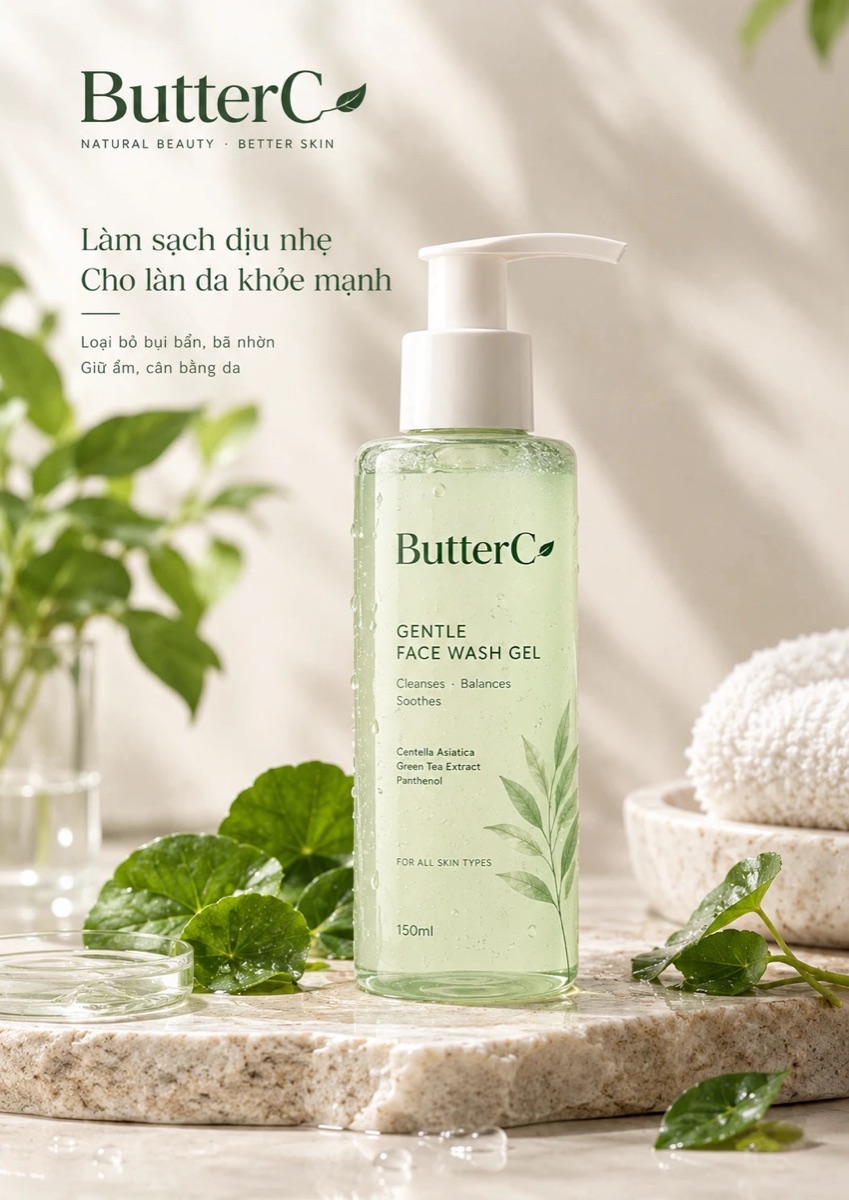
Gentle Face Wash Gel
A product Butter-C currently manufactures, shown here to illustrate one specific formula direction. Your brand is free to choose a different direction — this is simply a starting point for discussion.
Centella Asiatica
Centella extract for a soothing direction — commonly used for irritated skin.
Green tea extract
An oil-control and antioxidant direction for oily and combination skin.
Panthenol
Retains moisture and reduces the tight, dry feeling after cleansing.
150 ml size
Clear pump bottle that shows the color and texture of the gel inside.
Customization options
What you can specify
The same product type can target very different customers depending on the brand. Tell us your requirements in the areas below, and our team of pharmacists will develop a matching formula.
Surfactant system
Sulfate, amino acid or glucoside — this determines clarity, thickening method and the ingredient list.
Clarity
Fully transparent, clear with a tint, or slightly opaque with a conditioning phase.
Foam level
Gels are usually low-foam; for more foam, the surfactant system is increased and the viscosity rebalanced.
pH range and actives
Salicylic Acid, Niacinamide, Zinc PCA, soothing extracts — selected together with the pH range.
Fragrance and color
Fragranced or fragrance-free; color from extracts or left colorless.
Ingredient positioning
Vegan, sulfate-free, paraben-free — please state these at the outset so suitable raw materials can be selected.
How we work
From idea to finished batch
Eight steps and three milestones signed off by both sides: approved sample, notification number, finished batch. Step-by-step details (in Vietnamese) →
Get started
Tell us about the product you plan to launch
Send us your product direction and expected volume. Our team will get back to you during business hours (Vietnam time, GMT+7).
Head office: Huu Le village, Dai Thanh commune, Hanoi · Factory: Thanh Oai Industrial Cluster, Binh Minh commune, Hanoi, Vietnam
Hotline +84 987 964 764 · [email protected] · Privacy policy ← Full catalog