 BUTTER-C
Face care
Clay mask OEM/ODM manufacturing
Clay Mask · OEM/ODM
A clay mask cleanses by a physical mechanism: the clay minerals absorb excess oil and surface impurities, which are then rinsed away with the mask. Product quality therefore depends first on the quality of the mineral raw material — a naturally mined material that carries heavy metal and microbial risks if it is not properly processed and controlled. The formulation challenge is balancing oil absorption against moisture retention: a mask that dries too fast leaves skin tight and stinging, while a mask that never dries leaves users feeling it has done nothing. Butter-C offers full-service OEM/ODM manufacturing, from formula development to a labeled finished product with its cosmetic product notification.
Formula base
Clay minerals, humectants and actives
A clay mask formula consists of a mineral phase, a humectant phase and a group of supporting actives. The groups below are the directions Butter-C works with.
Clay minerals
Gentle Kaolin with moderate oil absorption; swelling Bentonite with strong absorption; green clay, pink clay and Ghassoul clay for color and origin stories. Usually two or three are blended to fine-tune absorption.
Supporting absorbent powders
Activated charcoal, mineral mud, Silica, starch. Increase oil absorption or give the product a distinctive color.
Humectants and soothing agents
Glycerin, Butylene Glycol and Betaine slow down drying; Panthenol, Allantoin, centella asiatica and Squalane keep skin from feeling dry and tight after rinsing.
Supporting actives
Niacinamide, Zinc PCA, low-concentration Salicylic Acid, green tea extract, tea tree — for lines aimed at oily skin and visible pores.
Key technical points
Four things that determine clay mask quality
Mineral raw material control
We select cosmetic-grade clays that have been heat-treated or irradiated; each raw material lot comes with a heavy metal and microbial analysis certificate and is retested before going into production.
Preservative system in a mineral base
Clay adsorbs part of the preservative and can carry microbial spores. The preservative system is selected and dosed through challenge testing on the actual clay-containing formula.
Drying speed and feel
The ratio of clay, water and humectants determines how long the mask takes to dry and how tight the skin feels. Target: set on the surface after ten to fifteen minutes, easy to rinse off, no stinging.
Suspension stability
Heavy minerals settle easily and water tends to separate to the surface; ions from the clay thin out some thickeners. We choose electrolyte-tolerant polymers and check for water separation across stability time points.
Three formulation directions
Three common clay mask formats
Cream clay mask
The most common format: a thick, smooth cream applied by hand or brush and rinsed off with water. Used once or twice a week.
Whipped clay mask
A light, airy texture like whipped cream, less tightening, easy to spread in a thin layer. For combination and sensitive skin.
Clay mask stick
A twist-up stick applied directly, no mess on the hands; convenient to carry. Requires a wax base and a hot-pour process.
Packaging designed alongside the formula
Wide-mouth jars with a tight inner liner so the mask does not dry at the edges; tubes retain moisture better and are more hygienic. Light-colored plastics are easily stained by clay and charcoal.
Parameters we monitor
What our R&D lab measures on every sample
Below are the parameters Butter-C monitors during formula development and scale-up to production. Specific limits are agreed with you on the approved sample and then written into the product's in-house specification.
- Sensory profile & color
- Color, odor, smoothness, no grittiness; natural mineral color varies between lots, so it is compared against a reference standard.
- pH
- Measured on a diluted solution; clay is slightly alkaline, so pH is adjusted to a skin-appropriate range.
- Viscosity & consistency
- Measured with a rotational viscometer or penetrometer; determines spreadability and how easily product is scooped from the jar.
- Heavy metals
- Lead, arsenic, mercury and cadmium in the mineral raw material and the finished product, against regulatory limits.
- Stability
- 40°C and freeze–thaw cycling; monitoring for water separation, mineral settling, edge drying and color change.
- Weight loss
- Periodic weighing in the actual packaging to assess water evaporation through the closure.
- Drying time and ease of rinsing
- On-skin evaluation: time to set, tightness, amount of water and number of rinses needed to remove.
- Microbiology & preservative challenge
- Tested at a GLP / ISO 17025-accredited laboratory; preservative efficacy (challenge) test according to ISO 11930.
- Packaging compatibility
- Filled into the actual jars or tubes to be used; checking seal integrity, staining and print peeling.
Claims
Writing claims within the cosmetic scope
On the label, "Purifying" should be understood as "cleansing". Butter-C reviews the wording on labels and marketing materials while preparing the cosmetic product notification; below are commonly used phrasings.
Cleanses and absorbs excess oil on the skin
Instead of: detoxifies skin, draws out toxins, purges lead.
Helps pores look smaller
Instead of: permanently tightens pores, shrinks pores.
Helps clear away sebum and reduce clogging
Instead of: treats blackheads, treats whiteheads, kills acne-causing bacteria.
Helps skin feel clearer and smoother
Instead of: regenerates skin, whitens skin after one use.
Directions for use
Clearly state leave-on time, uses per week, avoiding the eye and lip area, and moisturizing after rinsing.
Clay origin
State an origin (French clay, Dead Sea mud…) only when the supplier provides proof-of-origin documents.
Manufacturing specifications
Current capabilities
- Texture
- Thick cream, whipped or stick; the natural color of the clay or a custom color on request.
- Packaging format
- Jars, tubes or twist-up sticks. Volume agreed when selecting packaging.
- Minimum order quantity
- Agreed per order — depending on the formula direction and the chosen packaging format.
- Testing
- Performed at a GLP / ISO 17025-accredited laboratory, with a certificate of analysis delivered with each batch.
- Documentation
- Product Information File (PIF) and cosmetic product notification dossier prepared by Butter-C.
- Packaging
- Label design, printing and packing run in parallel with formula development.
Reference product
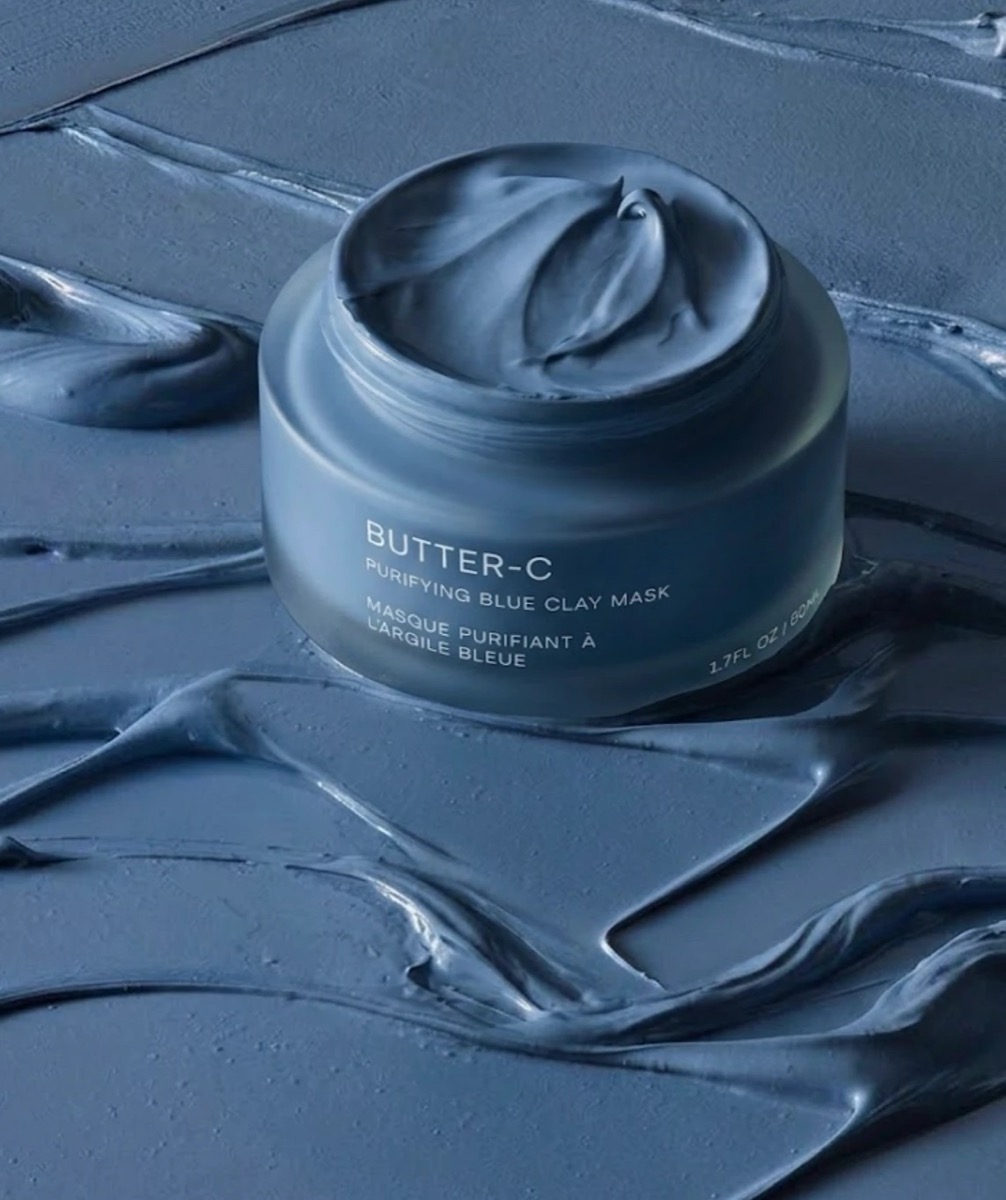
Butter-C Purifying Blue Clay Mask — cleansing blue clay mask
A sample made by Butter-C, shown here to help you picture a specific product direction. Your brand is free to choose a different direction — this is only a starting point for discussion.
Blue clay
The hero clay of the product, giving a distinctive blue-gray color without added colorants.
Thick, smooth cream texture
Holds its shape when swiped, spreads evenly into a thin layer, no grittiness.
Intended benefit
Cleanses and absorbs excess oil — for oily and combination skin.
Jar format
A frosted jar in the same color tone as the product, wide mouth; bilingual English–French label printed directly on the jar.
Customization options
What you can specify
The same product type can serve very different customers depending on the brand. Tell us your requirements in the areas below, and our team of pharmacists will develop a matching formula.
Clay type
Kaolin, Bentonite, green or pink clay, activated charcoal or mineral mud.
Oil absorption level
Gentle for combination and sensitive skin; strong for oily skin.
Texture
Thick cream, whipped or stick.
Supporting actives
Niacinamide, Zinc PCA, low-concentration Salicylic Acid, centella asiatica, green tea.
Scent and color
Fragrance-free or lightly scented; the natural clay color or a color matched to your brand identity.
Ingredient direction
Vegan, alcohol-free, paraben-free — please specify these from the start so suitable raw materials can be selected.
Further reading
Related topics
Caring for blemish-prone skin
The role of deep cleansing for oily, blemish-prone skin (in Vietnamese).
Raw material quality management
How natural mineral raw materials are controlled before going into production (in Vietnamese).
Sheet mask manufacturing
Hydrating masks to alternate with clay masks.
Serum manufacturing for blemish-prone skin
A daily product in the same routine for oily skin.
How we work
From idea to finished batch
Eight steps and three milestones signed off by both sides: approved sample, notification number, finished batch. Step-by-step details (in Vietnamese) →
Get started
Tell us about the product you plan to launch
Send us your product direction and expected volume. Our team will get back to you during business hours (Vietnam time, GMT+7).
Head office: Huu Le village, Dai Thanh commune, Hanoi · Factory: Thanh Oai Industrial Cluster, Binh Minh commune, Hanoi, Vietnam
Hotline +84 987 964 764 · [email protected] · Privacy policy ← Full catalog