 BUTTER-C
Face care
Hyaluronic acid serum OEM/ODM manufacturing
Hyaluronic Acid Serum · OEM/ODM
Hyaluronic Acid (HA) is a sugar polymer with a very high water-holding capacity that occurs naturally in the skin. In cosmetics, HA is not a single raw material but a whole range of materials that differ in molecular weight — and it is molecular weight that determines which layer of the skin HA holds water in, how viscous it is and whether it feels sticky. A good hydrating serum therefore usually combines several molecular sizes rather than increasing the content of just one. Butter-C offers full-service manufacturing, from formula development to a labeled finished product with its cosmetic product notification.
Formula base
Multi-weight HA — each molecular size holds water at a different layer
The larger the molecule, the more it stays on the surface and forms a film; the smaller the molecule, the further it can move between the layers of the stratum corneum. Combining three to five types gives both instant and longer-lasting hydration. Total HA content in a serum is usually only 0.1–2% — more does not hydrate better, it just becomes sticky and prone to pilling.
High molecular weight HA (above 1,000 kDa)
Stays on the surface, forming a thin water-holding film and giving a silky feel on application. It raises viscosity very strongly, so it is used only at low levels.
Medium molecular weight HA (100–1,000 kDa)
Hydrates the upper stratum corneum, balancing performance and feel. Usually the largest share of the blend.
Low molecular weight and hydrolyzed HA (below 50 kDa)
Hydrolyzed Hyaluronic Acid, low molecular weight Sodium Hyaluronate. Reaches deeper into the stratum corneum with almost no increase in viscosity; tolerance should be tested on sensitive skin.
HA derivatives
Sodium Acetylated Hyaluronate adheres well to skin and holds moisture longer; Sodium Hyaluronate Crosspolymer forms a network that releases water slowly; Hydroxypropyltrimonium Hyaluronate stays on the surface even after rinsing.
Key technical points
Viscous but not sticky, hydrating without pilling
HA is an easy ingredient to misuse: the formula looks simple, but pilling, stickiness and viscosity loss over time all come from the details below.
Viscosity and feel
High molecular weight HA already forms a gel at 1%. The desired viscosity is built through the ratio between molecular sizes, not the total content; too much high-weight HA causes stickiness and pilling when layered.
Hydration during manufacturing
HA powder swells slowly and clumps easily. Sprinkling it in gradually or pre-dispersing it in a glycol, low-speed mixing and enough swelling time determine clarity and batch-to-batch uniformity.
Electrolytes and pH
HA is negatively charged: salts and electrolyte actives reduce viscosity, and positively charged ingredients can cause precipitation. The formula is kept at pH 5–7 with total electrolytes under control.
Moisture sealing and preservation
HA holds water but does not prevent evaporation, so it is usually paired with Glycerin, Betaine, Panthenol and Ceramide. HA is also a nutrient source for microorganisms — preservative challenge testing is mandatory.
Three formulation directions
One active, three different experiences
Watery HA serum
Fluid, fast-absorbing, patted on in several layers. Low and medium molecular weight HA dominate; for oily, dehydrated skin and hot, humid climates.
Concentrated HA serum
As viscous as a thin gel, with more high-weight HA and derivatives. A noticeably plump, dewy feel; for dry skin and air-conditioned rooms.
HA serum with added actives
Added Panthenol, Hydrolyzed Collagen, Ceramide, peptides, or actives encapsulated in suspended microcapsules. Microcapsules require a suspending polymer and separate settling tests.
Packaging designed alongside the formula
Droppers suit fluid serums; thicker serums are better in pumps. Clear bottles show off the microcapsules and the clarity of the solution — but every air bubble or clump is also visible.
Parameters we monitor
What our R&D lab measures on every sample
Below are the parameters Butter-C monitors during formula development and scale-up to production. Specific limits are agreed with you on the approved sample and then written into the product's in-house specification.
- Sensory profile & clarity
- Color, odor, clarity; inspection for air bubbles and clumps — the two typical defects of HA formulas.
- pH
- Measured directly at 25°C; monitoring pH drift across stability time points.
- Viscosity
- Measured with a rotational viscometer at several speeds; monitoring viscosity loss over time.
- Raw material molecular weight
- Checked against the certificate of analysis for each incoming HA lot; an off-spec molecular weight means an off-spec product feel.
- HA content
- Assayed in the finished product to control blending variation between batches.
- Moisturizing performance
- Skin surface hydration measured on volunteers at the brand's request, with a control sample.
- Stability
- Accelerated aging at 40°C, freeze–thaw cycling; monitoring viscosity loss, haze and microcapsule settling.
- Packaging compatibility
- Filled into the actual bottles, droppers or pumps to be used; checking pump force and stringing when dropping.
- Microbiology & safety
- Tested at a GLP / ISO 17025-accredited laboratory; preservative efficacy (challenge) test according to ISO 11930; irritation testing before sign-off.
Claims
Writing claims within the cosmetic scope
HA is often marketed in the language of medical aesthetics. Butter-C reviews the wording on labels and marketing materials while preparing the cosmetic product notification; below are commonly used phrasings.
Hydrates, leaves skin plump and dewy
Instead of: inflates the skin, replaces filler injections.
Helps skin look fuller, softer and smoother
Instead of: fills wrinkles, erases wrinkle lines.
Helps maintain skin moisture
Instead of: repairs cells, regenerates skin.
Penetrates the stratum corneum
Instead of: penetrates deep into the dermis, acts on cells.
Ingredient names and descriptions
Use the correct INCI name for each form of HA; "multi-molecular" describes the formula and must match the actual ingredients.
Performance figures
HA's water-holding capacity is a property of the raw material, not a benefit of the product; figures are stated only when measured on the product itself.
Manufacturing specifications
Current capabilities
- Texture
- Watery, lightly viscous or thin-gel serum; transparent, optionally with suspended microcapsules.
- Packaging format
- Glass bottles with droppers, or pump bottles. Volume agreed when selecting packaging.
- Minimum order quantity
- Agreed per order — depending on the formula direction and the chosen packaging format.
- Testing
- Performed at a GLP / ISO 17025-accredited laboratory, with a certificate of analysis delivered with each batch.
- Documentation
- Product Information File (PIF) and cosmetic product notification dossier prepared by Butter-C.
- Packaging
- Label design, printing and packing run in parallel with formula development.
Reference product
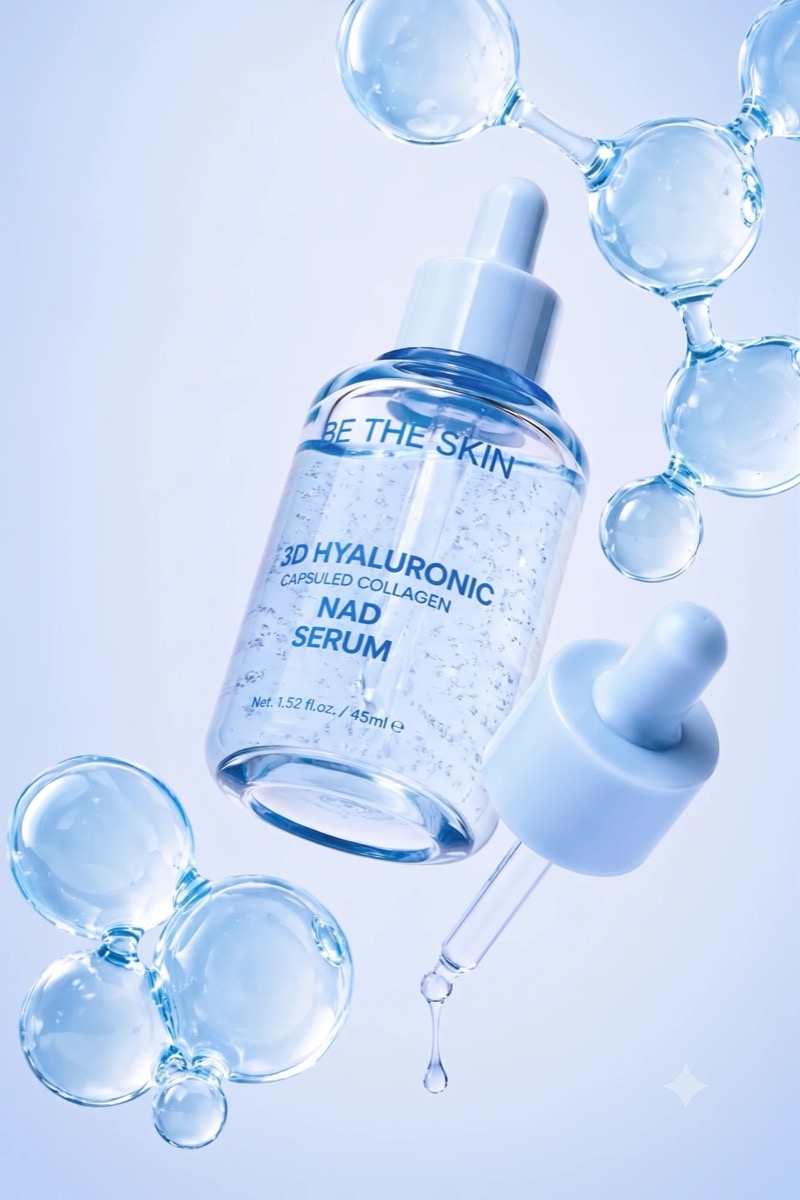
Multi-weight HA serum with microcapsules
A sample shown here to help you picture a specific formula direction. Your brand is free to choose a different direction — this is only a starting point for discussion.
HA in multiple molecular weights
A blend of high, medium and low weight HA to hold water at several layers of the stratum corneum.
Hydrolyzed collagen in microcapsules
Microcapsules suspended in a clear serum base that burst on application.
Clear, lightly viscous texture
Absorbs quickly without leaving a sticky layer; can be worn under moisturizer and sunscreen.
45 ml format
Clear glass bottle with dropper that shows off the microcapsules inside.
Customization options
What you can specify
The same product type can serve very different customers depending on the brand. Tell us your requirements in the areas below, and our team of pharmacists will develop a matching formula.
Number of HA types and ratio
Three, five or more molecular sizes; the ratio between sizes determines feel and cost.
Viscosity
Water-thin, lightly viscous or thin gel — tied to the choice of dropper or pump.
Complementary actives
Panthenol, Ceramide, Hydrolyzed Collagen, peptides; safety-assessed before inclusion.
Microcapsules
With or without; color and bead size chosen to match the label, with settling tests over the shelf life.
Scent and color
Scented or fragrance-free; transparent or with a light tint.
Ingredient direction
Vegan (fermentation-derived HA), fragrance-free, alcohol-free — please specify these from the start so suitable raw materials can be selected.
Further reading
Related topics
Dry skin vs. dehydrated skin: differences, causes and care
Lipid-deficient skin differs from water-deficient skin — and what HA can do (in Vietnamese).
How toners, essences, serums and moisturizers differ
Where a hydrating serum fits in the skincare routine (in Vietnamese).
How to choose cosmetics by skin type
Textures and actives to prioritize for each skin type (in Vietnamese).
How active ingredients feel on skin
Why the same active can deliver different experiences (in Vietnamese).
How we work
From idea to finished batch
Eight steps and three milestones signed off by both sides: approved sample, notification number, finished batch. Step-by-step details (in Vietnamese) →
Get started
Tell us about the product you plan to launch
Send us your product direction and expected volume. Our team will get back to you during business hours (Vietnam time, GMT+7).
Head office: Huu Le village, Dai Thanh commune, Hanoi · Factory: Thanh Oai Industrial Cluster, Binh Minh commune, Hanoi, Vietnam
Hotline +84 987 964 764 · [email protected] · Privacy policy ← Full catalog