 BUTTER-C
Face care
Moisturizing cream OEM/ODM manufacturing
Moisturizing Cream · OEM/ODM
A moisturizer is a product almost every skin care brand needs, and it is also the product consumers judge most by feel: does it absorb quickly or slowly, is the finish shiny or dry, heavy or light? Technically, a jar of cream does three jobs at once — drawing water into the stratum corneum, softening the skin surface and limiting water evaporation — in an emulsion base that must stay stable for months in a hot, humid climate. The balance between these three jobs determines which skin type the cream is for. Butter-C offers full-service OEM/ODM manufacturing, from formula development to labeled finished goods and the cosmetic product notification.
Formula base
Three ingredient groups behind every jar of cream
Every moisturizer is built from the three groups below; what differs is the ratio and the specific ingredients chosen.
Humectants
Glycerin, Butylene Glycol, Sodium Hyaluronate, Betaine, low-level Urea, Sodium PCA. Hold water in the stratum corneum; too much makes the cream sticky.
Emollients
Squalane, Caprylic/Capric Triglyceride, light esters, plant oils, shea butter. Determine slip, shine and after-feel.
Occlusives and barrier lipids
Dimethicone, waxes, refined Petrolatum; Ceramides, Cholesterol and fatty acids to replenish stratum corneum lipids.
What to weigh when choosing
Target skin type and the climate where it will be sold; acceptable level of shine; risk of pore clogging for oily skin; oxidative stability of plant oils; and cost.
Key technical points
Four factors that determine the quality of a cream base
Choosing the emulsion type
Oil-in-water feels light and rinses easily; water-in-oil seals in moisture better but feels heavier; gel-creams replace part of the emulsifier with polymers for a cool, dry finish.
Emulsifier system and structure
Emulsifiers that form lamellar liquid crystal structures give a smoother cream that holds moisture longer. Fatty alcohols and thickening polymers determine whether the cream holds its shape or flows in the jar.
Emulsification process
Phase temperatures, homogenization speed and time, and cooling rate determine droplet size. These parameters are recorded in the batch record so each batch matches the last.
Stability in a hot, humid climate
The cream must not separate, leak oil or change odor during transport and storage at high temperatures. Stability testing and preservative challenge testing are mandatory before the formula is finalized.
Three formulation directions
Three textures for three skin groups
Gel-cream
High water, low oil, cooling and fast-absorbing. Suited to oily and combination skin and hot weather.
Daily moisturizer
A balanced oil-in-water emulsion for morning and evening use. Suited to normal to slightly dry skin; a texture that sells year-round.
Rich cream
High in oils, butters and barrier lipids, with strong moisture sealing. Suited to dry skin, skin over 40, cold seasons and air-conditioned rooms.
Packaging must be planned with the formula
Wide-mouth jars with inner lids and spatulas for thick creams; tubes or airless jars for lighter creams and oxidation-sensitive formulas.
Parameters we monitor
What our R&D lab measures on every sample
Below are the parameters Butter-C monitors during formula development and scale-up to production. Specific limits are agreed with you on the approved sample and then written into the product's in-house specification.
- Sensory profile
- Color, odor, smoothness and surface sheen of the cream, compared with the approved reference sample.
- pH
- Measured at 25°C on a diluted solution; pH drift monitored over time.
- Viscosity
- Measured with a rotational viscometer; monitored at room temperature and after accelerated aging.
- Droplet size
- Observed under a microscope; small, uniform droplets indicate a stable emulsion.
- Emulsion stability
- Centrifugation, freeze–thaw cycling, storage at 40°C; monitored for separation and oil leakage.
- Skin feel
- Spreadability, absorption, tackiness and shine after application, rated on an internal scale.
- Moisturizing performance
- Stratum corneum hydration and transepidermal water loss measured at a testing facility when a label claim requires substantiation.
- Microbiology & preservative challenge
- Tested at a GLP / ISO 17025-accredited laboratory; preservative efficacy (challenge) test per ISO 11930.
- Packaging compatibility
- Filled into the actual jar or tube to be used; checked for seal integrity, weight loss and discoloration at contact surfaces.
Claims
Writing claims within the cosmetic scope
Moisturizers carry less regulatory risk than other categories, but some wording is still often flagged for correction. Butter-C reviews the wording on labels and marketing materials while preparing the notification dossier.
Moisturizes, helps skin feel soft and smooth
Instead of: treats dry skin, heals cracked skin, treats peeling.
Soothes skin
Instead of: anti-inflammatory, reduces inflammation, treats redness.
Helps support the skin's protective barrier
Instead of: regenerates skin, heals damaged skin.
Duration of hydration
State "24-hour hydration" or "72-hour" only when backed by in vivo measurement results.
Non-comedogenic
Only stated after testing on the finished product; not inferred from individual ingredients.
Ingredient names on the label
List correct INCI names in descending order of concentration; state net content in legal units of measurement (ml or g).
Manufacturing specifications
Available capabilities
- Textures
- Gel-cream, light cream, thick cream or rich cream; milky white or a light tint on request.
- Formats
- Jars, tubes or airless jars. Fill volume agreed when choosing packaging.
- Minimum order quantity
- Agreed per order — depends on the formula direction and the chosen format.
- Testing
- Performed at a GLP / ISO 17025-accredited laboratory; a certificate of analysis is delivered with every batch.
- Documentation
- Product Information File (PIF) and cosmetic product notification prepared by Butter-C.
- Packaging
- Label design, printing and packing run in parallel with formula development.
Reference product
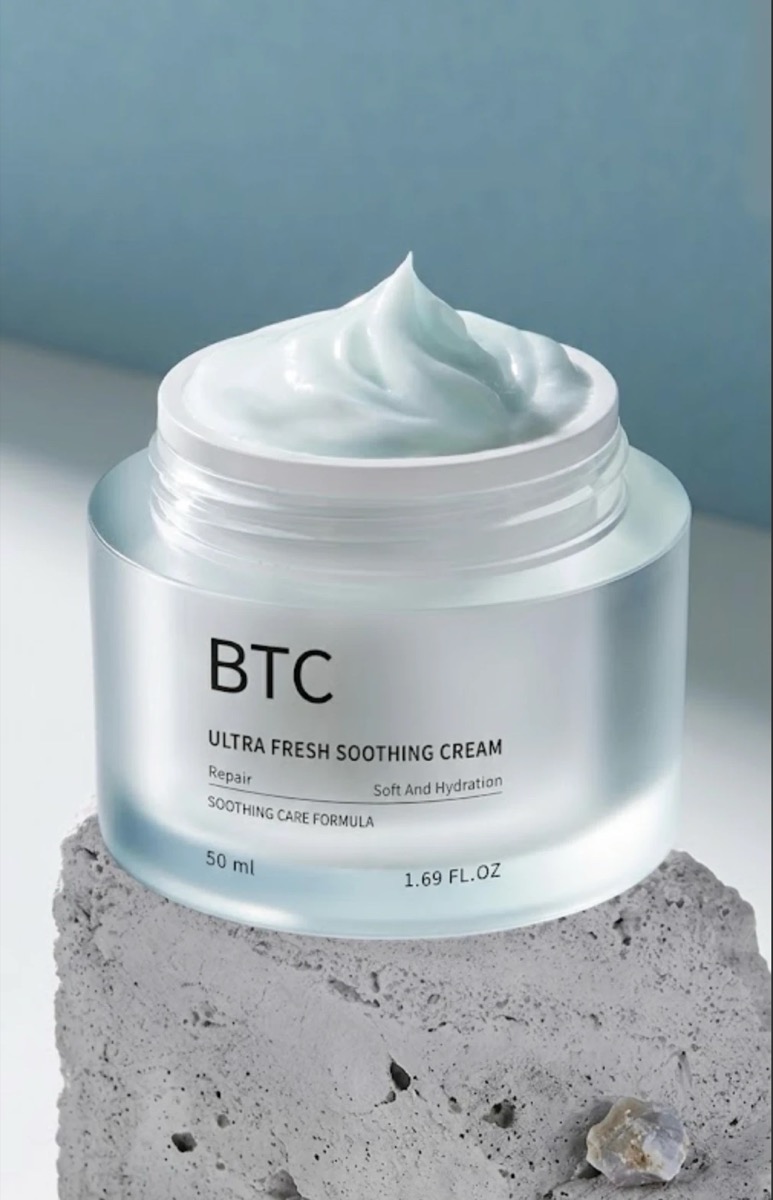
Ultra Fresh Soothing Cream
This sample is shown to help you picture a specific product direction. Your brand is free to choose a different direction — this is simply a starting point for discussion.
Gel-cream texture
A soft, peak-holding, pale blue cream; cool and dry-feeling after application.
Intended benefits
Moisturizes, softens and soothes skin — a formula designed for gentle skin care.
Volume
50 ml, a common size for facial creams.
Jar format
Thick-walled frosted jar with a wide mouth; label printed directly on the jar.
Customization options
What you can specify
The same product type can serve very different customers depending on the brand. Tell us your requirements in the areas below, and our team of pharmacists will develop a matching formula.
Target skin type
Oily, combination, dry or sensitive skin — determines the oil ratio and emulsion type.
Texture and finish
Gel-cream, light cream or thick cream; matte or dewy finish.
Added actives
Ceramides, Hyaluronic Acid, Niacinamide, Panthenol, centella, peptides.
Base oils
Squalane, plant oils, shea butter, or a mineral-oil-free, silicone-free formula.
Fragrance and color
Fragrance-free, lightly scented or a fragrance matched to your brand positioning; with or without color.
Ingredient positioning
Vegan, alcohol-free, paraben-free — please tell us at the outset so we can select suitable raw materials.
Further reading
Related topics
Dry skin vs. dehydrated skin: differences, causes and care
Oil-deficient and water-deficient skin need two different kinds of cream (in Vietnamese).
Choosing oils for cosmetic formulation
How the base oil shapes the feel of a cream (in Vietnamese).
Toner, essence, serum and moisturizer
Where moisturizer fits in a skin care routine (in Vietnamese).
Skin recovery serum manufacturing
A product often paired with moisturizer in sensitive-skin ranges.
How we work
From idea to finished batch
Eight steps and three milestones signed off by both sides: approved sample, notification number, finished batch. Step-by-step details (in Vietnamese) →
Get started
Tell us about the product you plan to launch
Send us your product direction and expected volume. Our team will get back to you during business hours (Vietnam time, GMT+7).
Head office: Huu Le village, Dai Thanh commune, Hanoi · Factory: Thanh Oai Industrial Cluster, Binh Minh commune, Hanoi, Vietnam
Hotline +84 987 964 764 · [email protected] · Privacy policy ← Full catalog