 BUTTER-C
Signature ingredients
Hexylresorcinol serum OEM/ODM manufacturing
Hexylresorcinol Serum · OEM/ODM
Before it reached brightening serums, hexylresorcinol (4-hexylresorcinol) was used in throat lozenges and as an anti-browning agent for shrimp after harvest — pharmaceutical and food contexts that help explain its safety profile but are not evidence of any skin benefit. In cosmetics it is used because it inhibits tyrosinase, the enzyme behind the first step of melanin formation; the mechanistic data come mainly from enzyme isolated from mushrooms. In people, the trial of hexylresorcinol on its own that we found is a small randomized, double-blind study: 32 women (29 completed), hexylresorcinol 1% on one side and hydroquinone 2% on the other for 12 weeks — pigmentation decreased on both sides, with no difference between them, and there was no placebo arm. Claims therefore stop at “helps skin look more even-toned”, require testing on the finished product and always come with a sunscreen recommendation. Two technical points decide quality: hexylresorcinol is barely soluble in water, so it needs a suitable solvent system, and the raw material turns brownish pink with light and air, so it needs light-shielding packaging. Hexylresorcinol is not listed in ASEAN Annexes II, III or VI and is a different substance from resorcinol and hydroquinone. Butter-C offers turnkey OEM/ODM manufacturing, from formula development and testing to a labeled finished product and notification dossier.
Formula base
One active with poor water solubility, one solvent system planned up front
The serum consists of hexylresorcinol pre-dissolved in a solvent, a light humectant base and a preservative system for the water phase. The complete formula needs cold crystallization testing, color stability testing and tolerance testing on the finished product.
Hexylresorcinol: the right substance, the right name
According to PubChem: IUPAC name 4-hexylbenzene-1,3-diol, CAS 136-77-6, formula C12H18O2, molecular weight 194.27; white to off-white needle-shaped crystals. The material Butter-C currently stocks carries the INCI name Hexylresorcinol. The COA should state CAS, purity and appearance; not to be confused with resorcinol (CAS 108-46-3) or hydroquinone (CAS 123-31-9).
1%: the level used in the single-ingredient trial
The comparison trial against hydroquinone used hexylresorcinol 1% (Wu 2023); a combination formula with retinol, niacinamide and resveratrol used 1.1% (Farris 2016). An analytical method study measured about 0.31–0.35% in the commercial creams it sampled (Ntorkou 2026) — a measurement on a few samples, not representative of the market. The ASEAN annexes set no specific limit, so the manufacturer must demonstrate safety of the chosen level in the Product Information File (PIF).
Solvent system
PubChem gives a water solubility of about 500 mg/L at 18 °C, roughly 0.05% — far below the 1% used in the study; the substance dissolves in ethanol, glycerol, acetone and vegetable oils. Hexylresorcinol is therefore pre-dissolved in a glycol (Propanediol, Butylene Glycol), glycerin or an oil phase; the exact solvent ratio follows the supplier's TDS and is confirmed by crystallization testing.
Humectant base and optional niacinamide
Glycerin, Panthenol and Sodium Hyaluronate give a moist, soft feel. Niacinamide is a partner with data behind it: in cultured melanocytes, combining it with hexylresorcinol reduced melanin synergistically, and in a split-face trial the combination formula improved hyperpigmented spots (measured by L*) more than niacinamide alone (Shariff 2022 — authors from the R&D department of a cosmetics company).
Key technical points
Keep the color, prevent crystallization, classify it correctly
Hexylresorcinol turns brownish pink with light and air
This is a property PubChem records for the raw material. Light-shielding packaging (amber glass with a carton, airless bottles), minimal headspace at filling; consider a metal-ion chelator (Disodium EDTA) and an antioxidant (Tocopherol for the oil version) — their effect must be proven by stability testing with color index measurement, not by eye alone.
No recrystallization in a water base
Because water solubility is low, hexylresorcinol that recrystallizes makes the serum grainy, changes the skin feel and makes the dose uneven from use to use. Samples are kept cold and run through freeze–thaw cycles, and checked for crystals before the solvent ratio is fixed.
Not resorcinol, not hydroquinone
Hexylresorcinol is not listed in ASEAN Annexes II, III or VI (06/2026 version). Resorcinol sits in Annex III, Ref 22 — only for oxidative hair dyes (maximum 1.25% after mixing) and hair lotions and shampoos (0.5%), and does not apply to hexylresorcinol. Hydroquinone is prohibited in Annex II, Ref 1339, except entry 14 of Annex III (artificial nail systems, 0.02% after mixing, professional use only).
Tolerance and cross-reactivity
The 12-week trial at 1% recorded no adverse effects (Wu 2023); the combination trial reported no product-related adverse events (Shariff 2022); long-term data are lacking. In cultured keratinocytes, hexylresorcinol triggered IL-1α release at cytotoxic concentrations (Newby 2000, in vitro) — finished-product tolerance testing is needed. According to the EU Scientific Committee on Food (SCF 2003): topical application did not sensitize guinea pigs, there was one case of occupational contact dermatitis, and 2 of 7 people already sensitized to resorcinol reacted to hexylresorcinol.
Three formulation directions
One active, three ways to dissolve and pair it
Single-active water–glycol serum
Hexylresorcinol dissolved in a glycol, then added to a humectant water base; light, clear texture. For brands that want a short ingredient list and a story centered on one active.
Hexylresorcinol – niacinamide serum
Niacinamide added at the level with human data per the niacinamide article, following the combination approach of Shariff 2022 (results belong to the combination formula; the abstract does not give concentrations). One more assay to run and more thorough tolerance testing.
Water-free oil serum
Hexylresorcinol dissolves in vegetable oils (PubChem), so a light oil serum is possible; its solubility in each base oil (Caprylic/Capric Triglyceride, Squalane) must be tested at low temperature. With no water phase there is no need for a water-phase preservative system, but microbiology is still checked and oil oxidation monitored.
Packaging is part of the formula
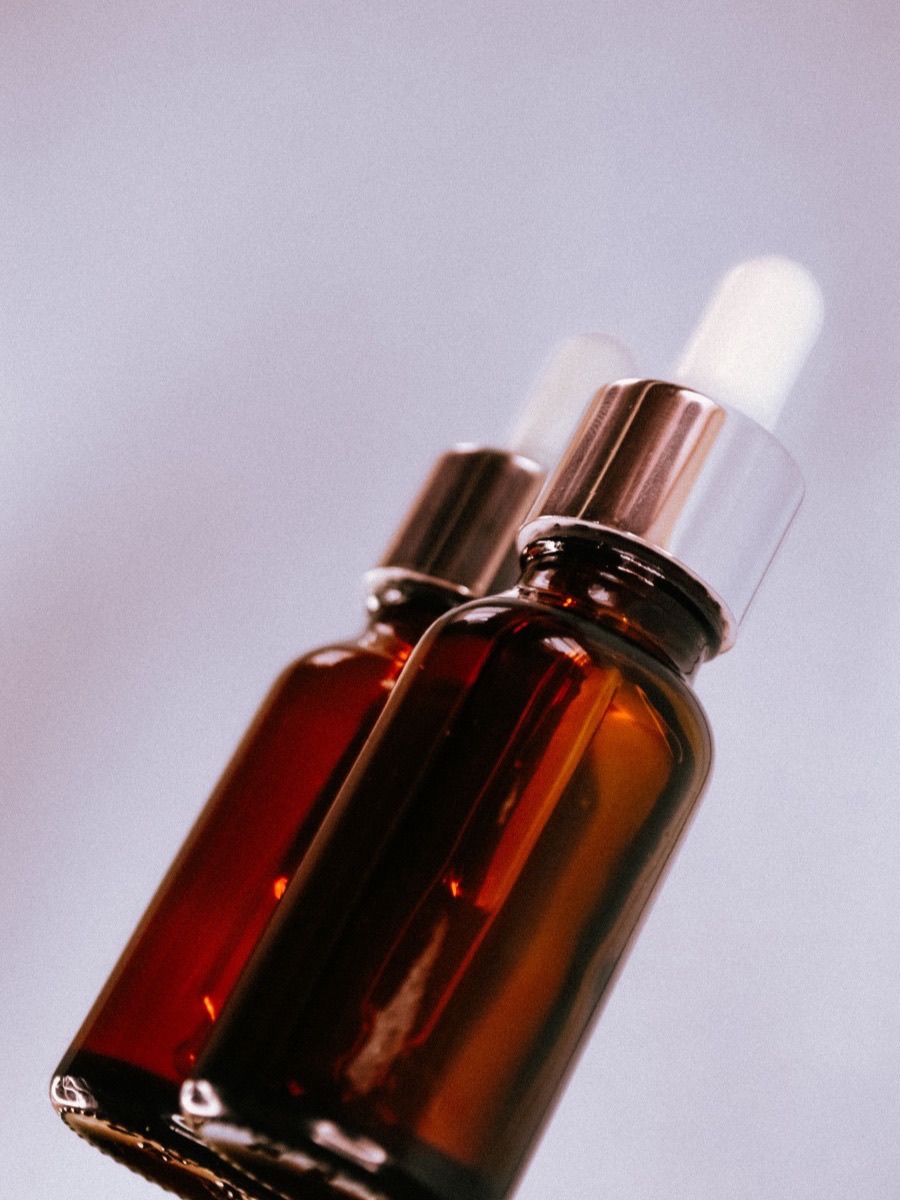
Amber glass or opaque light-shielding bottles, dropper or airless pump, with a carton; dropper and gasket materials are soak-tested with the sample, and discoloration at the bottle neck is monitored.
Parameters we monitor
What the R&D lab measures on every sample
These are the parameters Butter-C tracks during formula development and scale-up. Specific limits are agreed with you on the approved sample and then written into the product's in-house specification.
- Raw material COA
- CAS 136-77-6, purity, white to off-white appearance — material that has already turned pink shows prior exposure to light and air; niacinamide (if used): free nicotinic acid.
- Appearance & color index
- Color, odor and clarity; color index measured periodically to catch pink discoloration early.
- pH
- Measured directly at 25°C; the pH range follows the TDS (no verified source for an optimal range) and is fixed by stability testing with active assay.
- Hexylresorcinol content
- Assayed by HPLC-FLD or a spectrofluorimetric method validated on cosmetic creams (Ntorkou 2026; to be re-validated in the serum base) — written into the finished-product specification.
- Crystallization
- Checked for crystals after cold storage and after freeze–thaw cycles.
- Stability
- Accelerated aging at 40°C, freeze–thaw cycling and light exposure; remaining content and color compared — the basis for setting shelf life.
- Microbiology & challenge test
- Tested at a GLP / ISO 17025-accredited laboratory; water-based versions undergo a preservative efficacy (challenge) test to ISO 11930.
- Irritation & skin evaluation
- Tolerance tested on volunteers before the formula is locked; to state “skin looks more even-toned”, measure it on the finished product itself (colorimeter, standardized photos).
Claims
Claims matched to the evidence for hexylresorcinol
Wu 2023 is a randomized, double-blind, split-body trial: 32 healthy women aged 35–65, skin types I–IV, applied hexylresorcinol 1% to one side of the face and the matching hand and hydroquinone 2% to the other side, twice daily for 12 weeks; 3 dropped out. Pigmentation measured by colorimeter and clinical grading decreased significantly at weeks 4 and 12 versus baseline, with no difference between sides and no adverse effects; the authors call for studies in larger populations over longer periods. There was no placebo arm and the sample was small. Shariff 2022 (randomized, double-blind, split-face, Chinese participants, 12 weeks; the abstract gives neither sample size nor concentrations) found that a combination formula with niacinamide improved hyperpigmented spots (measured by L*) more than niacinamide alone — a result of the combination formula. Level of evidence: limited. Hydroquinone is a topical drug; melasma and persistent darkening fall within a dermatologist's examination.
Helps skin look more even-toned (to be tested on the finished product)
Basis: the small trial above plus results measured on the finished product itself; always with a sunscreen recommendation. Instead of: skin whitening, instant tone-up, erasing melasma, fading freckles.
Helps skin look brighter (to be tested on the finished product)
Instead of: “hydroquinone replacement”, “as effective as hydroquinone”, drug-like claims about melasma.
Contains hexylresorcinol
State the correct INCI name; give a percentage only when assayed. Instead of: “hexylresorcinol 1% as strong as hydroquinone 2%”, “an active that replaces a topical drug”, results of combination formulas attributed to hexylresorcinol alone.
Daily sunscreen recommendation
Included in the directions for use, as for every brightening product. Instead of: prevents melasma from returning, anti-melasma.
Warning
People who have reacted to resorcinol or to hair dyes containing resorcinol should take care and patch-test a small area first; stop use if redness or itching occurs. Pregnancy and breastfeeding: not enough data for leave-on products, consult a doctor. Instead of: non-irritating, safe for all skin types, safe for pregnancy.
Time to visible difference
The study recorded changes at week 4 and week 12; state days, weeks or percentages only with testing on the finished product. Instead of: “even tone in 7 days”.
Manufacturing specifications
Capabilities
- Texture
- Clear water–glycol serum, lightly thickened gel-serum, or water-free oil serum.
- Packaging format
- Amber glass or opaque light-shielding bottles with dropper, or airless pump bottles. Volume agreed when packaging is selected.
- Minimum order quantity
- Agreed per order — depends on the formula direction and packaging chosen.
- Testing
- Performed at a GLP / ISO 17025-accredited laboratory, including hexylresorcinol assay; certificates of analysis delivered with each batch.
- Documentation
- Product Information File (PIF) and notification dossier prepared by Butter-C, including the safety assessment for the chosen hexylresorcinol level.
- Packaging
- Label design, printing and packing run in parallel with formula development.
Suggested product concept
Hexylresorcinol – niacinamide serum, 30 ml amber bottle
One product concept to help you picture the result; not a ready-made product for sale. The actual formula is built around your brand's positioning and price range.
Hexylresorcinol 1%
The level of the single-ingredient trial (Wu 2023); dissolved in a glycol per the TDS, fixed after crystallization and tolerance testing.
Niacinamide
Level per the niacinamide article, paired following Shariff 2022; assayed per batch.
Glycerin, Panthenol, Sodium Hyaluronate
Light humectant base, fragrance-free, alcohol-free; Disodium EDTA chelates metal ions to support color stability — confirmed by stability testing.
30 ml amber glass bottle
Dropper and light-shielding carton; the label carries the sunscreen recommendation and a warning for people allergic to resorcinol.
Customization options
What you can specify
The same product type can serve very different customers. Tell us your requirements in the areas below and our pharmacists will build the matching formula.
Concentration
1% as in the study, or lower for a gentler version; any level needs a safety assessment in the PIF and tolerance testing.
Base type
Clear water–glycol, lightly thickened gel-serum or water-free oil serum — this decides the solvent and preservative systems.
Partner actives
Niacinamide has combination data. Pairing with a retinoid needs a separate assessment: a formula with retinol 0.5% recorded mild flaking and redness early on (Farris 2016, open-label, no control group).
Time of use
Morning and evening, or evening only; daytime versions give the sunscreen reminder more prominence.
Companion products
Sunscreen, moisturizer and cleanser in the same line, sold as a set.
Ingredient direction
Fragrance-free, alcohol-free, vegan — please state these at the outset so the right solvents and materials are selected.
Further reading
Related topics
Hexylresorcinol in cosmetics
Mechanism, the trial against hydroquinone, concentrations, safety and ASEAN rules (in Vietnamese).
Managing skin pigmentation
How melanin forms and which step cosmetics act on (in Vietnamese).
Using sunscreen correctly
The mandatory companion step for every brightening product (in Vietnamese).
Brightening serum manufacturing
A different direction: multi-active serums, vitamin C and its derivatives.
Tranexamic acid & alpha-arbutin serum manufacturing
A different direction: two water-soluble actives, with checks for hydroquinone released from arbutin.
Dark-spot brightening cream manufacturing
A different direction: a cream format with control of prohibited substances.
How we work
From idea to finished batch
Eight steps and three milestones signed off by both sides: approved sample, notification number, finished batch. Step-by-step details (in Vietnamese) →
Get started
Tell us about the product you plan to launch
Send us your product direction and expected volume. Our team will get back to you during business hours (Vietnam time, GMT+7).
Head office: Huu Le village, Dai Thanh commune, Hanoi · Factory: Thanh Oai Industrial Cluster, Binh Minh commune, Hanoi, Vietnam
Hotline +84 967 176 511 · [email protected] · Privacy policy ← Full catalog