 BUTTER-C
Body care
Handmade soap OEM/ODM manufacturing
Handmade Soap · Cold Process Soap · OEM/ODM
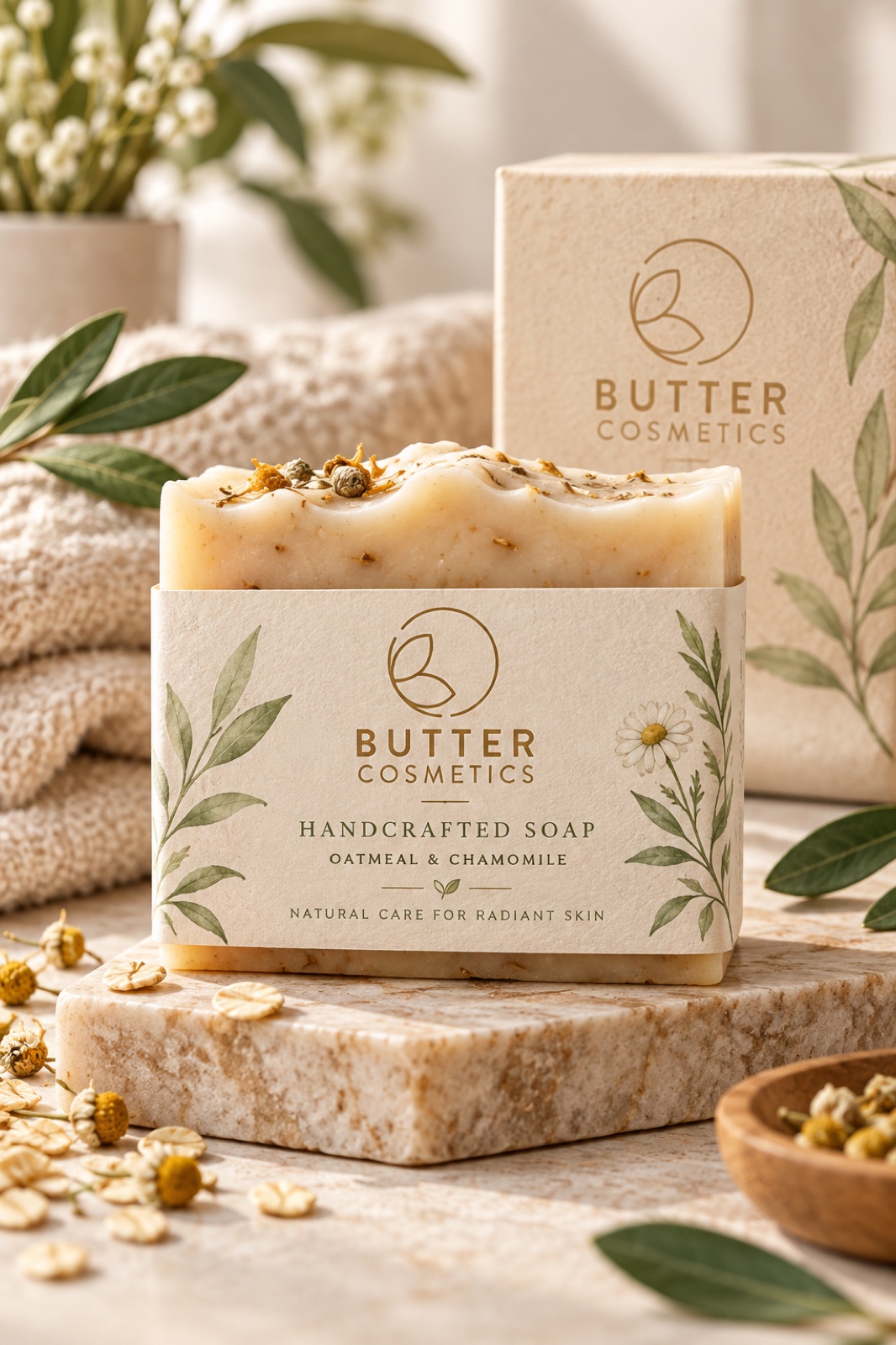
Handmade soap tells a story very well: plant oils, herbs, clay, honey — every bar has its own color, swirl and scent, a natural fit for brands built around nature, gifting, tourism or local specialties. Chemically, soap is a salt of fatty acids, formed when plant oils react with an alkali (saponification); the glycerin produced in the reaction stays in the bar instead of being removed as in industrial soap. The quality of a handmade soap bar depends on three things: calculating the right amount of alkali for each oil, curing the bars long enough, and keeping the excess oil from going rancid over time. Butter-C offers full-service OEM/ODM manufacturing, from formula development and testing to labeled finished product with its notification dossier.
Formula base
Plant oils, alkali and additives
The ratio of oils determines the bar's hardness, lather and skin feel; the amount of alkali is calculated from the saponification value of each oil.
Lathering and hardening oils
Coconut oil, palm oil or cocoa butter, shea butter — for a hard bar with plenty of lather. Too much coconut oil makes the bar drying, so its proportion is usually limited.
Conditioning oils
Olive, sunflower seed, rice bran and grapeseed oils — for a creamy lather and a soft skin feel. A high olive oil content produces a very mild Castile-style soap.
Alkali and superfat
Sodium Hydroxide calculated from the saponification value, leaving 5–8% unreacted oil (superfat) so the bar is mild and free of free alkali.
Additives
Clay, bamboo charcoal, turmeric powder, coffee, oats, honey, milk, essential oils — giving each line its own color, swirl, gentle exfoliating particles and scent.
Key technical points
Four factors that define soap bar quality
No free alkali
The amount of alkali is calculated from the actual saponification value of the oil lot and weighed precisely; finished bars are tested for free alkali before release.
Full curing time
Cold process soap needs several weeks of curing for water to evaporate and the reaction to complete; a fully cured bar is harder, lasts longer and is milder.
Superfat that does not go rancid
The superfat oxidizes easily, causing orange spots and a rancid smell after a few months. We choose oxidation-stable oils, add antioxidants and store the bars in a dry, ventilated place.
Stable color, swirls and essential oils
Herbal colors can fade or shift in an alkaline environment; essential oils can make the reaction proceed too fast. Every additive is tested first in a small batch.
Three formulation directions
Three ways to make bar soap
Cold process
Oils and the alkali solution are mixed at low temperature, poured into molds, cut into bars and cured. Preserves conditioning oils and essential oils well and allows attractive swirls; long curing time.
Hot process
The mixture is cooked so the reaction completes quickly before molding. Shortens curing time; a rustic bar surface with few swirls.
Melt-and-pour glycerin soap
A ready-made clear soap base is melted, colored, scented and enriched with extracts, then poured into molds. Fast, allows clear bars and complex shapes; less of a "handmade" story.
Packaging is planned with the formula
Kraft paper, paper boxes, shrink film or cloth bags. High-glycerin bars readily absorb moisture and "sweat" if tightly wrapped in humid weather.
Parameters we monitor
What our R&D lab measures on every sample
These are the parameters Butter-C monitors while developing the formula and scaling it up to production. Specific limits are agreed with you on the approved sample and then written into the product's in-house specification.
- Free alkali
- Quantified on the finished bar; the key safety parameter for bar soap.
- Total fatty matter
- Reflects the actual amount of soap in the bar, directly linked to quality and how long it lasts in use.
- Moisture and weight
- Tracked throughout curing; the weight on the label is the weight after curing.
- Solution pH
- Measured on a diluted solution according to the specified method; true soap has a mildly alkaline pH, unlike synthetic cleansing bars.
- Hardness, cracking, wear
- Assesses bar hardness, cracking, crumbling, softening when left in water and how fast it wears down in use.
- Stability
- Orange spots, rancid odor, fading and sweating are tracked over time under hot, humid conditions.
- Heavy metals
- Clay, charcoal and mineral powders are sources that must be controlled; checked against raw material certificates of analysis and tested on the finished product.
- Essential oil allergens
- Essential oil composition is reviewed; any allergen above the labeling threshold is added to the ingredient list.
Claims
Writing claims within the cosmetic scope
Handmade soap often comes with a herbal story — and that easily slides into promises beyond the cosmetic scope. Butter-C reviews the wording on the label and marketing materials as soon as the notification dossier is prepared.
Cleanses skin with a fine lather
Instead of: anti-bacterial, kills bacteria, disinfects.
Retains natural glycerin, skin feels soft after washing
Instead of: treats dry skin, treats cracked skin.
Removes excess oil from the skin
Instead of: treats acne, treats back acne.
Suitable for sensitive skin
Stated only when backed by skin test results. Instead of: treats itching, treats diaper rash, treats skin fungus.
Herbal ingredients
Name each ingredient correctly with its cosmetic role; do not claim herbal benefits beyond the cosmetic scope.
Ingredient names on the label
Soap is listed by the fatty acid salt names (e.g. Sodium Cocoate, Sodium Olivate) or by the starting raw materials plus Sodium Hydroxide, agreed when preparing the dossier.
Manufacturing specifications
Current capabilities
- Textures
- Opaque cold process or hot process bars; clear glycerin bars.
- Formats
- Square, rectangular, round or custom-molded bars; paper wrap, paper boxes, shrink film. Bar weight is agreed when the mold is finalized.
- Minimum order quantity
- Agreed per order and per bar design.
- Testing
- Performed at a GLP / ISO 17025-accredited laboratory; a certificate of analysis is delivered with each batch.
- Documentation
- The Product Information File (PIF) and the notification dossier are prepared by Butter-C.
- Packaging
- Label design, printing and packing run in parallel with formula development.
Suggested product concept
Coconut, olive, turmeric and honey handmade soap
A product concept to help you picture the possibilities — not a ready-made product for sale. The actual formula is developed to match your brand positioning and price range.
Balanced oil base
Coconut oil for lather, olive oil and shea butter for mildness; about 6% superfat.
Turmeric and honey
Turmeric powder gives a natural warm yellow color, honey makes the lather creamy and fine — two ingredients familiar to Vietnamese consumers.
Light essential oil scent
Lemongrass or sweet orange essential oil at a low level, suited to daily use.
Gift format
100 g bar wrapped in kraft paper printed with your logo; can be boxed as a set of three bars in three scents.
Customization options
What you can specify
The same product type can serve very different customer groups depending on the brand. Tell us your requirements in the areas below and our team of pharmacists will develop a matching formula.
Method
Cold process, hot process or melt-and-pour glycerin soap.
Oil base
Coconut, olive, rice bran, tamanu, gac, shea butter; with or without palm oil.
Additives
Turmeric, bamboo charcoal, coffee, clay, oats, honey, goat milk, local herbs.
Scent
Natural essential oils, fragrance or unscented.
Shape and weight
Standard molds or molds with an embossed logo; large bars for daily use or small bars for hotels and gifts.
Ingredient direction
Vegan (no milk, no honey), palm-free, fragrance-free — please tell us at the outset.
Further reading
Related topics
Choosing oils for formulation
The properties of each plant oil, the basis for calculating a soap formula (in Vietnamese).
Types of foaming agents
How true soap differs from body washes made with synthetic surfactants (in Vietnamese).
Body wash manufacturing
A liquid format with easier control of pH and mildness.
Cosmetic labeling rules
How to state ingredients and weight on a soap bar (in Vietnamese).
How we work
From idea to finished batch
Eight steps and three milestones signed off by both sides: approved sample, notification number, finished batch. Step-by-step details (in Vietnamese) →
Get started
Tell us about the product you plan to launch
Send us your product direction and expected volume. Our team will get back to you during business hours (Vietnam time, GMT+7).
Head office: Huu Le village, Dai Thanh commune, Hanoi · Factory: Thanh Oai Industrial Cluster, Binh Minh commune, Hanoi, Vietnam
Hotline +84 987 964 764 · [email protected] · Privacy policy ← Full catalog