 BUTTER-C
Home care
Fabric softener OEM/ODM manufacturing
Fabric Softener · Fabric Conditioner · OEM/ODM
Fabric softener goes into the final rinse, after the detergent has been rinsed out. Its main ingredient is a cationic softening agent — today most often an esterquat: the positively charged molecules deposit on fiber surfaces, which carry a negative charge in water, forming a thin layer that makes fibers smoother, fabric softer, less static, easier to iron, and holds part of the fragrance on the fabric. Technically, fabric softener is an emulsion-type dispersion: the softening agent is dispersed into warm water, stirred and cooled under control — a process close to a liquid hair conditioner, so the mixing, gentle heating and filling are similar to a liquid cosmetics line. The difficulty lies in stability: keeping viscosity constant over time, with no separation, no thickening in cold weather, and compatibility with a fairly high fragrance load. Please note: fabric softener is a household product, not a cosmetic, and has no cosmetic product notification; the label follows the rules on product labeling, with safety warnings appropriate to the ingredients. If the product is to make claims about effects on microorganisms, it falls under the regulated preparations category with its own registration dossier. Butter-C advises on formulation and packaging; manufacturing requirements, in-house specification and product labeling are discussed separately for each project.
Formula base
Esterquat dispersed in water at a mildly acidic pH
Fabric softener is a dispersion of a cationic softening agent in water, with salt to adjust viscosity, fragrance and a preservative system.
Softening agent
Palm-derived esterquat — a cationic surfactant with ester bonds that deposits on fibers for a soft feel and less static; the ester bonds make it more readily biodegradable than older-generation softeners.
Mildly acidic pH
Ester bonds hydrolyze quickly in neutral and alkaline conditions; an organic acid keeps the pH mildly acidic so the softener stays stable throughout the shelf life.
Viscosity control
A small amount of calcium chloride lowers and stabilizes viscosity, especially in concentrates; a cationic polymer maintains body and limits separation in diluted versions.
Fragrance and preservation
Fragrance makes up a significant share and strongly affects viscosity; the preservative system is chosen for the product's acidic pH range.
Key technical points
Four things that decide the quality of a fabric softener
Emulsion stability
Control the temperature of the water and the softener when combining, the mixing speed and the cooling rate so the dispersion is uniform; deviations at this step lead to separation or lumps after a period of storage.
Viscosity over time and temperature
Fabric softener tends to thicken during storage or in cold weather; freeze–thaw cycling and accelerated aging are used to set the salt and polymer levels.
Fragrance compatibility
Each fragrance affects viscosity and emulsion stability differently; lock in the fragrance first, then fine-tune viscosity. Fragrance microcapsules are optional and release scent when the fabric is rubbed.
Correct use
Add to the softener compartment or the final rinse, never mixed directly with detergent, because anionic cleansers reduce the softening effect; the label states dosage and warnings clearly.
Three formulation directions
Three common types of fabric softener
Baby line, mild scent
Very light scent or fragrance-free, no color; preservative and fragrance chosen to suit young children's items.
Long-lasting scent line
Higher fragrance content, optional fragrance microcapsules; scent stays on fabric after drying.
Concentrated line
High softener content, a small dose each time; tighter viscosity control needed.
Packaging must be planned with the formula
Jugs and bottles with measuring caps, refill pouches; materials that withstand high fragrance levels and a mildly acidic medium.
Parameters we monitor
What our R&D lab measures on every sample
Below are the parameters monitored during formula development. Specific limits are agreed with you on the approved sample and then written into the product's in-house specification.
- pH
- Mildly acidic range; measured when freshly made and after aging to detect softener hydrolysis.
- Viscosity
- Measured over storage time, after freeze–thaw cycling and at low temperature.
- Softener content
- Cationic active assayed on the finished product against the formula.
- Thermal stability
- Accelerated aging and cold storage: no separation, no lumps, no solidifying.
- Performance on fabric
- Softness and scent assessed on test cotton towels after rinsing, against a control.
- Microbiology
- Tested at a GLP / ISO 17025-accredited laboratory.
- Packaging compatibility
- Jug, bottle, measuring cap and refill pouch checked after aging.
Claims
Writing claims that fit the product category
A fabric softener only talks about softness, static and scent on fabric; claims about microorganisms or health belong to other categories.
Softens fabric, reduces static
Describes the softener's function accurately.
Makes ironing easier, fewer creases after drying
Describes the result when used as directed.
Scent stays on fabric after drying
Instead of: claiming a number of days of fragrance without an assessment.
Pleasant scent on clothes
Instead of: claims of killing odor-causing microorganisms without a regulated-preparation dossier.
Baby line: light scent, no color
Instead of: "non-irritating" claims without a user assessment.
Directions and warnings
Dose with the measuring cap; add in the final rinse; avoid the eyes; do not swallow; keep away from children; declare fragrance allergens on the label as required by the target market.
Manufacturing specifications
Scope of cooperation
- Texture
- Milky-white or lightly tinted liquid emulsion, medium viscosity.
- Packaging
- Bottles and jugs with measuring caps, refill pouches. Volume agreed when choosing packaging.
- Product category
- Household laundry product — not covered by a cosmetic product notification.
- Manufacturing and dossier
- Manufacturing requirements, in-house specification and product labeling are discussed separately for each project.
- Minimum order quantity
- Agreed per order.
- Packaging design
- Label design to the mandatory product-labeling content, printing and packing.
Suggested product concept
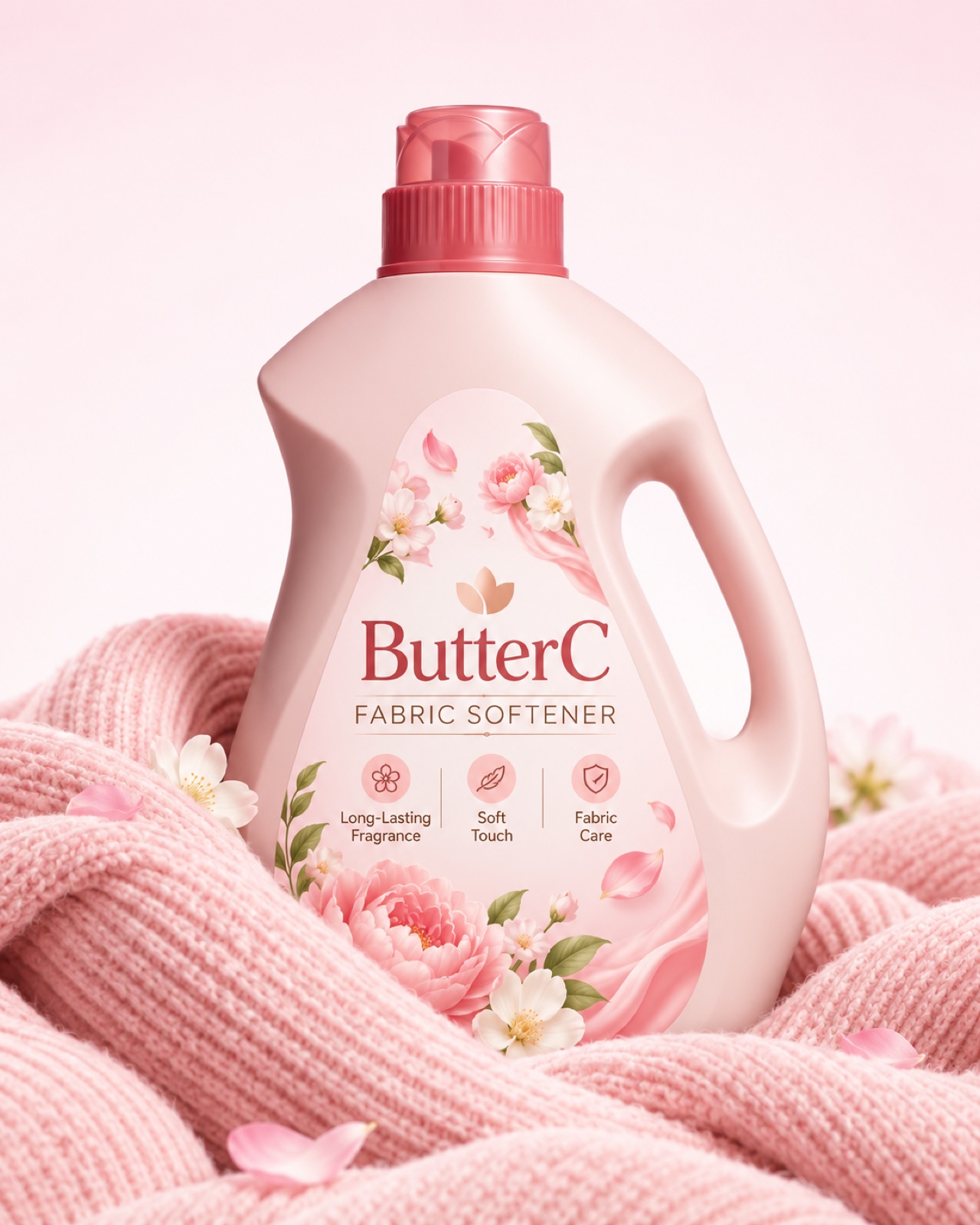
Fabric softener with a light floral scent that stays after drying
A product direction to help you picture it — not a ready-made product for sale. The actual formula is developed to your brand positioning and price range.
Palm-derived esterquat
Softens fabric, reduces static.
Mildly acidic pH
Keeps the softener stable throughout the shelf life.
Light floral scent
Fragrance microcapsules optional for the long-lasting scent line.
1-liter bottle with measuring cap
With a refill pouch; dosage clearly stated on the label.
Customization options
What you can specify
The same product type serves different customers for each brand. Tell us your requirements below and our pharmacists will propose a matching approach.
Users
Families, baby items, sportswear, towels and bed linen.
Scent
Fragrance-free, light, floral, woody; with or without fragrance microcapsules.
Color
No color, or a light tint matching your brand identity.
Format
Regular, concentrated.
Use
Machine wash (softener compartment), hand wash.
Packaging
Bottles and jugs with measuring caps, refill pouches.
Further reading
Related topics
Underwear laundry detergent manufacturing
Another household laundry product in our catalog.
Room & linen spray manufacturing
Scent for fabric and living spaces, in the same Home Care group.
Conditioner manufacturing
The same cationic surfactant principle — cosmetic category.
Stability and shelf life
Accelerated aging and freeze–thaw cycling to set the shelf life (in Vietnamese).
How we work
From idea to finished batch
Eight steps and three milestones signed off by both sides: approved sample, notification number, finished batch. Step-by-step details (in Vietnamese) →
Get started
Tell us about the product you plan to launch
Send us your product direction and expected volume. Our team will get back to you during business hours (Vietnam time, GMT+7).
Head office: Huu Le village, Dai Thanh commune, Hanoi · Factory: Thanh Oai Industrial Cluster, Binh Minh commune, Hanoi, Vietnam
Hotline +84 987 964 764 · [email protected] · Privacy policy ← Full catalog