 BUTTER-C
Signature ingredients
Bakuchiol serum OEM/ODM manufacturing
Bakuchiol Serum · OEM/ODM
Bakuchiol is a meroterpene phenol found mainly in the seeds and leaves of Psoralea corylifolia — a plant known in Vietnam as an ingredient of traditional herbal medicine; that is a cultural story, not evidence of a benefit. Bakuchiol has no retinoid structure and is not vitamin A, so calling it “plant retinol” is incorrect. Human data are still scarce: in one randomized, double-blind trial in 44 people, a 0.5% bakuchiol cream applied twice daily and a 0.5% retinol cream applied once daily for 12 weeks both significantly reduced wrinkle surface area and hyperpigmentation, with no statistical difference between groups; the retinol group reported more scaling and stinging — a small study, not enough to call the two equivalent. A bakuchiol serum developed by Butter-C therefore takes the 0.5% level tested in humans as its reference, and claims stay with how skin looks, once tested on the finished product. The formulation challenge lies in the active itself: bakuchiol is oil-soluble, sensitive to light and oxygen, and seed-derived raw material can carry furocoumarin impurities. Butter-C offers full-service OEM/ODM manufacturing, from raw material selection and formula development to a labeled finished product with its cosmetic product notification.
Formula base
Bakuchiol dissolves in oil — the oil base drives everything
Bakuchiol is an oily liquid at room temperature and practically insoluble in water. So the first question is not what percentage to use, but which oil phase will carry the active and how to keep it stable.
Bakuchiol — the named active
INCI Bakuchiol, CAS 10309-37-2, C18H24O, about 256 g/mol; an experimental oil–water partition coefficient (logP) of 4.27, so it goes into the oil phase. The level with human data is 0.5% (a 44-person trial; a 13-person open-label study). Other levels have no verified source — they are assessed on the specific formula.
Stable, low-odor base oils
Squalane, Caprylic/Capric Triglyceride and jojoba oil (Simmondsia Chinensis Seed Oil) dissolve bakuchiol and give a light oil feel. Highly unsaturated plant oils that turn rancid easily are limited so they do not drag the active down with them.
Oil-phase antioxidant
Formulation studies describe bakuchiol as unstable to light and oxygen; Tocopherol in the oil phase, filling with minimal headspace and light-blocking packaging are a required part of the formula, not options.
When a water base is needed
A milky serum (oil-in-water emulsion) or a small-particle system (nanoemulsion, microcapsules) carries bakuchiol into a water base. In an in vitro skin experiment, a nanoemulsion delivered 3–4 times more bakuchiol into the skin than micelles or a microemulsion.
Key technical points
Four things specific to a serum named after bakuchiol
When a product carries the name of one active, that active's documentation must be checked very closely. The four items below are settled before the texture is chosen.
Furocoumarin impurities on the certificate of analysis
Seed-derived bakuchiol extract may still contain psoralen and angelicin — two furocoumarins. Annex II of the ASEAN Cosmetic Directive (Ref 358) lists furocoumarins as prohibited (except for normal content in natural essences used); in sun protection and bronzing products, furocoumarins must be below 1 mg/kg. The certificate of analysis (COA) for each lot must state the bakuchiol content and limits for these two impurities with an HPLC method; regulatory affairs confirm before the raw material is approved.
Light and oxygen
Verified sources give no degradation data for free bakuchiol, only the background statement that it is unstable. So: no prolonged heating, airtight filling, dark bottles or airless pumps, and a bakuchiol assay at each stability time point — not just a visual color check.
Color and odor of the raw material
Commercial bakuchiol is an oily liquid; its color, odor and purity follow the supplier's technical data sheet (TDS). The serum is compared with a reference standard at each time point, because color drift and off-odor are early signs of change.
Safety must be reasoned in-house
No dedicated CIR or SCCS safety assessment of bakuchiol was found, and cases of contact allergy to bakuchiol in cosmetics have been reported. The safety assessment in the PIF is built on the use level, backed by irritation and sensitization testing on volunteers. Most GHS notifications for the neat raw material classify it as toxic to aquatic life — equipment rinse water is not discharged to drains.
Three formulation directions
Three ways to bring bakuchiol to the skin
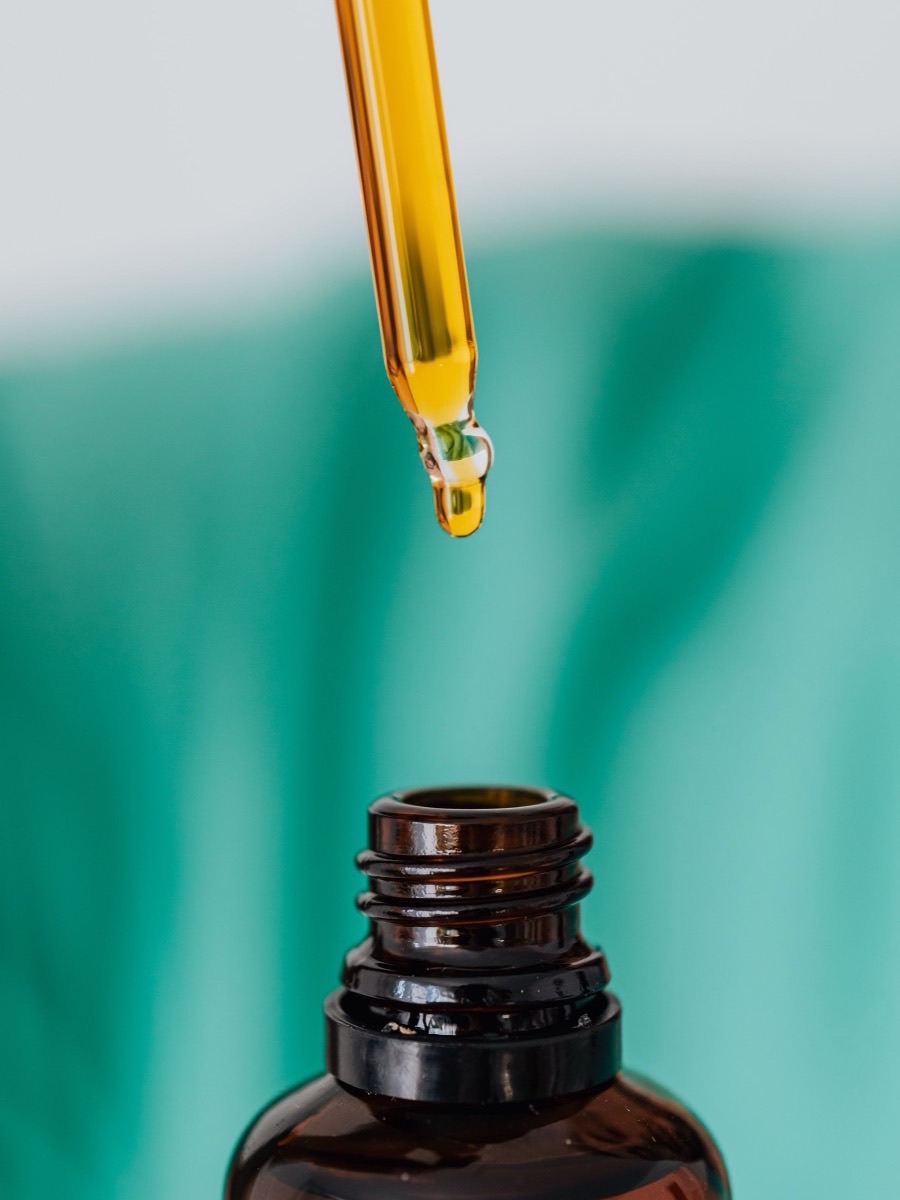
Bakuchiol facial oil serum
Anhydrous: bakuchiol dissolved in squalane, triglyceride and jojoba oil with Tocopherol. A short formula, with the active sitting in the phase it dissolves in; a light oil feel suited to dry and normal skin.
Bakuchiol milky serum
A thin oil-in-water emulsion: bakuchiol in the oil phase, Glycerin and Panthenol in the water phase. Absorbs quickly with little shine; for combination skin and users who dislike oils. It contains water, so it needs a preservative system and challenge testing.
Water-based gel with bakuchiol in a small-particle system
Bakuchiol is enclosed in a nanoemulsion or carrier particles, then dispersed in a translucent gel. A light texture, but more technically demanding than the two directions above: it needs suitable homogenizing equipment or a supplier's pre-encapsulated raw material, with particle size and content data — confirmed at the sampling stage.
Packaging is designed together with the formula
Dark glass dropper bottles for the oil serum; light-blocking airless pumps for the milky serum and gel. Gaskets and droppers are soak-tested with the sample, as oils can swell some types of rubber.
Parameters we monitor
What our R&D lab measures on every sample
Below are the parameters Butter-C monitors during formula development and scale-up to production. Specific limits are agreed with you on the approved sample and then written into the product's in-house specification.
- Sensory profile & color
- Color, odor, clarity; compared against a reference standard kept in the R&D lab. Color drift and off-odor are early signs of oxidation.
- Bakuchiol content
- Assayed by HPLC when the label names the active; 1H qNMR has been applied to cosmetics containing bakuchiol, with results comparable to HPLC.
- Content remaining after aging
- Bakuchiol is re-assayed after each accelerated aging and light-exposure time point — the basis for setting shelf life.
- Furocoumarin impurities
- Psoralen and angelicin on the COA of each raw material lot; also tested on the finished product when regulatory affairs require it.
- Rancidity of the oil base
- For the oil serum: the peroxide value of the oil base is tracked across stability time points.
- pH
- For the milky serum and water-based gel: measured directly at 25°C, with pH drift tracked.
- Stability
- Accelerated aging at 40°C, freeze–thaw cycling and light exposure; we track separation, and particle size for nanoemulsion systems.
- Microbiology & preservative challenge
- Tested at a GLP / ISO 17025-accredited laboratory; preservative efficacy (challenge) test to ISO 11930 for versions containing water.
- Irritation & sensitization
- Tested on volunteers before the formula is locked — contact allergy to bakuchiol has been reported, so we do not rely on a generic “gentle” statement.
Claims
Writing claims within the cosmetic scope
Bakuchiol is often marketed as “plant retinol” and tied to the word anti-aging — neither can be used. Annex 03-MP of Circular 06/2011/TT-BYT does not accept claims to prevent, reduce or reverse age-related changes; statements about how skin looks are made only after testing the finished product. Butter-C reviews the wording on labels and marketing materials as soon as the notification dossier is prepared.
Helps fine lines look less visible, skin look smoother
Only with testing on the finished product; any figure comes with the design (number of people, duration, whether there was a control group). Instead of: anti-aging, wrinkle eraser, skin rejuvenation.
Helps skin look more even-toned
Requires data on the finished product itself. Instead of: fades melasma, erases dark spots.
Contains bakuchiol — an active of plant origin
Origin stated according to the supplier's declaration. Instead of: plant retinol, natural retinol, plant vitamin A, retinol replacement.
Gentle on skin
Only with tolerance data for the product itself; any comparison with retinol must state the difference in application frequency. Instead of: non-irritating, safe for all skin types, as effective as retinol.
Directions and label cautions
Use sunscreen during the day; anyone with a history of cosmetic allergy should test on a small area first; pregnant or breastfeeding women should consult a doctor before use, as data are insufficient. Instead of: pregnancy-safe, photostable so fine for daytime use.
Study figures
Results from other studies are not borrowed as product claims. Mechanism data and part of the clinical research come from authors affiliated with companies; a 2024 systematic review rated most trials as open-label, using combination products, with a high risk of bias. Instead of: “reduces wrinkles by X% in clinical studies”.
Manufacturing specifications
Current capabilities
- Texture
- Clear facial oil serum, thin milky serum, or water-based gel with bakuchiol in a small-particle system.
- Format
- Dark glass dropper bottles, light-blocking airless pumps. Volume agreed when packaging is selected.
- Minimum order quantity
- Agreed per order — depends on the formula direction, the bakuchiol source and the chosen format.
- Testing
- Tested at a GLP / ISO 17025-accredited laboratory, with a bakuchiol assay when the label names the active; a certificate of analysis accompanies every lot.
- Documentation
- Product Information File (PIF) and cosmetic product notification dossier prepared by Butter-C, including a raw material file with furocoumarin limits.
- Packaging
- Label design, printing and packing run in parallel with formula development.
Suggested product concept
Fragrance-free bakuchiol facial oil serum in a dark bottle
A product direction to help you picture the idea — not a ready-made product for sale. The actual formula is developed around your brand's positioning and price range.
Bakuchiol
The hero of the product, with the 0.5% level tested in humans as a reference; raw material with a COA stating bakuchiol, psoralen and angelicin content.
Squalane, Caprylic/Capric Triglyceride, jojoba oil
Light, low-odor base oils that dissolve bakuchiol; ratios chosen by skin feel.
Tocopherol, no fragrance, no essential oils
Protects the oil phase from oxidation; a short ingredient list, no colorants.
30 ml dark glass dropper bottle
Light protection for the active; the label advises daytime sunscreen, a patch test on a small area, and that pregnant women consult a doctor.
Customization options
What you can specify
The same product type can serve very different customers depending on the brand. Tell us your requirements in the areas below, and our team of pharmacists will develop a matching formula.
Texture
Oil serum, milky serum or water-based gel — determines the emulsifier system, preservative system and packaging.
Bakuchiol level
0.5%, the level with human data, as the reference; other levels are assessed on the formula and tolerance-tested.
Base oils
Squalane, triglyceride, jojoba oil — chosen by the desired feel and skin type.
Companion ingredients
Humectants and soothing agents such as Glycerin and Panthenol in versions containing water. There are no verified data on combining bakuchiol with retinoids, AHAs or BHAs — if combined, tolerance and stability are tested on the formula itself.
Fragrance and color
We recommend no fragrance and no essential oils for an active serum; the product color is the natural color of the raw materials.
Ingredient preferences
Fragrance-free, alcohol-free, vegan — please tell us at the start so suitable raw materials can be selected.
Further reading
Related topics
Bakuchiol in cosmetics
Mechanism, the head-to-head trial with retinol, levels tested in humans, furocoumarin impurities and ASEAN rules (in Vietnamese).
Retinol in cosmetics
A retinoid active — to see where bakuchiol differs from retinol (in Vietnamese).
Squalane in cosmetics
A stable base oil often used to dissolve bakuchiol (in Vietnamese).
Using sunscreen correctly
The daytime step that should accompany any active serum (in Vietnamese).
Anti-aging serum OEM/ODM manufacturing
A different direction: a serum with several active groups (peptides, retinoids, vitamin C), where bakuchiol is just one option.
How we work
From idea to finished batch
Eight steps and three milestones signed off by both sides: approved sample, notification number, finished batch. Step-by-step details (in Vietnamese) →
Get started
Tell us about the product you plan to launch
Send us your product direction and expected volume. Our team will get back to you during business hours (Vietnam time, GMT+7).
Head office: Huu Le village, Dai Thanh commune, Hanoi · Factory: Thanh Oai Industrial Cluster, Binh Minh commune, Hanoi, Vietnam
Hotline +84 967 176 511 · [email protected] · Privacy policy ← Full catalog