 BUTTER-C
Face care
Facial exfoliator OEM/ODM manufacturing
Facial Exfoliator · OEM/ODM
Exfoliation helps old stratum corneum cells shed more evenly, leaving the skin surface smoother so the products that follow absorb better. There are two routes: physical, using fine particles to gently buff the skin, and chemical, using acids or enzymes to loosen the bonds between corneocytes. Both deliberately act on the skin barrier, so the line between "smoother" and "stinging and red" is narrow. A good formula controls that level of action: particle size, particle hardness, and acid concentration and pH. Butter-C offers turnkey OEM/ODM manufacturing, from formula development to labeled finished goods and the notification dossier.
Formula base
Particles, acids and enzymes
A product can rely on a single mechanism or combine two at a mild level. The three groups below are the directions Butter-C works with.
Physical exfoliants
Jojoba wax beads, cellulose beads, silica, bamboo powder, perlite, finely ground seed powder. Rounded, small and uniform particles are preferred; no plastic microbeads.
Chemical exfoliating acids
AHAs (glycolic, lactic, mandelic acid) act on the surface; BHA (salicylic acid) is oil-soluble and reaches into pores; PHA (gluconolactone) is gentler for sensitive skin. Concentration and pH follow current safety recommendations.
Enzymes and peeling gels
Papain and bromelain break down stratum corneum proteins under mild conditions. Peeling gels use polymers that ball up when rubbed, carrying away shed corneocytes.
Base and soothing agents
Cream, gel or cleanser bases with mild surfactants; panthenol, allantoin, centella and hyaluronic acid keep skin from feeling dry and tight after rinsing.
Key technical points
Four factors that decide gentleness and performance
Particle size and shape
Large, sharp-edged particles scratch the skin. Raw materials are selected by the particle size distribution on the certificate of analysis and rechecked by sieve or microscope.
Keeping particles suspended
Heavy particles settle and light ones float. The base needs enough yield stress to keep particles evenly distributed from filling to the end of the shelf life; checked by centrifuge and temperature storage.
Acid concentration and pH
AHA and BHA performance depends more on pH than on the concentration stated on the label. pH is set at a balance between performance and gentleness, with a buffer so it does not drift over time.
Enzyme and particle stability
Enzymes lose activity with heat and some preservatives; wax beads soften at high temperatures; plant particles carry microbes. Each needs its own processing and storage conditions.
Three formulation directions
Three common product formats
Cream or gel with particles
The familiar format, with visible results right after rinsing. Used once or twice a week; aimed at normal and oily skin.
Chemical exfoliants
Toners, serums or pre-soaked pads containing AHA, BHA or PHA. No scrubbing, even action; aimed at acne-prone skin, dull skin and users already accustomed to actives.
Peeling gels and enzyme powders
Peeling gels ball up when rubbed; enzyme powders form a fine foam on contact with water. Gentle, aimed at sensitive skin and beginners.
Packaging designed with the formula
Wide-mouth jars with a spatula for particle creams; tubes with an opening large enough that particles do not jam. Acid products need low-pH-resistant plastic; enzyme powders need moisture-proof packaging.
Parameters we monitor
What our R&D lab measures on every sample
These are the parameters Butter-C monitors during formula development and scale-up to production. Specific limits are agreed with you on the approved sample and then written into the product's in-house specification.
- Appearance
- Color, odor, smoothness of the base, particle density and uniformity.
- pH
- Measured at 25°C; for acid products, pH is the critical parameter and is checked on every batch.
- Viscosity
- Measured with a rotational viscometer; determines the ability to keep particles suspended.
- Particle size
- Particle size distribution of the raw material checked, and particles in finished goods observed under a microscope.
- Acid content
- AHA and BHA assayed at the start and after stability testing when the label names the active.
- Stability
- 40°C, freeze–thaw cycling and centrifuge; monitored for settling or floating particles, separation and discoloration.
- On-skin assessment
- Gentleness when rubbed, stinging, redness after rinsing and perceived smoothness.
- Microbiology & preservative efficacy
- Tested at a GLP / ISO 17025-accredited laboratory; preservative efficacy (challenge) test to ISO 11930.
- Packaging compatibility
- Filled into the actual jar or tube to be used; checked for particles jamming the tube opening, seal integrity and plastic discoloration.
Claims
Writing claims within cosmetic scope
English labels in this category often carry words such as "Blackhead Removing" and terms that suggest dermatology. When moving to the Vietnamese supplementary label and the notification dossier, these lines need to be reworded.
Removes dead skin cells, helps skin feel smooth
Instead of: peels skin, resurfaces skin, regenerates skin.
Helps clear excess sebum from pores
Instead of: removes blackheads, treats whiteheads, treats closed comedones.
Helps skin look brighter and more even-toned
Instead of: whitens skin, treats dark spots, treats melasma.
Product name and line
Avoid names that suggest a dermatological or medical product when the dossier is a cosmetic one.
Usage warnings
Products containing AHA or BHA: state frequency of use, avoid the eye area, stop use if irritation occurs, use sunscreen during the day.
Collagen in rinse-off products
Collagen acts as a moisturizing ingredient in the base; do not claim "replenishes collagen in the skin".
Manufacturing specifications
Current capabilities
- Texture
- Creams, gels and cleansers with particles; acid solutions or gels; peeling gels; enzyme powders.
- Pack formats
- Jars, tubes, bottles or powder sachets. Fill weight agreed when packaging is selected.
- Minimum order quantity
- Agreed per order, depending on the formula direction and pack format chosen.
- Testing
- Performed at a GLP / ISO 17025-accredited laboratory, with a certificate of analysis delivered with every batch.
- Documentation
- Product Information File (PIF) and notification dossier prepared by Butter-C.
- Packaging
- Label design, printing and packing run in parallel with formula development.
Reference product
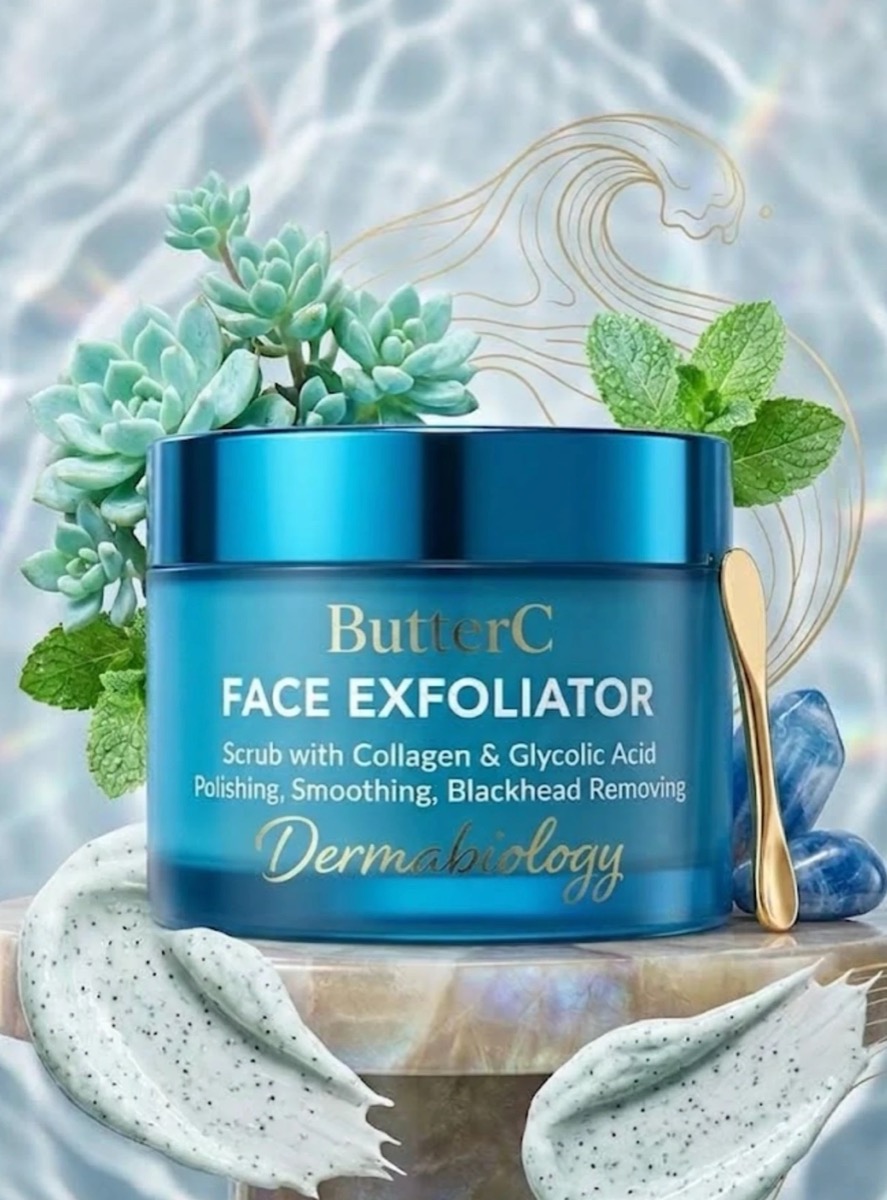
ButterC Face Exfoliator
A sample made by Butter-C, shown here to help you picture a specific product direction. Your brand can take a completely different direction; this is only a starting point for discussion.
Fine particles in a cream base
Pale blue cream with evenly distributed dark particles; a physical mechanism you can see.
Glycolic acid
A mild level of AHA alongside the particles helps loosen the stratum corneum before the particles sweep it away.
Collagen
A moisturizing ingredient in the cream base that keeps skin from feeling dry and tight after rinsing.
Jar
Wide-mouth blue jar with a metallic cap and a spatula.
Customization options
What you can specify
Within the same product type, each brand targets a different customer group. Tell us your requirements in the areas below, and our team of pharmacists will develop a matching formula.
Mechanism
Physical, chemical, enzymatic or a mild combination.
Particle type
Jojoba wax beads, cellulose, bamboo powder, silica; fine or medium particle size.
Acid type
Glycolic, lactic, mandelic, salicylic acid or gluconolactone.
Texture
Cream, gel, cleanser, peeling gel or powder.
Target skin type
Oily, normal, dry or sensitive skin; this determines how strong the formula is.
Ingredient direction
Vegan, microplastic-free, alcohol-free, paraben-free; please state these from the start so suitable raw materials can be selected.
Further reading
Related topics
How actives feel on the skin
Why acids sting and what level is acceptable (in Vietnamese).
Facial skin care steps
Where exfoliation fits in the routine and how often to use it (in Vietnamese).
Clay mask OEM/ODM manufacturing
A deep-cleansing product to alternate during the week.
Skin recovery essence OEM/ODM manufacturing
A soothing step after exfoliation.
How we work
From idea to finished batch
Eight steps and three milestones signed off by both sides: approved sample, notification number, finished batch. Step-by-step details (in Vietnamese) →
Get started
Tell us about the product you plan to launch
Send us your product direction and expected volume. Our team will get back to you during business hours (Vietnam time, GMT+7).
Head office: Huu Le village, Dai Thanh commune, Hanoi · Factory: Thanh Oai Industrial Cluster, Binh Minh commune, Hanoi, Vietnam
Hotline +84 987 964 764 · [email protected] · Privacy policy ← Full catalog