 BUTTER-C
Signature ingredients
Pomelo peel oil hair spray OEM/ODM manufacturing
Pomelo Peel Oil Hair Spray · OEM/ODM
Pomelo peel is tied to a hair-washing pot familiar to many Vietnamese families; that is a cultural story for your brand, not evidence of efficacy. Pomelo oil sprays are often marketed as making hair grow, yet we found no study in humans, animals or cells showing that pomelo oil grows hair, and Appendix 03-MP of Circular 06/2011/TT-BYT does not accept claims such as "stimulates hair growth" or "prevents hair loss" for cosmetics. The supported role of pomelo peel oil is fragrance; soft, easy-to-comb hair comes from the conditioning agents in the formula. So this pomelo oil hair spray is built as a light leave-on spray for the hair shaft with a pomelo scent, plus three tasks specific to pomelo oil left on the hair: choosing the right material (pomelo, not grapefruit), controlling furocoumarins (compounds that react with sunlight) on the scalp, forehead and nape, and keeping the solution clear and the scent stable when the oil oxidizes easily. Butter-C offers turnkey OEM/ODM manufacturing, from formula development and testing to labeled finished goods and the notification dossier.
Formula base
Pomelo peel oil in a light water base
The formula has the same four groups as any hair mist (see our general hair mist page); the difference is that pomelo oil is the named ingredient, so it drives the choice of solubilizer, antioxidant, packaging and raw-material documents from the very first sample.
Pomelo peel oil: right species, right name
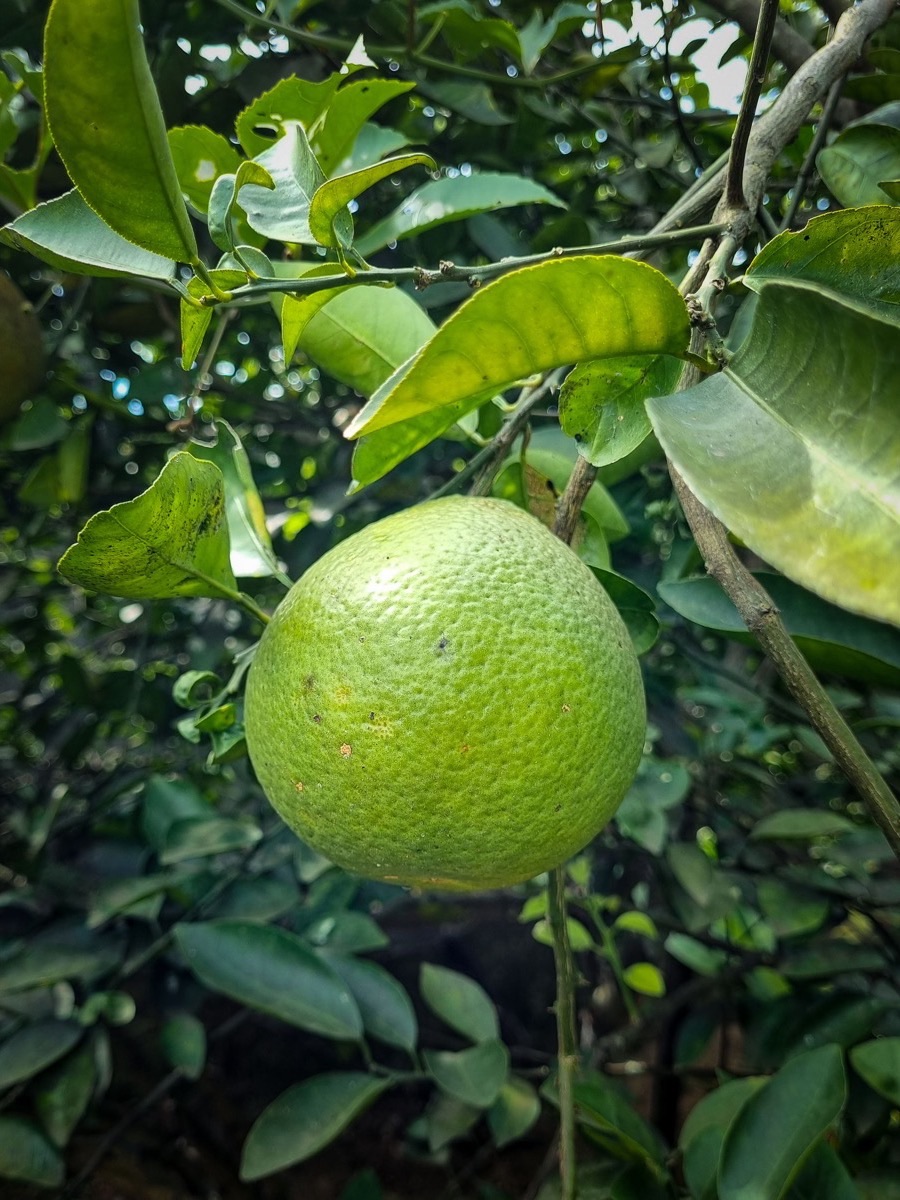
Pomelo is Citrus maxima (synonym C. grandis); grapefruit is a different species. Proposed INCI: Citrus Grandis Peel Oil. The 2019 CIR report, however, ties the US name "Citrus Grandis (Grapefruit) Peel Oil" to grapefruit with CAS 8016-20-4, and itself notes this naming inconsistency. The raw-material file states the scientific name, the peel as the plant part and the production method (cold-pressed or distilled); grapefruit's CAS 8016-20-4 is not used. The INCI name on the label is confirmed by regulatory affairs.
Water base, with or without alcohol
Purified water is the main component; glycerin and panthenol add moisture at low levels so hair does not feel sticky. Alcohol (Alcohol Denat.) dries fast and helps dissolve the oil, but in patch tests on the forearm it reduced skin hydration (per our article on alcohol in cosmetics; no scalp-specific data). Versions for dry or sensitive scalps favor alcohol-free; if denatured alcohol is used, the denaturant is declared.
Solubilizer for the essential oil
PEG-40 Hydrogenated Castor Oil or Polysorbate 20: the oil is premixed with the solubilizer before it goes into the water. Solubilizer-to-oil ratios are usually screened from 1:1 to 5:1 or higher (our PEG-40 hydrogenated castor oil article); too much makes hair sticky, foams when shaken and traps part of the preservative in micelles, so any ratio change means re-testing the preservative system.
Light conditioning for the hair shaft
Polyquaternium-10, water-soluble silicone (PEG-12 Dimethicone), hydrolyzed rice protein; Cetrimonium Chloride for a detangling version. ASEAN Annex III Ref 286: up to 1.0% in leave-on hair products (individually or summed with steartrimonium chloride), for purposes other than preservation, and that purpose must be apparent from the product presentation. Cationics can precipitate with anionic ingredients, so compatibility is tested.
Key technical points
Five things specific to a hair spray with pomelo oil
These are the points where a pomelo oil spray differs from a standard hair mist; each is settled by raw-material documents or testing on samples.
No hair-growth data: position it right from the start
PubMed search (28/10/2026, per our pomelo oil article): no study in humans, animals or cells on pomelo or grapefruit peel oil and hair growth. The "pomelo peel has naringin" argument rests on a mouse study using naringin as an isolated compound, with the route not clearly stated in the abstract (Zheng et al., 2026); naringin is extracted in a separate step and is not the essential oil (Mai et al., 2022). The product is therefore positioned on fragrance and hair-shaft care.
Furocoumarins and sunlight
One cold-pressed pomelo oil sample (Liangping variety) had no bergapten but about 350 ppm isoimperatorin, 110 ppm oxypeucedanin and 85 ppm epoxybergamottin; distilled oil from the same variety contained these only in traces (Li et al., 2021). A leave-on spray reaches the scalp, forehead and nape, areas exposed to the sun. CIR 2019: leave-on products no more than 0.0015% (15 ppm) bergapten. Butter-C prefers distilled or furocoumarin-free (FCF) oil with a COA covering both bergapten and oxypeucedanin. We found no phototoxicity test on pomelo oil itself.
Oil level set by IFRA and safety assessment
IFRA has no standard specific to pomelo; the "Grapefruit oil expressed" standard (grapefruit, 2020) allows up to 4.0% in hair sprays (Category 7B). Using 4% as a ceiling is a cautious inference that needs confirmation by safety assessment. The industry survey in the CIR report (INCI tied to grapefruit) recorded a maximum of 0.005% in non-coloring hair products. The actual level is set by the supplier's IFRA certificate, scent and scalp feel; combining several citrus oils adds up their phototoxic compounds.
Clear solution, stable scent
Limonene is the main component (87.60% by hydrodistillation and 95.66% by CO2 extraction in a study of Vietnamese pomelo peel, Mai et al., 2022). Oxidized limonene forms hydroperoxides, which are sensitizers; IFRA requires a peroxide value below 20 mmol/L, for example by adding 0.1% BHT or alpha-tocopherol to the oil. UV light changes the scent of pomelo oil, so the bottle is light-protective, well filled with little headspace; clarity is also checked after cold storage.
Eyes, face and spray mist
Essential oil, alcohol and cationic conditioners all sting if they get into the eyes. Practical directions: spray onto hair, away from the face, close the eyes when spraying near the front hairline, do not inhale the mist; do not spray on a scratched scalp. The actuator is chosen so the mist lands on hair rather than hanging around the face, checked on the exact actuator to be used.
Three formulation directions
Three ways to build a hair spray named after pomelo oil
Alcohol-free water-based pomelo spray
Distilled oil with a COA, solubilizer, panthenol and low Polyquaternium-10. Gentle on dry, sensitive scalps; an all-water base means the preservative system must pass an ISO 11930 challenge test.
Quick-dry pomelo spray with a little alcohol
Alcohol Denat. added for a dry feel and fast drying, and the oil dissolves more easily. Not suited to dry or sensitive scalps; the flash point depends on the alcohol–water ratio and is measured on the actual formula.
Pomelo-scented detangling spray
Cetrimonium Chloride (≤ 1.0%, Ref 286 leave-on) with water-soluble silicone and a low level of pomelo oil. Suits long and color-treated or permed hair; the "detangling" claim rests on combing-force measurements on hair tresses.
Packaging is designed with the formula
Amber or opaque light-protective bottles with a fine-mist actuator. Limonene-rich oil can soften plastics and gaskets, so compatibility, leakage and actuator clogging are tested on the actual packaging.
Parameters we monitor
What our R&D lab measures on every sample
Below is the set of parameters Butter-C tracks during formula development and scale-up. Specific limits are agreed with you on the approved sample and then written into the product's in-house specification.
- Clarity
- At room temperature, after cold storage and after freeze–thaw cycling; no haze, no oil film. Re-checked whenever the oil batch or solubilizer ratio changes.
- pH
- Measured at 25°C; gentle for the scalp and within the working range of the preservative system.
- Odor & color after light exposure
- Compared with the reference sample after stability testing with light exposure; watching for off-notes from oxidized or UV-exposed oil.
- Incoming oil COA
- Scientific name, plant part, production method; furocoumarins (including bergapten and oxypeucedanin); peroxide value; fragrance allergen declaration; IFRA certificate.
- Spray pattern & output
- Checked on the exact actuator and bottle to be used; even coverage across the hair.
- Hair & scalp assessment
- Combing force on tresses before and after spraying; root greasiness after a few hours; stinging over several days of use. An irritation test on volunteers at an independent lab is recommended.
- Microbiology & preservative challenge
- Tested at a GLP / ISO 17025-accredited laboratory; preservative efficacy (challenge) test per ISO 11930.
- Fragrance allergens
- ASEAN has no list of fragrance allergens that must be named individually (Annex III, entries 67–92 left blank). For EU export, limonene and citral (plus linalool and geraniol if present) are named above 0.001% in leave-on products; Regulation (EU) 2023/1545 has no specific entry for pomelo oil.
- Packaging compatibility
- Monitoring plastics and gaskets softened by the oil, leakage, actuator clogging and weight loss.
Claims
Claims for a hair spray with pomelo oil
Labels and advertising for pomelo oil sprays are often asked to change their wording. Evidence for pomelo oil on hair: no hair-growth studies and no controlled human trial for any cosmetic benefit; its supported role is fragrance. Butter-C reviews label and marketing wording when preparing the notification dossier.
Hair with a fresh pomelo scent
Instead of: stimulates hair growth, new baby hairs, stops hair loss.
Helps hair feel soft and easy to comb (when the formula contains conditioners and has been assessed on tresses)
Instead of: restores damaged hair, regenerates hair.
Helps reduce breakage from combing (when breakage has been tested on the finished product)
Instead of: prevents hair loss, thickens the hair strand.
Leaves the scalp feeling comfortable
Instead of: nourishes hair follicles, gets rid of dandruff, stops scalp itching.
Contains pomelo peel oil; inspired by traditional pomelo peel hair washing
Instead of: "works like minoxidil", citing the naringin mouse study, "pure essential oil" when the product is a water solution.
Label warnings and directions
"Spray onto hair, away from the face; avoid contact with eyes, if contact occurs rinse immediately with plenty of water"; do not use on a scratched scalp; stop if redness, itching or burning occurs. For versions using cold-pressed oil without a furocoumarin COA, consider advising not to spray on skin just before going out in the sun (practice). Heavy, prolonged or patchy hair loss needs a dermatologist. Instead of: safe in the sun, hypoallergenic, safe for pregnancy.
Manufacturing specifications
Capabilities
- Texture
- Clear solution, water base or water with a little alcohol.
- Format
- Fine-mist spray bottle, continuous-spray bottle. Volume agreed when choosing packaging.
- Minimum order quantity
- Agreed per order and per fragrance.
- Testing
- Performed at a GLP / ISO 17025-accredited laboratory; certificate of analysis delivered with every batch.
- Documentation
- Product Information File (PIF) and cosmetic product notification dossier prepared by Butter-C, with the essential oil's COA and IFRA certificate.
- Packaging
- Label design, printing and packing run in parallel with formula development.
Suggested product concept
Distilled pomelo peel oil hair spray, alcohol-free water base
One product concept to help you picture the range, not a ready-made product for sale. The actual formula is built around your brand's positioning and price point.
Distilled pomelo peel oil with a COA
Furocoumarin COA, peroxide value, IFRA certificate; premixed with PEG-40 Hydrogenated Castor Oil for a clear solution.
Panthenol and hydrolyzed rice protein
Moisture and a soft feel for the hair shaft; level assessed on tresses.
Low Polyquaternium-10
Easy combing without greasy roots.
150 ml amber spray bottle
Light protection keeps the pomelo scent; the label directs users to spray away from the face and avoid the eyes.
Customization options
Options you can specify
The same product type can target very different customers. Tell us your requirements in the areas below and our pharmacists will build the matching formula.
Type of pomelo oil
Distilled, furocoumarin-free (FCF) or cold-pressed with a COA; cold-pressed oil without a COA is not used in leave-on products.
Base
Alcohol-free for sensitive scalps, or a little alcohol for fast drying.
Main benefit
Fragrance, moisture, detangling or a combination; each needs its own conditioners and measurements.
Target users
Women, men, long hair, color-treated or permed hair. A children's version needs a separate dossier, without strong essential oils.
Scent blend
Pomelo alone, or with holy basil, peppermint or rosemary; each added oil brings its own limits and allergens.
Product set
Gleditsia–pomelo shampoo, conditioner and pomelo spray sharing one traditional hair-washing story.
Further reading
Related knowledge
Pomelo peel oil in cosmetics
Pomelo vs grapefruit naming, evidence on hair, furocoumarins, IFRA and ASEAN rules (in Vietnamese).
Hair mist OEM/ODM manufacturing
General principles of hair mists; this page focuses on pomelo oil.
Scalp essence OEM/ODM manufacturing
Applied directly to the scalp with scalp-care actives; the pomelo spray mainly conditions the hair shaft and adds fragrance.
Hair loss and hair breakage
What cosmetics can and cannot do; hair claims under Appendix 03-MP (in Vietnamese).
PEG-40 hydrogenated castor oil
How essential oils are solubilized for a clear spray (in Vietnamese).
How we work
From idea to finished batch
Eight steps and three milestones signed off by both sides: approved sample, notification number, finished batch. Step-by-step details (in Vietnamese) →
Get started
Tell us about the product you plan to launch
Send us your product direction and expected volume. Our team will get back to you during business hours (Vietnam time, GMT+7).
Head office: Huu Le village, Dai Thanh commune, Hanoi · Factory: Thanh Oai Industrial Cluster, Binh Minh commune, Hanoi, Vietnam
Hotline +84 967 176 511 · [email protected] · Privacy policy ← Full catalog