 BUTTER-C
Fermented soymilk (Lactobacillus/Soymilk Ferment Filtrate)
Fermented soymilk is often promoted as a source of isoflavones for the skin. For the INCI ingredient Lactobacillus/Soymilk Ferment Filtrate, the available data relate mainly to foods, cultured cells or ingredients fermented by other bacteria; there are as yet no human trials with this exact ingredient.
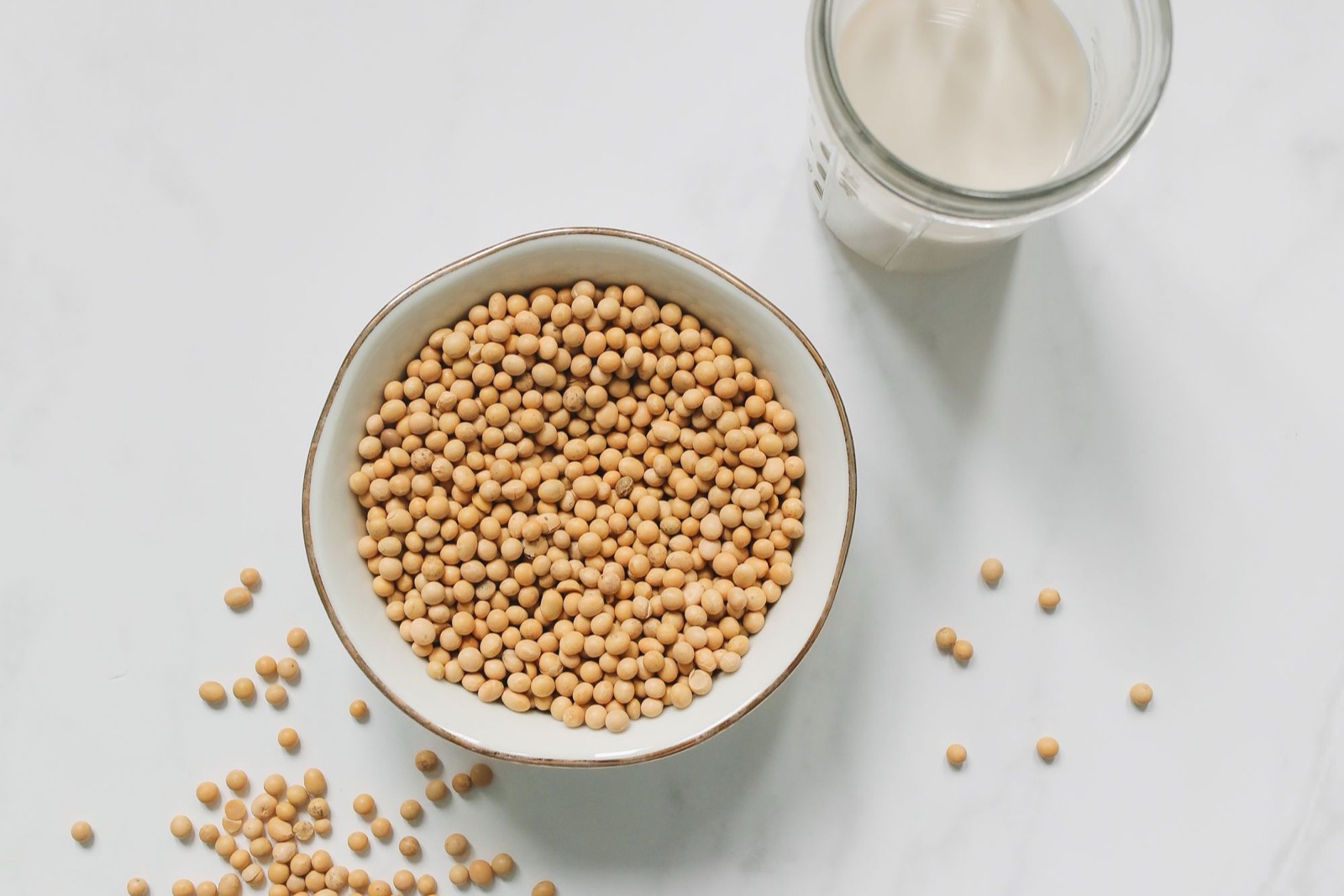
Lactobacillus/Soymilk Ferment Filtrate is the INCI name of the filtrate obtained after lactic acid bacteria of the genus Lactobacillus ferment soymilk. The bacterial cells are removed by filtration, and what remains is the fermented soymilk together with the substances produced by the bacteria. This ingredient contains no live bacteria and is not a “probiotic.”
This article separates the data on this INCI ingredient itself from the data on fermented soymilk as a food, on soy fermented by other bacteria, and on pure isoflavones.
1. What is Lactobacillus/Soymilk Ferment Filtrate?
Under the INCI naming conventions cited in the Cosmetic Ingredient Review (CIR, 2025) report, when fermentation takes place on a non-standard substrate, the name of the substrate must be included in the INCI name. The word “Soymilk” in the name indicates that the substrate is soymilk. This is therefore a separate INCI name, distinct from Lactobacillus Ferment Filtrate (in Vietnamese), which is obtained by fermenting a standard culture medium.
| Substance | Nature | Relationship to the INCI ingredient in this article |
|---|---|---|
| Lactobacillus/Soymilk Ferment Filtrate | Filtrate of soymilk after fermentation by Lactobacillus | Subject of this article |
| Lactobacillus Ferment Filtrate | Filtrate of a standard culture medium | A different INCI name; the CIR 2025 conclusion applies only to this group |
| Soymilk extract fermented by Bifidobacterium | Test material in studies from 2003–2004 | Bacteria of a different genus; not the INCI ingredient in this article |
| Soybean seed ingredients (e.g., Glycine Soja (Soybean) Seed Extract) | Extracts, powders, lipids, etc., not fermented | Not fermented; assessed separately by CIR (2020) |
| Pure genistein, daidzein | Isoflavones in aglycone form | May be present in the fermented liquid in unknown amounts; subject to their own limits in ASEAN Annex III |
The INCI name does not state the bacterial species, strain or process, so two ingredients with the same name should not be assumed to be identical. The ingredient Butter-C currently has is a blend declared with the INCI “Water (and) Lactobacillus/Soymilk Ferment Filtrate (and) Butylene Glycol (and) Pentylene Glycol”; the proportions are as stated in the technical data sheet (TDS).
2. Composition and mechanisms: what is known and what is not
In our PubMed searches (November 2026), we found no study that names this exact INCI ingredient. The closest data concern soymilk fermented by defined strains:
- Isoflavones change form during fermentation (food): in soymilk, isoflavones are mainly bound to sugars (glycosides). When soymilk was fermented with Lactiplantibacillus plantarum LP95 at 37 °C, aglycone levels increased after 24 hours, reaching daidzein 48.45, glycitein 5.10 and genistein 56.35 µmol/100 g dry matter; antioxidant activity (ABTS) increased after 6 hours (Letizia et al., 2023). This is a food, not a cosmetic filtrate.
- Peptides from soymilk (in vitro): a fraction obtained by ultrafiltration through a 5 kDa membrane from soymilk that had been enzyme-treated and then fermented with Lacticaseibacillus paracasei MK1 showed the highest DPPH radical-scavenging activity among the fractions tested; this fraction increased type I procollagen production in fibroblasts and reduced TNF-α in UVB-irradiated HaCaT keratinocytes (Lee et al., 2023; some authors are affiliated with a dairy company). This process (enzyme treatment, fermentation, ultrafiltration) differs from a conventional filtrate, and the authors themselves note that the peptides have too high a molecular weight to penetrate the skin barrier.
- Skin bacteria (in vitro): a preparation of soymilk fermented by lactic acid bacteria, in a preservative-free form, increased the growth of Staphylococcus epidermidis, S. hominis and S. lugdunensis, inhibited S. warneri and slightly increased Cutibacterium acnes; the preserved form strongly inhibited all strains at high concentrations (Funatsu et al., 2026; authors affiliated with a company).
No verified source states how much isoflavone or peptide remains in the cosmetic filtrate; statements such as “rich in isoflavones,” “estrogen-like” and “stimulates collagen” have no basis for this INCI ingredient.
3. Evidence of efficacy
| Study | Test material and model | Results (per abstract) | Notes |
|---|---|---|---|
| Lee et al., 2023 | Fraction of soymilk fermented by L. paracasei MK1; UVB-irradiated human skin cells | DPPH radical scavenging; increased type I procollagen, reduced TNF-α | In vitro; process includes enzyme treatment and ultrafiltration; some authors affiliated with a company |
| Funatsu et al., 2026 | Preparation of soymilk fermented by lactic acid bacteria; 12 Staphylococcus strains, 7 C. acnes strains | The preservative-free form increased the growth of some resident staphylococci | In vitro; authors affiliated with a company; abstract does not state the INCI name |
| Letizia et al., 2023 | Soymilk fermented by Lp. plantarum LP95 (food) | Increased isoflavone aglycones and ABTS activity | Food analysis, not tested on skin |
| Miyazaki et al., 2004 | Bifidobacterium-fermented soymilk extract; topical application in hairless mice for 6 weeks; 10% gel applied to human forearms for 3 months | In mice: increased hyaluronic acid and moisture; in humans: reduced the decline in skin elasticity | Bacteria of a different genus; abstract does not state the number of participants; authors affiliated with a company |
Conclusion: limited evidence. We have found no human trial comparing this exact INCI ingredient with a vehicle. Results for the Bifidobacterium-fermented extract and for orally consumed fermented soymilk are not evidence for this topical ingredient.
4. Typical concentrations and product formats
No use concentration has been established from verified sources: this INCI ingredient is not included in the CIR reports on Lactobacillus ferment ingredients (2025) or on soy-derived ingredients (2020). Use levels follow the TDS; the percentage of the blend is not the same as the percentage of filtrate. The blend is water-based and is added to the water phase of toners, essences, serums or moisturizers.
5. How to use and combine
- It can be paired with humectants such as glycerin, sodium hyaluronate and panthenol; efficacy is assessed on the finished product.
- The sources reviewed do not report any specific incompatibility with retinoids, AHAs or vitamin C; check with stability testing.
- The filtrate and glycols in the blend do not replace the preservative system: a water-containing finished product still requires challenge testing according to ISO 11930 (in Vietnamese).
6. Safety: who should take care
There is as yet no verified safety assessment specific to this INCI ingredient: the CIR’s 2025 conclusion “safe in the present practices of use and concentration” applies only to four Lactobacillus ferment INCI ingredients whose names do not specify a substrate; the 2020 CIR report on 28 soy-derived ingredients does not cover fermented ingredients.
Soy allergy. We have found no irritation, sensitization or case-report data that name this exact INCI ingredient (PubMed, November 2026). For unfermented soy ingredients, the 2020 CIR report summarizes two cases: a woman developed facial redness and swelling after using a night cream containing soy extract and had a positive patch test to soy extract (and to several other substances); an esthetician developed finger eczema a few months after starting regular contact with cosmetic lotions, and several years later had anaphylactic symptoms after eating soy; skin prick tests were positive to soy extract and to the soy-extract-containing lotion this person used. The CIR Panel was not concerned that topically applied soy proteins would cause immediate (type I) allergy, because they are water-soluble, do not penetrate the skin, have molecular weights much lower than the level needed to cross-link IgE, and no type I cases caused by cosmetics containing soy proteins or peptides have been reported.
A small study in 6 people with pollen-related soy allergy (caused by the protein Gly m 4) found that unfermented soymilk gave positive skin prick test reactions in all 6; with fermented soymilk, the clear liquid fraction was positive in none of them (3 had weak reactions), whereas the whole fermented soymilk remained positive in 3 of 6 (Shiba et al., 2026; food product, some authors affiliated with a company). This result relates only to Gly m 4 and does not show that the ingredient is safe for everyone with soy allergy.
People with a known soy allergy should check the ingredient list (the word “Soymilk”) and consult a doctor. People who have reacted to cosmetics before should test on a small area of skin. Pregnant or breastfeeding women: data are insufficient; consult a doctor.
7. Perspective for brand owners
- ASEAN regulations: the INCI name, butylene glycol, pentylene glycol and the search terms checked (“soy”, “soja”, “lactobac”, “ferment”, “filtrate”) do not appear in Annexes II, III and VI (version 2026-1, June 22, 2026) or Annex VII (version 2025-2) of the ASEAN Cosmetic Directive. Annex III has two entries to be aware of if the ingredient contains isoflavones: genistein (Ref 343), maximum 0.007%, and daidzein (Ref 344), maximum 0.02%, in the finished product. Ask the supplier to quantify these two substances on the COA.
- Ingredient documentation: ask for clear information on the bacterial strain, filtration process, sterilization, proportion of filtrate, and a microbiology and heavy-metal COA for each batch.
- Do not pool data: oral or pure isoflavones, unfermented soy, soy fermented by Bifidobacterium, or Lactobacillus Ferment Filtrate are not a basis for claims.
- Proportionate claims: “moisturizes,” “helps skin feel soft and smooth,” “contains fermented soymilk filtrate.” Avoid “anti-aging,” “stimulates collagen,” “estrogen-like,” “firming,” “whitening” or “brightening,” “balances the microbiome,” “contains beneficial bacteria” and “non-irritating.”
- Labeling: list all four INCI names of the blend. The word “Soymilk” helps people who need to avoid soy recognize it.
Butter-C can use Lactobacillus/Soymilk Ferment Filtrate in contract manufacturing of fermented essences, toners and moisturizers, with stability testing, preservative efficacy (challenge) testing and claims kept at the moisturizing level.
Frequently asked questions
Does Lactobacillus/Soymilk Ferment Filtrate contain live beneficial bacteria?
No. It is a post-fermentation filtrate, and the bacterial cells have been removed. Background information is available in our article on the skin microbiome (in Vietnamese).
Does this ingredient have anti-aging effects or stimulate collagen?
There are no human data for this exact INCI ingredient; the procollagen results come only from cultured cells.
Does it contain isoflavones like soymilk does?
Possibly, but the amount has not been published in the verified sources; the amount in the filtrate depends on the process and must be checked on the COA.
Can people with soy allergy use it?
There are no data specific to this INCI ingredient. Avoid it or consult a doctor before use.
How is it different from bifida ferment lysate?
Bifida ferment lysate is a lysate of Bifidobacterium bacteria, whereas the ingredient in this article is a filtrate of soymilk fermented by Lactobacillus; the data are not interchangeable.
References
- Cosmetic Ingredient Review Expert Panel. Safety Assessment of Lactobacillus Ferment Ingredients as Used in Cosmetics (Final Report, issued October 6, 2025). https://cir-reports.cir-safety.org/view-attachment?id=ef347091-d80a-2bc3-afc5-c23abbb736b9
- Cosmetic Ingredient Review Expert Panel. Safety Assessment of Soy-Derived Ingredients as Used in Cosmetics (Final Report, issued July 9, 2020). https://www.cir-safety.org/sites/default/files/soy062020FR.pdf
- Lee S et al. The Radical Scavenging Activities and Anti-Wrinkle Effects of Soymilk Fractions Fermented with Lacticaseibacillus paracasei MK1 and Their Derived Peptides. Antioxidants (Basel). 2023. PMID 37507931
- Funatsu O et al. Short-Term Promotion of Beneficial Skin Commensal Staphylococcus Species Growth by PS-B1, a Postbiotic Composed of Lactic Acid Bacteria-Fermented Soy Milk. Microbiol Immunol. 2026. PMID 42037251
- Letizia F et al. Antioxidative Properties of Fermented Soymilk Using Lactiplantibacillus plantarum LP95. Antioxidants (Basel). 2023. PMID 37507980
- Miyazaki K et al. Topical application of Bifidobacterium-fermented soy milk extract containing genistein and daidzein improves rheological and physiological properties of skin. J Cosmet Sci. 2004. PMID 15608997
- Shiba T et al. Fermentation of soymilk with Lacticaseibacillus paracasei strain Shirota reduces soluble Gly m 4 levels and allergic reactions associated with soybean-related pollen-food allergy syndrome. Biosci Microbiota Food Health. 2026. PMID 41492374
- ASEAN Cosmetic Directive. Annex III – List of substances which cosmetic products must not contain except subject to restrictions and conditions laid down (Release Version 2026-1, June 22, 2026). https://asean.org/wp-content/uploads/2026/07/Annex-III_Release_22nd-June-2026-clean.pdf