 BUTTER-C
Signature ingredients
Sea buckthorn oil cream OEM/ODM manufacturing
Sea Buckthorn Oil Cream · Signature Ingredients · OEM/ODM
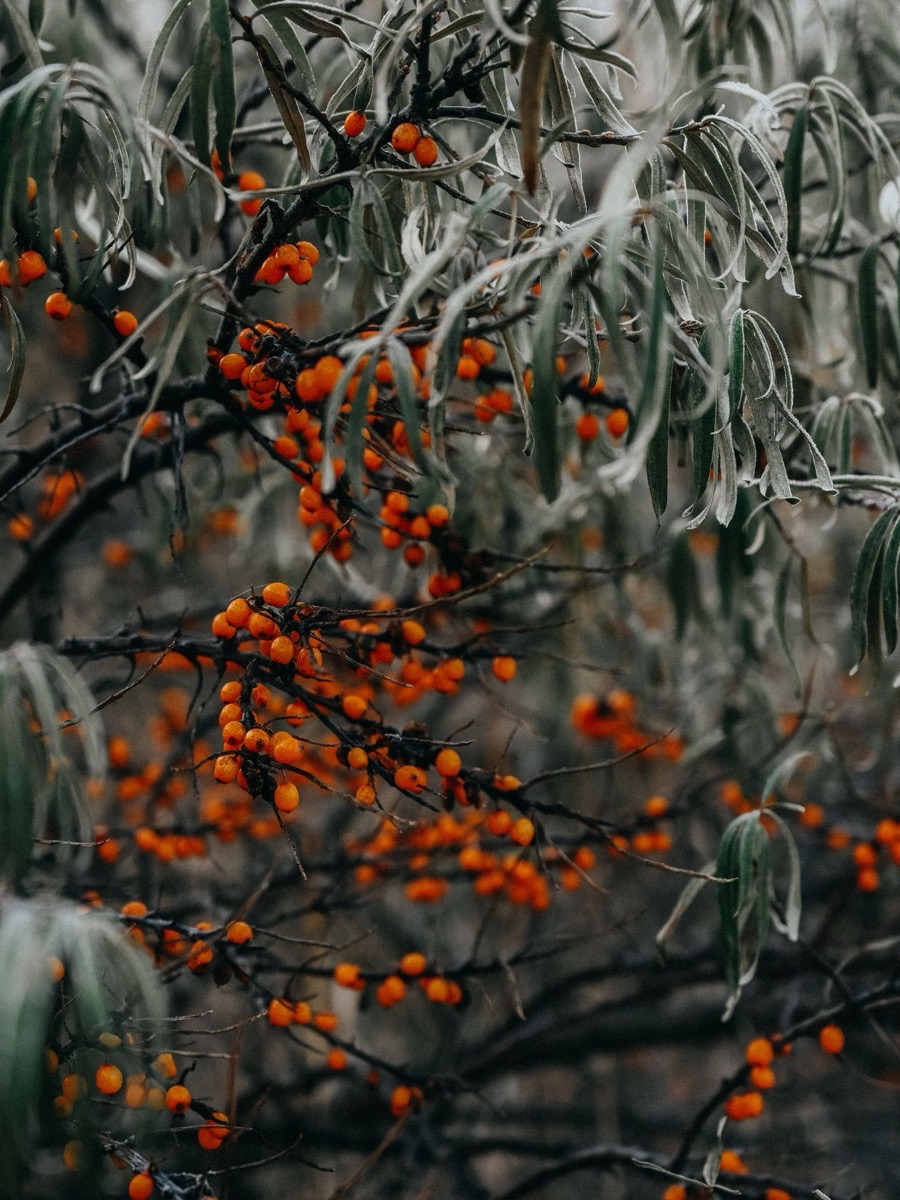
Sea buckthorn (Hippophae rhamnoides) is a cold-hardy shrub native to the cold temperate regions of Eurasia; its berries, seeds and leaves have been used in folk medicine in many places. Its familiar sales story is “omega-7”: oil pressed from the pulp and peel of the berry is rich in palmitoleic acid (an omega-7 fatty acid), while oil from the seeds contains almost none and is rich in linoleic and α-linolenic acids instead. The fruit oil also carries the orange-red color of carotenoids, mainly zeaxanthin in ester form. The evidence needs to be stated plainly: we found no trial applying sea buckthorn fruit oil on its own to healthy human skin; the trial in which a “sea buckthorn” cream improved skin hydration used a 5% extract, not the oil; results on burns and atopic dermatitis come from a medical setting, from animals or from oral intake. So the sea buckthorn oil cream Butter-C develops tells the ingredient story honestly and focuses on what the factory can control: the right fruit oil (fatty acid profile on the certificate of analysis), a consistent orange tone between lots, antioxidant protection for an oil that goes rancid easily, and light-tight packaging. The oil level stays within the range reported to the CIR Expert Panel; claims stop at softening and moisturizing. Sea buckthorn oil is not in Butter-C's standing raw-material list, so it is sourced per order. Butter-C offers turnkey OEM/ODM manufacturing, from formula development and testing to a labeled finished product and its notification dossier.
Formula base
Sea buckthorn fruit oil in the oil phase of an oil-in-water emulsion
Four points are settled before formulating: the right raw material, the use level, the companion oils and the cream base.
What sea buckthorn fruit oil is
INCI Hippophae Rhamnoides Fruit Oil — oil from the fruit (pulp and peel) of sea buckthorn, family Elaeagnaceae. PubChem lists CAS 225234-03-7 for this name (from one depositor); the dossier records the CAS on the supplier's certificate of analysis (COA). Fruit oil is different from seed oil (Hippophae Rhamnoides Seed Oil) and from fruit extract: three raw materials with their own composition, INCI and data. According to one supplier specification cited by the CIR Expert Panel, the fruit oil is orange-red; the seed oil in the same report is orange — color does not tell them apart, the fatty acid profile does.
Oil level in the cream
The 2017 CIR safety assessment of 244 plant oils lists 7 uses of sea buckthorn fruit oil, all leave-on, at reported concentrations of 0.004–2% (2% in products with dermal contact). These are reported market levels, not a recommendation. Butter-C keeps the fruit oil within this range, usually around 0.5–2% (formulation experience), set by the desired color and stability testing.
Companion oils and antioxidants
Squalane and Caprylic/Capric Triglyceride are stable base oils that accompany the oxidation-prone sea buckthorn oil in the oil phase (formulation experience); shea butter (Butyrospermum Parkii Butter) gives a richer cream. Tocopherol is mixed into the sea buckthorn oil as soon as the oil phase is combined; Disodium EDTA binds metal ions in the water phase. The tocopherol level follows the technical data and stability testing (formulation experience).
Oil-in-water cream base
Cetearyl Olivate, or Glyceryl Stearate with Cetearyl Alcohol, builds the cream; Glycerin, Panthenol and Sodium Hyaluronate hold moisture — the humectants and emollient oils are the main basis for moisturizing and softening claims. Fragrance-free is the recommended choice: the base odor of sea buckthorn oil is assessed on samples before deciding whether to add fragrance.
Key technical points
Fruit oil or seed oil, color, oxidation and evidence
The fatty acid profile separates fruit oil from seed oil
Yang and Kallio (2001) analyzed berries of two subspecies: palmitoleic acid made up 12.1–39.0% of pulp/peel oil and 8.9–31.0% of whole-berry oil and was practically absent from seed oil; linoleic and α-linolenic acids made up about 70% of seed oil fatty acids. One cold-pressed fruit oil sample had palmitic 49.4%, palmitoleic 28.0% and oleic 11.7% (Tudor et al., 2019). The COA should state the part used (pulp, whole berry or seed) and the fatty acid profile of the lot.
Orange color: carotenoids vary by lot and processing
Tudor's (2019) cold-pressed fruit oil contained 302.8 mg carotenoids/100 g, of which free and esterified zeaxanthin made up 76.35%. In a study on refining pulp oil (Jiang et al., 2020; the authors work at a company research center), the bleaching step removed 72.02% of β-carotene. The cream's color therefore depends on the oil lot, crude or refined oil, and the use level — a color standard is set and each finished lot is checked against it; fading during stability testing is a signal to re-check.
An oil that oxidizes easily — antioxidants and packaging
Li et al. (2025) describe sea buckthorn fruit oil as highly prone to oxidation in storage; over 30 days of accelerated storage, oxidized fatty acids increased and the oxidation products were linked to linoleic acid metabolism. Jiang (2020): crude cold-pressed oil had an acid value of 22.16 mg KOH/g and an oxidation induction time (Rancimat, 120 °C) of 2.06 hours; 10.65 hours after bleaching and 9.60 hours after deodorization. In practice: acid and peroxide values are checked at receipt; the oil goes into the oil phase at a low temperature with short heating; airless pump or opaque tube.
Evidence on skin: limited
Khan and Akhtar (2014): an oil-in-water emulsion with 5% sea buckthorn extract (not the oil), 13 healthy men, 84 days, compared with the base without extract: skin hydration rose and transepidermal water loss fell. The other trials concern a “sea buckthorn” cream on second-degree burns (a medical setting; the abstract does not give the composition), oral oil in atopic dermatitis (Yang, 1999 — the paraffin oil control group also improved), or mice and cells. A 2026 systematic review notes that most of the evidence is preclinical. None of these data become a claim for the cream.
Three formulation directions
Three creams named for sea buckthorn oil
Sea buckthorn – squalane cream
A soft oil-in-water cream for normal to dry skin: sea buckthorn fruit oil within the CIR survey range, Squalane, Glycerin, Panthenol, Tocopherol. Light peach-orange, for morning and evening; softening and moisturizing claims after testing on the finished product.
Light sea buckthorn gel-cream
Low-oil for combination skin and hot, humid climates: sea buckthorn oil at a low level with Caprylic/Capric Triglyceride, Glycerin and Sodium Hyaluronate on a Carbomer – Xanthan Gum base. Paler because of the lower oil level; emulsion stability is checked when little emulsifier is used.
Sea buckthorn – shea night cream
A richer cream for dry skin: sea buckthorn oil, Butyrospermum Parkii Butter, Rosa Canina Fruit Oil, Squalane, Tocopherol. Adding rosehip oil adds a polyunsaturated oil — antioxidants and packaging matter even more; the label lists the INCI of each oil and does not credit one oil with another's benefits.
How this differs from other cream and oil pages
The general moisturizing cream page chooses humectants, emollients and occlusives by skin type; the night cream page centers on a richer base. Rosehip and gac facial oils are anhydrous oils named for a different plant oil. This page is for a deep-orange, oxidation-prone oil placed in an oil-in-water cream: the fruit-or-seed question, color from lot to lot, and the gap between the “omega-7” story and the published data.
Parameters we monitor
What our R&D team measures on every sample
Below are the parameters Butter-C monitors during formula development and scale-up. Specific limits are agreed with you on the approved sample and then written into the product's in-house specification.
- Incoming raw material records
- COA for each lot of sea buckthorn oil: INCI, species, part (pulp, whole berry or seed), cold-pressed or refined, fatty acid profile, acid value, peroxide value, added antioxidant.
- Color
- Compared with the color standard for each lot and at each stability time point (storage at 40 °C, light exposure in the final pack); gradual fading suggests carotenoid breakdown.
- Odor
- Base odor of the oil and rancid notes at each stability time point; an off-odor is a signal to re-check the oil phase.
- Peroxide value of the oil phase
- Measured on the oil at receipt and per the stability plan; used to set shelf life and period after opening.
- pH
- Measured at 25 °C, set within a range suited to facial skin and the preservative system; pH drift is tracked.
- Viscosity & emulsion stability
- Rotational viscometer at 25 °C; centrifugation, freeze–thaw cycles, storage at 40 °C; watch for separation and colored oil streaks on the surface.
- Tolerance on people
- Repeat-application patch test on the finished product at a testing laboratory; a moisturizing claim with figures requires skin hydration measured on the product itself.
- Microbiology & preservative challenge
- Tested at a GLP/ISO 17025 laboratory; preservative challenge test per ISO 11930 on the final formula.
- Packaging compatibility
- Filled into the actual pump or tube; checked for color staining on plastic, sealing and residual product.
Claims
Claims at the level of softening and moisturizing
The CIR Expert Panel (2017) concluded that sea buckthorn fruit oil is safe in cosmetics in the present practices of use and concentration — a safety conclusion, not efficacy evidence. We found no trial applying the fruit oil alone to healthy human skin; data on burns, atopic dermatitis, psoriasis and radiation skin injury come from a medical setting, animals or oral intake. Annex 03-MP of Circular 06/2011/TT-BYT lists “Prevention, reduction or reversal of physiological changes and degeneration due to aging” and “Scar removal” among claims not acceptable for skin care products.
Softens the skin, helps skin feel smooth
A benefit of the emollient oil and of the whole formula. Instead of: restores the skin, regenerates the skin, mends damaged skin.
Moisturizes (to be tested on the finished product)
Basis: the formula's humectants and oils; hydration figures only when measured on the product itself. Instead of: borrowing the result of a cream with 5% sea buckthorn extract for a cream with the oil.
Contains sea buckthorn fruit oil (Hippophae Rhamnoides Fruit Oil) rich in palmitoleic acid
An ingredient statement; “rich in palmitoleic acid (omega-7)” only when the lot COA includes the fatty acid profile. Instead of: “omega-7 nourishes skin cells”, “age-defying superfruit”.
The oil contains tocopherol and carotenoids (antioxidants — their role in the formula)
Describes the oil's composition, not an effect on skin. Instead of: anti-aging, fights free radicals in the skin, blocks UV rays, replaces sunscreen.
Natural peach-orange tone from sea buckthorn oil
A sensory description. If the oil is to be declared with a coloring function, the regulatory team decides how to declare it. Instead of: “the more orange, the more nutrients” — color changes with lot and processing.
Label reminders
Test on a small area of skin first; stop if redness or itching occurs; avoid the eyes; use sunscreen during the day; close tightly and keep away from light. Pregnant or breastfeeding: not enough data, ask a doctor. Instead of: non-irritating, safe for expectant mothers, for damaged skin or burns.
Manufacturing specifications
Current capabilities
- Texture
- Soft cream, light gel-cream or richer night cream; light peach to orange depending on the oil level and oil lot.
- Pack formats
- Airless pump, opaque tube, jar with an inner seal. Volume agreed when choosing packaging.
- Minimum order quantity
- Agreed per order — depends on the formula direction, pack format and sea buckthorn oil lot.
- Testing
- Carried out at a GLP/ISO 17025 laboratory; results delivered with each batch.
- Documentation
- Product information file (PIF) and notification dossier prepared by Butter-C, with the sea buckthorn oil COA (part used, fatty acid profile, oxidation values) and color stability results.
- Packaging
- Label design, printing and packing run in parallel with formulation; reminders to keep away from light and use sunscreen during the day are laid out from the first label draft.
Suggested product concept
Fragrance-free sea buckthorn – squalane cream
A concept to help you picture the product, not a ready-made product for sale. The actual formula is developed around your brand positioning and price range.
Sea buckthorn fruit oil as the named ingredient
About 1%, within the 0.004–2% reported to CIR; COA states the fruit as the part used and the fatty acid profile; sourced per order.
Squalane, Glycerin, Panthenol
A stable base oil and humectants — the basis for softening and moisturizing claims.
Tocopherol, Disodium EDTA, fragrance-free
Antioxidant for the oil phase, metal-ion binding; no fragrance, no essential oils.
50 ml opaque airless pump
Limits air and light; label lists full INCI, a small-area test reminder, keep away from light, daytime sunscreen.
Customization options
What you can specify
The same product type can serve very different customers. Tell us your requirements in the areas below and our pharmacists will build the matching formula.
Oil level and color
Within the CIR survey range; higher levels bring a deeper color, higher raw material cost and a separate safety assessment — tell us early if you want the percentage on the label.
Oil source
Pulp oil or whole-berry oil, cold-pressed or refined, organic certification, origin — put on the label only when the supplier has documents.
Texture
Light gel-cream, soft cream or rich night cream.
Companion oils
Squalane, MCT oil, shea butter, rosehip oil — each oil has its own INCI and its own level of evidence.
Testing on people
Besides tolerance testing, skin hydration measurement and sensory testing on volunteers can be added — needed for a moisturizing claim with figures.
Ingredient preferences
Fragrance-free, silicone-free, paraben-free, vegan — please tell us at the outset so we can choose suitable raw materials.
Further reading
Related topics
Sea buckthorn oil (Hippophae Rhamnoides Fruit Oil) in cosmetics
Fruit oil versus seed oil, carotenoids, oxidation, evidence and regulation (in Vietnamese).
Moisturizing cream OEM/ODM
General page: humectants, emollients and occlusives by skin type.
Rosehip facial oil OEM/ODM
Another oxidation-prone fruit oil in the same line: rancidity control, packaging, softening claims.
Gac facial oil OEM/ODM
Another carotenoid-rich plant oil: color and oxidation control.
Choosing oils in cosmetic formulation
Skin feel and oxidative stability of oil groups, how to blend base oils (in Vietnamese).
How we work
From idea to finished batch
Eight steps and three milestones signed off by both sides: approved sample, notification number, finished batch. Step-by-step details →
Get started
Tell us about the product you plan to launch
Send us your product direction and expected volume. Our team will get back to you during business hours (Vietnam time, GMT+7).
Head office: Huu Le village, Dai Thanh commune, Hanoi · Factory: Thanh Oai Industrial Cluster, Binh Minh commune, Hanoi, Vietnam
Hotline +84 967 176 511 · [email protected] · Privacy policy ← Full catalog