 BUTTER-C
Signature ingredients
Kojic acid serum OEM/ODM manufacturing
Kojic Acid Serum · OEM/ODM
Kojic acid is a substance made by molds during fermentation — its name comes from koji, the mold used to make sake, soy sauce and miso — and the raw material is produced by fermenting starch or sugar with molds such as Aspergillus oryzae. In cosmetics, kojic acid is used because it inhibits tyrosinase, the first step in melanin formation; the mechanism data come from mushroom enzyme and cultured pigment cells. In ASEAN, kojic acid is a restricted substance in Annex III: up to 1.0% in face (neck) and hand leave-on products and all rinse-off products, and 0.2% in body leave-on products. Human evidence comes mostly from combination formulas in people with melasma; many studies include hydroquinone or a corticosteroid (drugs) or use 2% kojic acid — above the ASEAN limit — so they cannot support cosmetic claims; claims stop at “helps skin look more even-toned”, to be tested on the finished product and always paired with sunscreen. Kojic acid can cause contact allergy, so the label advises a small-area patch test. Two technical tasks decide quality: holding content and color through the shelf life (kojic acid loses content under stress conditions and also chelates metal ions), and setting the right level for each area of use. The material is not in Butter-C's current stock list, so it is sourced per order with a mandatory COA. Butter-C offers turnkey OEM/ODM manufacturing, from formula development and testing to a labeled finished product and notification dossier.
Formula base
A water-soluble active and a legal limit to respect
Kojic acid dissolves in water and goes straight into the serum's water phase; what needs planning is the level under Annex III, the stability of content and color, and the allergy risk.
Kojic acid — the right substance, the right name
Per PubChem: kojic acid (INCI: Kojic Acid; 5-hydroxy-2-(hydroxymethyl)-4H-pyran-4-one), CAS 501-30-4, C6H6O4, molecular weight 142.11; soluble in water, ethanol and acetone; pKa about 7.66 at 25 °C; a metal chelator. The US CIR panel lists its function in cosmetics as an antioxidant (Burnett 2010). Derivatives such as kojic dipalmitate are different substances — the data and limits for kojic acid do not automatically apply to them.
Sourced per order, COA mandatory
Kojic acid is not in Butter-C's current stock list. The COA should state CAS, purity, appearance and manufacturing date; every concentration calculation is based on pure kojic acid in the lot.
ASEAN Annex III, Ref 346: 1.0% for face products
Annex III (06/2026 version), Ref 346 (EU entry 375), substance “Kojic Acid”: the field-of-application column reads “(a) Face (neck), hand Leave-on and all rinse-off products” and “(b) Body Leave-on Products”; the maximum concentration in the ready-for-use preparation reads “(a) 1.0 %” and “(b) 0.2 %”. The other-limitations and mandatory label-warning columns are blank, and no footnote is attached to the entry. A face serum uses limit (a); a body lotion in the same line must follow the 0.2% of (b). Kojic acid is not listed in Annexes II or VI.
A moisturizing water–glycol base
Glycerin, Propanediol, Panthenol and Sodium Hyaluronate give a light, hydrating fluid; Hydroxyethylcellulose adds non-ionic body; Sodium Citrate and Citric Acid buffer pH; preservation with Phenoxyethanol and Ethylhexylglycerin. There is no verified source for an optimal pH range for kojic acid in a serum — pH follows the supplier's TDS and is set through stability testing with assays.
Key technical points
Holding content and color, the right limit and an allergy warning
Content falls over time — it must be measured by HPLC
In a three-month study, 1% kojic acid gel and emulgel with added sodium metabisulfite kept 76% (gel) and 86% (emulgel) of the initial content under stress conditions; the authors recommended refrigerated storage (Khadivi 2024). That result does not carry straight over to an ASEAN cosmetic serum: inorganic sulphites used for purposes other than preservation are allowed only in oxidative hair dyes, hair straightening products and self-tanning products (Annex III Ref 99), and as a preservative they are limited to 0.2% as free SO2 (Annex VI Ref 9). Stability is therefore shown by assaying kojic acid at each stability point on the actual formula.
Color and metal ions
Kojic acid is a metal chelator (PubChem): avoid putting metal salts or mineral-rich extracts in the same formula until compatibility is tested; Disodium EDTA binds free metal ions (formulation experience). The color of the finished product is measured regularly during stability testing; a color shift triggers a re-assay.
Airtight, light-proof packaging
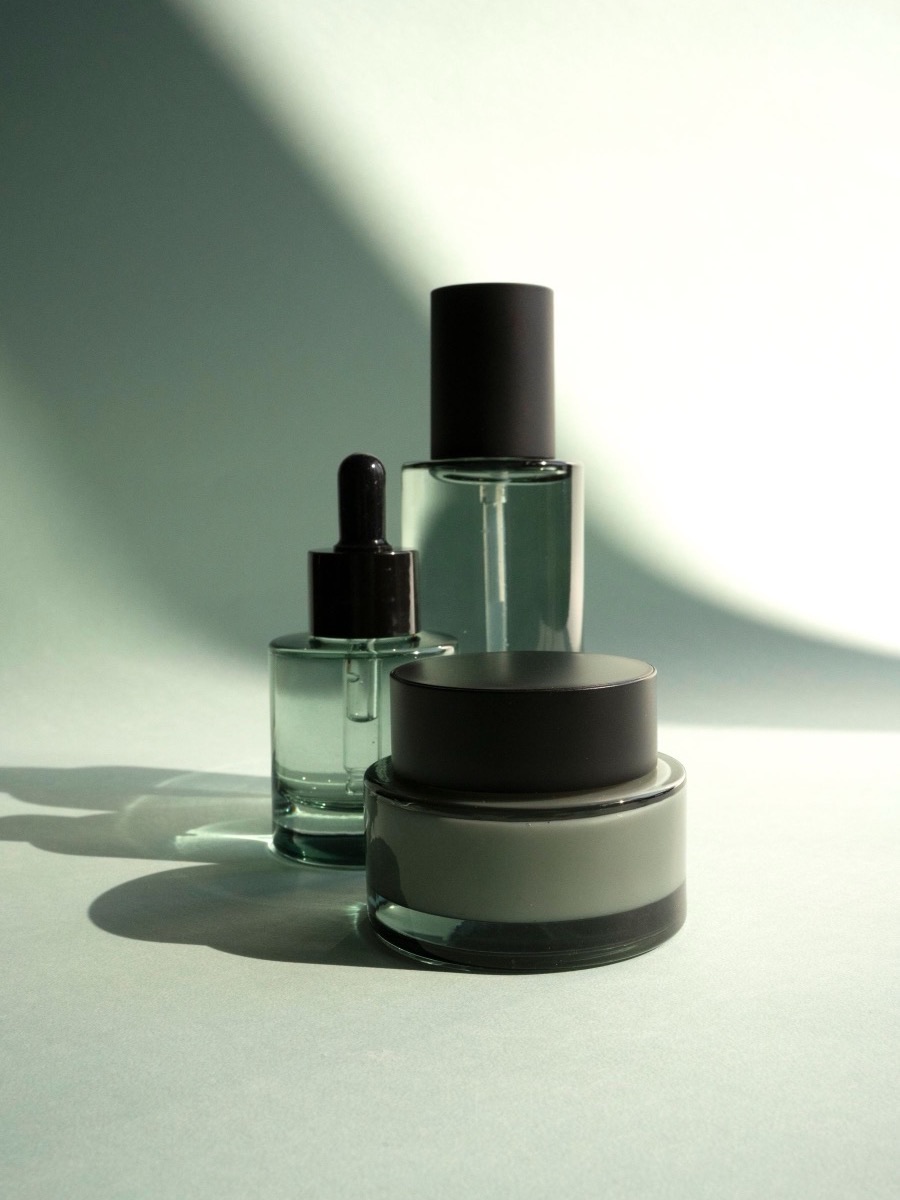
Dark glass or frosted bottles with a carton, or airless pumps; minimal air headspace when filling. The packaging's effect is confirmed by stability testing with assays and color measurement in the exact pack to be used.
Contact allergy is the main safety point
In Japan, patch testing of 220 women with suspected cosmetic dermatitis (10/1992–9/1993) found that 5 of the 8 who had used kojic acid products reacted to kojic acid and to their own 1% products; all 212 who had never used it were negative; facial dermatitis began 1–12 months after starting use; the authors judged kojic acid to have a high sensitizing potential (Nakagawa 1995 — figures from patients referred for patch testing, not a rate in the general population). The CIR panel concluded that the two endpoints of concern — skin sensitization and skin lightening (depigmentation) — would not be seen at concentrations below 1% (Burnett 2010).
Three formulation directions
One active, three ways to combine it
Single-active kojic acid serum
Kojic acid within the 1% limit dissolved in a moisturizing water–glycol base (Glycerin, Propanediol, Panthenol, Sodium Hyaluronate) with Disodium EDTA, a buffer and preservatives. For brands that want a short ingredient list and a story centered on one active.
Kojic acid – niacinamide serum
Adds niacinamide at the 2–5% range with human data on even tone, per the niacinamide article. There is no study on this exact kojic acid – niacinamide pair; the even-tone claim rests on each ingredient's data and on testing the finished product. Adds one more assay and calls for closer tolerance testing.
Gentle kojic acid serum-gel for first-time users
Kojic acid below the ceiling, more Panthenol and Allantoin, fragrance-free, in a lightly thickened Hydroxyethylcellulose base. Trades some intensity for tolerance; “suitable for sensitive skin” is stated only after tolerance testing on the finished product.
How it differs from our other pages
The tranexamic – arbutin serum uses two actives with a different legal status (tranexamic acid up to 3%, alpha-arbutin checked for hydroquinone); the hexylresorcinol serum uses an active that barely dissolves in water; the brightening serum is a multi-active page. This page is for a serum named after kojic acid, built around the 1% limit, content stability, color and the allergy risk of kojic acid itself.
Parameters we monitor
What the R&D lab measures on every sample
These are the parameters Butter-C tracks during formula development and scale-up. Specific limits are agreed with you on the approved sample and then written into the product's in-house specification.
- Raw material COA
- CAS 501-30-4, purity, appearance, manufacturing date; niacinamide (if used): free nicotinic acid.
- Kojic acid content
- HPLC assay at the start and at each stability point; the figure must stay within the 1% limit and match the label to the end of the shelf life.
- Appearance & color index
- Color, odor and clarity; the color index is measured regularly to catch any shift early.
- pH
- Measured directly at 25 °C; pH range per the TDS, set through stability testing with assays of the active.
- Stability
- Accelerated aging, freeze–thaw cycling, light exposure and a refrigerated control sample; remaining content and color compared — the basis for the shelf life and the storage conditions on the label.
- Microbiology & preservative challenge
- Tested at a GLP / ISO 17025-accredited laboratory; ISO 11930 preservative efficacy (challenge) test on the final formula.
- Irritation & on-skin assessment
- Tolerance testing on volunteers before the formula is locked; to state “skin looks more even-toned”, measure it on the finished product itself (colorimeter, standardized photos).
- Packaging compatibility
- Samples soaked with the dropper, gasket and bottle; color changes at the neck and in the materials monitored.
Claims
Claims matched to the evidence for kojic acid
Mechanism: on mushroom tyrosinase, kojic acid inhibits both monophenolase and diphenolase activity; in cultured B16F10 pigment cells it lowered melanin in a dose-dependent way without reducing cell viability at 43.8–700 µM (Wang 2022 — in vitro). On black guinea pig skin, 4% kojic acid caused depigmentation and 1% did not (Burnett 2010). All human efficacy trials were run in people with melasma — a dermatology-clinic setting: Garcia & Fulton 1996 compared half faces in 39 people, glycolic acid + kojic acid on one side and glycolic acid + hydroquinone on the other (the abstract gives no concentrations): 51% responded equally, 28% did better on the kojic side and 21% on the hydroquinone side, a difference that was not statistically significant, and the kojic side was more irritating. Lim 1999 (40 Chinese women, side chosen at random, 12 weeks) added 2% kojic acid to a gel of 10% glycolic acid + 2% hydroquinone: more than half of the melasma cleared in 24/40 people (60%) on the kojic side versus 19/40 (47.5%) on the side without it. Deo 2013 (80 people, randomized, single-blind, 4 groups, 12 weeks) compared a 1% kojic acid cream alone with combinations containing 2% hydroquinone and 0.1% betamethasone valerate; there was no vehicle group; efficacy ranked kojic + hydroquinone, the triple combination, kojic alone, then kojic + betamethasone. Monteiro 2013 (60 people, alternate allocation, not randomized, 12 weeks): a 4% hydroquinone cream responded earlier at week 4 and was rated better by the authors at week 12 than a 0.75% kojic acid + 2.5% vitamin C cream. Hydroquinone and corticosteroids are drugs (hydroquinone is banned in ASEAN cosmetics, Annex II Ref 1339), and 2% exceeds the 1% ASEAN limit — so these data cannot support cosmetic claims. Level of evidence for kojic acid alone at cosmetic levels: limited. Melasma and persistent darkening belong with a dermatologist.
Helps skin look more even-toned (to be tested on the finished product)
Basis: tyrosinase inhibition, the limited data above and measurements on the finished product itself; always paired with a sunscreen recommendation. Instead of: whitening, instant tone-up, erases melasma, fades freckles.
Contains kojic acid
State the INCI name; give a percentage when assayed and within the 1% limit (face products). Instead of: “2% kojic”, “replaces hydroquinone”, “works like hydroquinone”, results of formulas containing hydroquinone or a corticosteroid attributed to kojic acid.
Daytime sunscreen recommended
Included in the directions for use, as for every even-tone product. Instead of: prevents melasma from returning, anti-melasma, permanent results.
Warning: patch test on a small area before use
Kojic acid can cause contact allergy (Nakagawa 1995); test for a few days behind the ear or on the inner arm, and stop if redness, itching or a rash persists; people with past cosmetic contact dermatitis should take care; avoid layering several products that all contain kojic acid. Pregnant and breastfeeding women: data for topical use are insufficient, so ask a doctor. Instead of: allergy-free, gentle for every skin, safe for mothers-to-be.
Time to visible change
The studies followed people with melasma for 12 weeks on combination formulas; state days, weeks or percentages only with a trial on the finished product. Instead of: “even tone in 7 days”, “instant brightening”.
Manufacturing specifications
Capabilities
- Texture
- A clear water–glycol serum or a lightly thickened serum-gel.
- Packaging format
- Dark glass or frosted light-blocking bottles with a dropper, or airless pump bottles. Volume agreed when packaging is selected.
- Minimum order quantity
- Agreed per order — depends on the formula direction, pack format and raw-material lot.
- Testing
- Performed at a GLP / ISO 17025-accredited laboratory, including a kojic acid assay; a certificate of analysis comes with every batch.
- Documentation
- The Product Information File (PIF) and notification dossier are prepared by Butter-C, with the kojic acid COA and stability data.
- Packaging
- Label design, printing and packing run in parallel with formulation; the label carries the patch-test advice and daytime sunscreen recommendation.
Suggested product concept
Kojic acid – niacinamide serum in a 30 ml dark glass bottle
One product concept to help you picture the result; not a ready-made product for sale. The actual formula is built around your brand's positioning and price range.
Kojic acid within the 1% limit
Sourced per order with a COA for every lot; HPLC assay at the start and along the stability plan.
Niacinamide
At 2–5% per the niacinamide article; assayed per batch; free nicotinic acid checked on the COA.
Glycerin, Panthenol, Sodium Hyaluronate
A light hydrating base, fragrance-free and alcohol-free; Disodium EDTA binds metal ions — its color-holding effect is confirmed by stability testing.
30 ml dark glass bottle
Dropper and light-blocking carton; the label carries the sunscreen recommendation, the advice to patch test before use and storage conditions based on the stability results.
Customization options
What you can specify
The same product type can serve very different customers. Tell us your requirements in the areas below and our pharmacists will build the matching formula.
Concentration
Up to 1% for a face serum; a gentler version sits lower. Any level is confirmed by tolerance and stability testing on the finished product.
Combined actives
Niacinamide; alpha-arbutin (SCCS safe level of 2% for face creams, with free hydroquinone checked per lot). No hydroquinone or corticosteroids — banned substances or drugs.
Base type
A clear water–glycol serum or a lightly thickened serum-gel; a version with oil needs extra emulsion-stability testing.
Extending the line
A facial cleanser (rinse-off) also follows the 1% limit; body lotions and body creams left on the skin are limited to 0.2% — Butter-C calculates each product in the line separately.
Companion products
A sunscreen, moisturizer and cleanser in the same line to sell as a set, helping users follow the directions.
Ingredient preferences
Fragrance-free, alcohol-free — please state these at the outset so we can choose the right base and preservative system.
Further reading
Related topics
Kojic acid in cosmetics
Mechanism, the ASEAN 1% and 0.2% limits, contact allergy risk, evidence and stability (in Vietnamese).
Managing skin pigmentation
How melanin forms and where cosmetics act (in Vietnamese).
Using sunscreen correctly
The essential companion step for every even-tone product (in Vietnamese).
Tranexamic acid – arbutin serum OEM/ODM
Another direction: two water-soluble actives, with hydroquinone released from arbutin checked.
Hexylresorcinol serum OEM/ODM
Another direction: an active that barely dissolves in water and needs a solvent system and light-proof packaging.
Brightening serum OEM/ODM
Another direction: a multi-active serum with vitamin C and its derivatives.
How we work
From idea to finished batch
Eight steps and three milestones signed off by both sides: approved sample, notification number, finished batch. Step-by-step details (in Vietnamese) →
Get started
Tell us about the product you plan to launch
Send us your product direction and expected volume. Our team will get back to you during business hours (Vietnam time, GMT+7).
Head office: Huu Le village, Dai Thanh commune, Hanoi · Factory: Thanh Oai Industrial Cluster, Binh Minh commune, Hanoi, Vietnam
Hotline +84 967 176 511 · [email protected] · Privacy policy ← Full catalog