 BUTTER-C
Mango seed butter (Mangifera Indica Seed Butter) in cosmetics
Mango seed butter is often introduced as “softer than cocoa butter, melts instantly on the skin.” Published data show that its composition and melting point vary widely with the mango variety, while evidence on human skin is very scarce. This article separates what is backed by data from what is only promotional description, and answers a frequently asked question: can people with mango allergy use it?
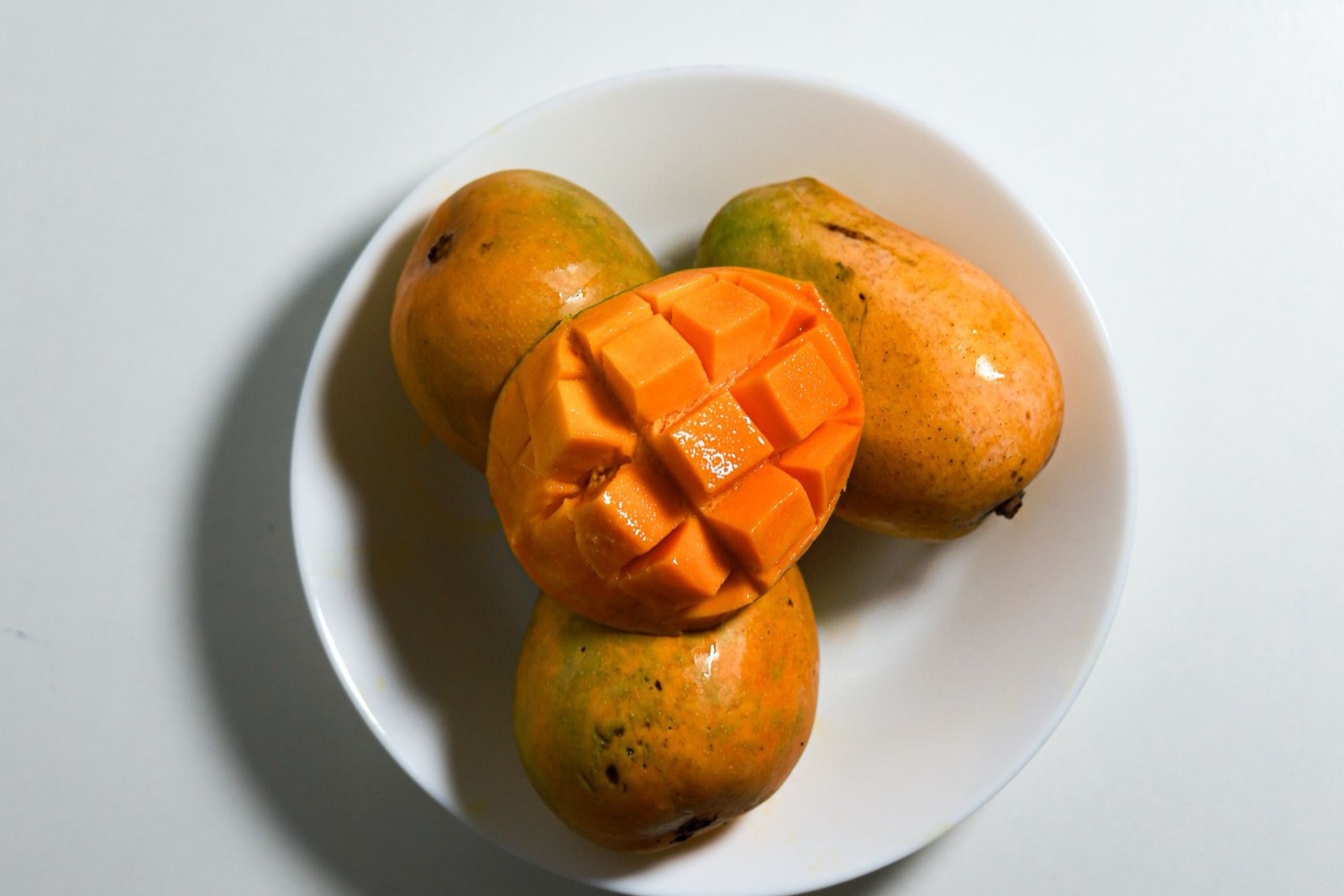
Mango seed butter (mango butter; INCI: Mangifera Indica Seed Butter) is a fat obtained from the kernel inside the seed of the mango fruit, Mangifera indica; it is solid at cool room temperature and melts gradually as it warms. Its main fatty acids are stearic and oleic acid. In cosmetics, mango seed butter mainly softens the skin, forms a layer that seals in moisture, and gives structure to body butters, lip balms and hand creams.
This article covers only the seed butter. Mango leaf extract and mangiferin are different ingredients, covered in the article on mango leaf in cosmetics (in Vietnamese); data on the leaf do not apply to the seed butter.
1. What is mango seed butter?
The mango fruit has a hard stone, inside which is the seed (Berghea et al., 2021); the fat is extracted from the seed kernel. The fat content of the kernel varies with the variety: 5.73–7.74% (on a dry-matter basis) in four Thai mango varieties (Sonwai and Ponprachanuvut, 2014), and 5.4–11.9% total lipids in seven varieties from Latin America and Thailand (Lieb et al., 2019).
On PubChem, one substance record for “mango butter” is linked to CAS 90063-86-8 (another record is linked to 167747-36-6); this CAS number is also assigned to mango extract, mango pulp extract and mango seed oil. CAS therefore does not help distinguish the plant part — when buying the raw material, check the INCI name and the description on the certificate of analysis (COA).
2. Composition: fatty acids and triglycerides
The fatty acid composition table in the draft report on vegetable oils by the US Cosmetic Ingredient Review (CIR) Expert Panel (meeting document, August 2010) gives the following for mango seed oil “as mango kernel fat”:
| Fatty acid | Proportion (%) |
|---|---|
| Stearic (C18:0, saturated) | 33–48 |
| Oleic (C18:1) | 35–50 |
| Palmitic (C16:0, saturated) | 5–8 |
| Linoleic (C18:2) | 4–8 |
| Arachidic (C20:0) | 1–7 |
As for triglycerides, the review by Jin et al. (2019) reports that mango kernel fat contains 28.9–65.0% SOS (1,3-distearoyl-2-oleoyl-glycerol: stearic acid at both outer positions, oleic acid in the middle). Lieb et al. (2019) also found that the Maha Chanook variety, rich in saturated fatty acids and saturated triglycerides, had a significantly higher melting point; the Falan variety, rich in polyunsaturated fatty acids, melted and crystallized at lower temperatures.
The CIR draft gives the unsaponifiable fraction as 0.8–2.9%.
3. Melting point and crystallization
The same CIR draft gives the following for mango oil/fat: pale yellow to ivory white, melting point 34–43 °C, iodine value 32–93, saponification value 190–195. This table does not list ingredients named “seed butter” separately.
Sonwai and Ponprachanuvut (2014) measured the kernel fats of four Thai mango varieties: solid fat content was high at 20 °C and below; the fat melted gradually as the temperature rose and became completely liquid at close to 35 °C. When crystallized at 20 °C, the samples formed a mixture of several crystal forms (pseudo-β′, β′, sub-β, β), with β′ predominating; the crystallization rate differed between varieties.
Implications for anhydrous products (inferred from food science data; we have not found studies in cosmetic bases): because mango seed butter has several crystal forms, like cocoa butter (in Vietnamese) it can recrystallize into small grains if the oil phase is not fully melted, if cooling does not follow the procedure, or if the product goes through heat–cold cycles during shipping. Melt the oil phase completely, fix the cooling regime and run temperature cycling tests during stability studies.
4. Compared with shea butter and cocoa butter
| Criterion | Mango seed butter | Cocoa butter | Shea butter |
|---|---|---|---|
| Source | Seed kernel of Mangifera indica (cashew family, Anacardiaceae) | Seeds of Theobroma cacao | Seed kernel of Vitellaria paradoxa |
| Fatty acids (CIR draft 2010) | Stearic 33–48%, oleic 35–50%, palmitic 5–8% | Palmitic 24–29%, stearic 34–36%, oleic 30–40% | Covered in a separate draft on tree nut oils in the same meeting document; mainly stearic and oleic (see the shea butter article) |
| Melting point (CIR draft 2010) | 34–43 °C | 33.5 °C | — |
| Notable points | SOS 28.9–65.0%; composition varies strongly with the variety | Crystal polymorphism, prone to “bloom” (see the cocoa butter article) | Unsaponifiable fraction rich in triterpene alcohols (see the shea butter article) |
We have not found studies directly comparing the skin feel or tolerability of the three butters; the choice of butter should be based on sensory testing, stability and price in the actual formula. For information specific to shea butter, see the article on shea butter (in Vietnamese).
5. Effects on the skin: limited evidence
Like other plant fats, mango seed butter leaves a lipid layer on the skin surface, which helps soften the skin and limit water loss; CIR describes the vegetable oil group as used for its skin-conditioning, occlusive, emollient and moisturizing properties.
We found only one human study using mango seed butter: Mandawgade and Patravale (2008) formulated an oil-in-water foot care cream containing 25% of a blend of mango seed butter and its liquid fraction (olein), plus 1% vitamin E acetate. Six volunteers with foot skin problems used the cream for 8 weeks, with no control group; the authors described the cracked foot skin as having “fully recovered” in all of them. The wound tests in rats belong to a medical research context. The results belong to the formula as a whole; the butter sample was donated by a commercial company.
Conclusion: limited evidence. Appropriate claims are at the level of “softens skin” and “moisturizes,” substantiated on the finished product.
6. Reported concentrations
The 2010 CIR draft records 175 uses of mango seed butter reported to the FDA’s voluntary registration program (134 leave-on products, 41 rinse-off products). The concentration table is internally inconsistent: the total row gives 0.0005–3%, but the leave-on row gives 0.01–5% and products that may be ingested (such as lipstick) 1–5%; rinse-off 0.0005–0.5% (survey by the US cosmetics industry association, 2010). These are reported concentrations, not recommended levels or limits. The final report published in 2017 may have updated the data; we have not been able to read the full text of the final report.
7. Safety and the mango allergy question
CIR conclusion: the 2017 final report concluded that the 244 vegetable oils in the group are safe as used in cosmetics; the CIR Quick Reference Table (December 2025) lists Mangifera Indica (Mango) Seed Butter as “S” (safe in the present practices of use and concentration).
Repeated patch testing in humans (unpublished data submitted to CIR, as cited in the 2010 draft): a body care product containing 9% mango seed butter, 102 subjects, semi-occluded patches — no sensitization; a facial lotion containing 1%, 100 subjects — no irritation, no sensitization. These are multi-ingredient finished products.
Mango allergy. Mango belongs to the same family as poison ivy, poison oak, cashew and pistachio. The review by Berghea et al. (2021) compiled 37 patients with contact dermatitis caused by mango; the cases occurred after contact with the fruit, the peel, the stalk, the sap or the tree, or after eating mango. The suspected sensitizers are alk(en)yl catechols and/or alk(en)yl resorcinols; a reaction can appear on the very first contact with mango in people previously sensitized to urushiol-containing plants. The authors concluded that contact dermatitis caused by mango is rare. Oka et al. (2004) patch tested two resorcinols extracted from mango (0.05% in petrolatum): both patients with mango allergy and 5 of 6 people with a history of lacquer dermatitis and a positive urushiol patch test reacted to the first compound (heptadecadienylresorcinol).
The review above describes no cases involving mango seed butter. Searching PubMed (November 27, 2026) for “mango butter,” “mango kernel fat” and “mango seed oil,” we found no reports of contact allergy. There are also no data on resorcinols or urushiol in the seed butter. Therefore “safe for people with mango allergy” should not be claimed, but there are also no data that attribute that risk to the seed butter. People who have had an allergy to mango, lacquer or poison ivy should try the product on a small area of skin or consult a dermatologist.
Comedogenicity: we have not found data (rabbit ear or human) for mango seed butter.
Pregnant and breastfeeding women: data are insufficient; consult a doctor.
8. Perspective for brand owners
| Substance | ASEAN annexes (II, III, VI version 2026-1; VII version 2025-2) |
|---|---|
| Mangifera Indica Seed Butter | Not listed in Annexes II, III, VI, VII — searched for “mango,” “Mangifera” and CAS 90063-86-8 |
- Quality: according to Jin et al. (2019), prolonged drying of mango kernels at high temperature hydrolyzes the triglycerides, producing large amounts of free fatty acids and diglycerides. Request a COA for each batch covering acid value, peroxide value, melting point and fatty acid composition.
- Oxidative stability: the same review gives an oxidative stability index of 58.8–85.2 hours at 110 °C (food data). The butter still contains unsaturated fatty acids — adding an antioxidant such as tocopherol and using airtight packaging is advisable (formulation practice).
- Claims: suitable: “softens skin,” “moisturizes,” “leaves lips soft and smooth.” Avoid: “rich in mangiferin,” “anti-aging” (data from the leaf or kernel extract, not the butter), “heals cracks” (medical language), “safe for people with mango allergy,” “non-comedogenic” without testing on the finished product.
Butter-C uses mango seed butter in contract manufacturing of body butter and some anhydrous products; the level is finalized through sensory and stability testing on each formula.
Frequently asked questions
Can people with mango allergy use cosmetics containing mango seed butter?
There are no data specific to the seed butter. Reported cases of mango allergy involved the fruit, the peel, the sap, the tree or eating mango. People who have had an allergy should try it on a small area of skin or consult a dermatologist.
How does mango seed butter differ from shea butter and cocoa butter?
All three are rich in saturated fatty acids and oleic acid; mango seed butter contains less palmitic acid than cocoa butter (5–8% versus 24–29%, CIR draft) and varies considerably with the variety.
Does mango seed butter contain mangiferin like mango leaf?
We have no data for cosmetic-grade seed butter. Data on mangiferin or leaf extract should not be used to advertise the seed butter.
Can pregnant women use it?
There are not enough human data; consult a doctor.
References
- Cosmetic Ingredient Review. Draft Report: Vegetable Oil, Related Plant-Derived Oils, and Other Derivatives as Used in Cosmetics (draft, CIR Expert Panel meeting document, August 30–31, 2010; Tables 3, 4, 5a, 7). https://www.cir-safety.org/sites/default/files/116_draft_oils.pdf
- Burnett CL et al. Safety Assessment of Plant-Derived Fatty Acid Oils. Int J Toxicol. 2017. PMID 29243540 · CIR. Quick Reference Table (December 2025)
- Jin J et al. Mango kernel fat fractions as potential healthy food ingredients: A review. Crit Rev Food Sci Nutr. 2019. PMID 29337601
- Sonwai S, Ponprachanuvut P. Studies of fatty acid composition, physicochemical and thermal properties, and crystallization behavior of mango kernel fats from various Thai varieties. J Oleo Sci. 2014. PMID 24919475
- Lieb VM et al. Fatty acids, triacylglycerols, and thermal behaviour of various mango (Mangifera indica L.) kernel fats. Food Res Int. 2019. PMID 30716977
- Mandawgade SD, Patravale VB. Formulation and evaluation of exotic fat based cosmeceuticals for skin repair. Indian J Pharm Sci. 2008. PMID 20046792
- Berghea EC et al. Contact Allergy Induced by Mango (Mangifera indica): A Relevant Topic? Medicina (Kaunas). 2021. PMID 34833457
- Oka K et al. A study of cross-reactions between mango contact allergens and urushiol. Contact Dermatitis. 2004. PMID 15606656