 BUTTER-C
Double cleansing: when you need it and how to do it
Two cleansing steps every evening have become a habit for many people. But when is double cleansing really necessary, and how well supported are promises such as “deep cleansing” and “reducing acne”?
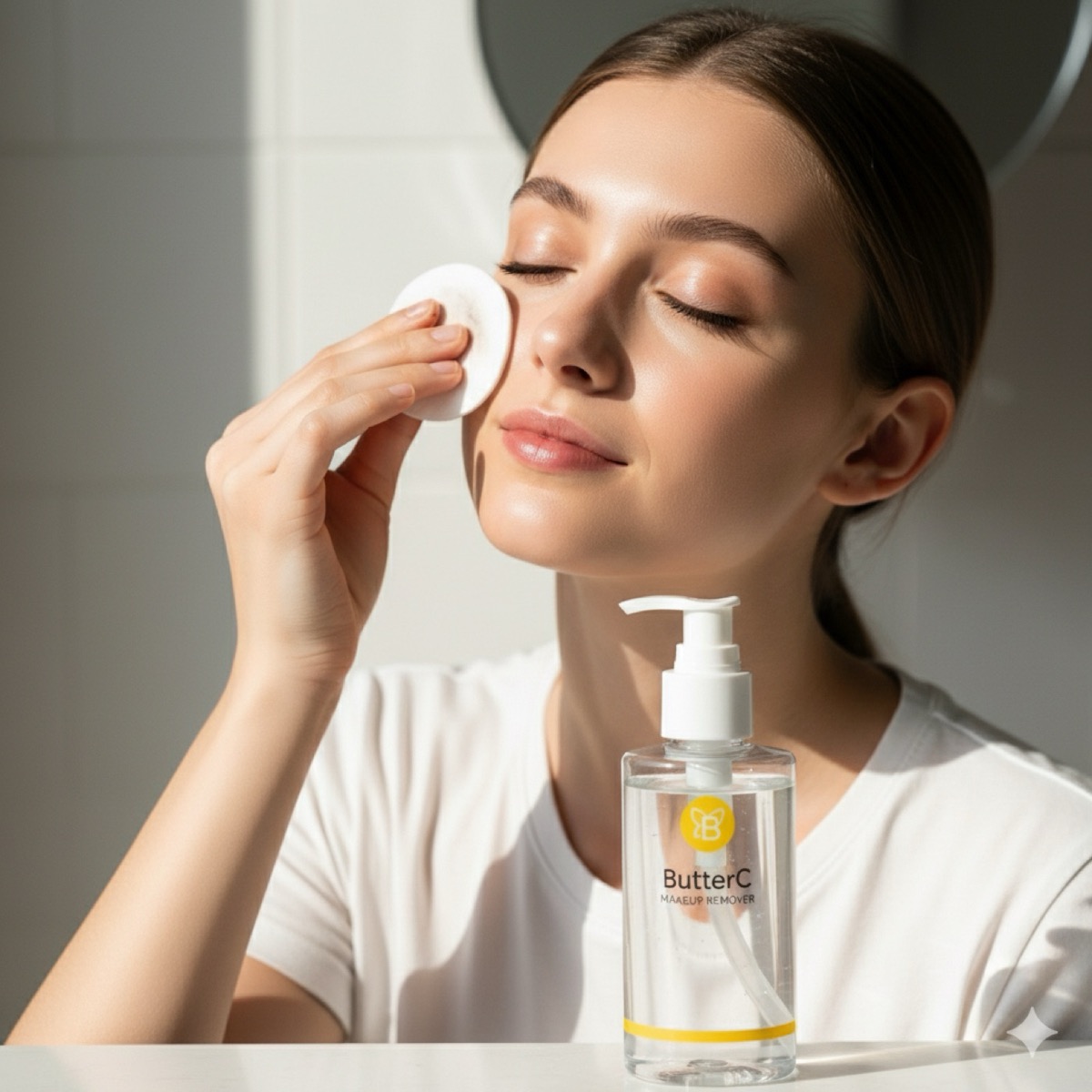
Double cleansing is a two-step way of washing the face: step one uses an oil-based makeup remover — an oil, a balm or a bi-phase makeup remover — to dissolve makeup and sunscreen; step two uses a cleanser to clean away what remains. This article reviews the measured data: what double cleansing helps with, when it is not needed, how to avoid harming the skin barrier, and which claims have no source yet.
1. Two steps, two mechanisms
Makeup and sunscreen, especially water-resistant types, contain many hydrophobic ingredients such as oils, waxes, silicones and film-forming polymers. A cleansing oil dissolves these ingredients when applied to dry skin; the emulsifiers in the formula turn the mixture into a milky white emulsion on contact with water so that it can be rinsed away. A cleanser uses surfactants to carry away sweat, sebum, dust and any remaining oil.
| Step | Commonly used products | Job |
|---|---|---|
| Step 1 — oil-based | Cleansing oil, cleansing balm, bi-phase makeup remover (shake before use) | Dissolves makeup and water-resistant sunscreen |
| Step 2 — water-based | Gel, cream or foam cleanser | Cleans away sweat, sebum and what remains from step 1 |
2. Data on sunscreen: when one step is enough
The most direct study we found is that of Chen et al. (2020). The authors took standardized photographs of the faces of 20 people before sunscreen application (used as the negative control), after application, and after washing with water, a foaming cleanser or a cleansing oil, then used image analysis software to calculate the proportion of sunscreen remaining.
| Cleansing method | Regular sunscreen | Water-resistant sunscreen |
|---|---|---|
| Water only | 54.0% | 59.3% |
| Foaming cleanser | 15.6% | 36.8% |
| Cleansing oil | 13.4% | 5.8% |
| Negative control (photo before application) | 9.9% | 3.2% |
Mean proportion remaining by image analysis; data from Chen et al. (2020).
With regular sunscreen, neither the cleanser nor the cleansing oil differed significantly from the negative control — meaning that, under the study conditions, a single cleanser step was enough. With water-resistant sunscreen, only the cleansing oil reached a level not different from the negative control; after the cleanser, more than one-third still remained. Eight people in the cleanser group and one person in the cleansing oil group reported dry skin after washing. The study was small, only one product of each type was tested and micellar water was not tested, so this is an indication of direction rather than a general figure.
The takeaway: double cleansing makes sense when you wear water-resistant sunscreen or heavy makeup and, by the same principle, long-wear makeup products; with regular sunscreen and no makeup, a single step with a gentle cleanser may be enough.
3. Rubbing, not the number of steps, is what to watch
Hosokawa et al. (2021; most of the authors affiliated with a cosmetics company) had 35 women replace their usual makeup remover with a cleansing oil that cleansed better but required less rubbing; the participants were people with atopic dermatitis who had mild symptoms on the face. After 4 weeks, dryness, scaling, irritation, redness and itching decreased significantly; moisture retention increased and transepidermal water loss (TEWL) decreased; the improvement was greater in people who had previously used a product with poor cleansing ability. The authors suggested that many people rub hard precisely because their makeup remover works poorly. The abstract does not describe a control group, so this is a suggestion rather than a conclusion.
The implication: the step-one product should dissolve makeup quickly so that you do not have to rub; two gentle steps are better than one step with hard rubbing. Why friction weakens the outermost layer of the skin: see the article the skin barrier.
Cool water or warm water
In a 10-day randomized controlled study in 52 healthy people who washed their faces with a cleansing balm, makeup removal efficacy did not differ between cool and warm water. Repeated washing with warm water significantly increased TEWL, by about 3.4 g/m²/h on day 10, whereas cool water caused no significant change (Long et al., 2026 — one product; some co-authors affiliated with the manufacturer). Preferring cool or lukewarm water and avoiding hot water is easy advice to follow.
4. More cleansing agents do not necessarily mean cleaner skin
Emulsifiers in cleansing oils and surfactants in cleansers can remain on the skin if not rinsed off thoroughly. The double-blind, randomized study by Lodén et al. (2004) of eight bath oils and shower oils found very large differences in irritation: some products were no more irritating than water, while others caused considerable damage; the study also found that, after rinsing with water, residues remained on the skin that impaired the barrier. These were bath products rather than facial makeup removers, but the principle is similar: double cleansing means the skin is exposed to cleansing agents twice, so a gentle formula that emulsifies quickly and rinses off thoroughly matters more than a “squeaky clean” feeling.
5. Who should, and who does not necessarily need to
| Situation | Suggestion | Basis |
|---|---|---|
| Heavy makeup, water-resistant sunscreen | Double cleanse in the evening | Chen et al., 2020 |
| Regular sunscreen only, no makeup | A single step with a gentle cleanser may be enough | Chen et al., 2020 |
| Acne-prone skin | Do not add a step when there is no water-resistant layer; if wearing makeup, always remove it before bed | Suh et al., 2021; AAD |
| Dry or sensitive skin, atopic dermatitis | Prefer products that remove makeup quickly with little rubbing; drop steps when they are not needed | Hosokawa et al., 2021 |
| Contact lens wearers | Remove lenses before removing makeup | In the laboratory, a cleansing oil was absorbed by four of the seven silicone hydrogel lens brands tested under both wet and dry conditions, plus one more brand only under dry conditions; conventional hydrogel lenses did not absorb it (Tsukiyama et al., 2017) |
For acne-prone skin, a questionnaire survey of 539 people with acne in Korea found that, in the group who had followed a treatment regimen without achieving results, 38.1% believed cosmetics made their acne worse, significantly higher than 26.3% in the group who had not followed a treatment regimen; double cleansing and the number of cosmetics in use were also more common in the group without results (Suh et al., 2021). This is a correlation and does not prove that double cleansing causes acne, but it is enough not to recommend “the more steps, the better”. On the other hand, the American Academy of Dermatology (AAD) notes that even non-comedogenic makeup can cause acne if left on overnight. Overall care: see the article caring for acne-prone skin.
6. Doing it correctly: a checklist
- Dry hands, dry face: take a cleansing oil or balm and massage gently so that the makeup dissolves; no force is needed.
- Add a little water and keep massaging until the mixture turns milky white, then rinse it off thoroughly.
- Gentle cleanser: apply it with your fingertips in circular motions, without a washcloth, sponge or scrubbing tool (AAD).
- Rinse with cool or lukewarm water, avoiding hot water (Long et al., 2026); pat dry with a clean towel (AAD).
- Moisturize right afterward; for the role of each skin care product, see the article toner, essence, serum and moisturizer.
- In the morning there is not yet any makeup or sunscreen on the skin, so a gentle cleanser is usually all you need.
- Eye area: remove contact lenses first, close your eyes while applying, and avoid getting product in your eyes.
7. Claims worth a second look
| Common claim | Data we have read | Appropriately measured wording |
|---|---|---|
| “Washes away every trace of makeup” | Results depend on the type of makeup and the type of product; with water-resistant sunscreen, a single cleanser step leaves more than one-third behind (Chen et al., 2020) | “Helps remove makeup and sunscreen” |
| “Double cleansing helps reduce acne” | We have not seen a study demonstrating this; a review of face washing and cleansers in acne could include only 14 studies (671 participants), too few good-quality studies to make reliable recommendations (Stringer et al., 2018) | “Suitable for people who wear makeup or water-resistant sunscreen” |
| “Deeply cleansed skin absorbs nutrients better” | We found no study comparing the penetration of skin care products after double cleansing with that after single-step cleansing | Do not use this claim |
| “Removes bacteria from the skin” | We have not seen a study showing that double cleansing with cosmetic products reduces bacteria on the skin; the aim of cleansing is to remove dirt, sebum and makeup, while the skin naturally has a resident microbiota — see the article the skin microbiota | “Cleanses away dirt, sebum and makeup” |
8. A formulation perspective
When developing a cleansing oil or a cleansing balm, the Butter-C formulation team selects the oil phase and the emulsifiers together so that the product emulsifies quickly, rinses off cleanly and needs little rubbing; for the cleanser used in step two, the goal is gentle cleansing, not a “squeaky clean” feel. The claim “removes water-resistant sunscreen” should be made only after testing with that exact type of product.
Frequently asked questions
Can micellar water replace the oil step?
For light makeup, many people use micellar water as step one. The study by Chen et al. (2020) did not test micellar water, so there are no direct comparative data yet; in principle, water-resistant layers dissolve more easily in products with an oil phase, such as oils, balms or bi-phase makeup removers.
Should people with oily skin use a cleansing oil?
They can. Cleansing oils are designed to emulsify and rinse off; in the study by Chen et al. (2020), fewer people reported dry skin after the cleansing oil than after the cleanser. People with acne-prone skin should choose a product labeled non-comedogenic (AAD) and rinse it off very thoroughly.
Do you need to double cleanse every night?
It is not required. Double cleansing suits evenings when you have worn makeup or water-resistant sunscreen; on other days, a single step with a gentle cleanser may be enough.
References
- Chen W et al. The optimal cleansing method for the removal of sunscreen:Water, cleanser or cleansing oil? J Cosmet Dermatol. 2020. PMID 31157512.
- Hosokawa K et al. Rubbing the skin when removing makeup cosmetics is a major factor that worsens skin conditions in atopic dermatitis patients. J Cosmet Dermatol. 2021. PMID 33040474.
- Long S et al. Cool versus warm water for facial cleansing: A randomized controlled clinical study of skin barrier, skin physiology, cleansing efficacy and water consumption. Int J Cosmet Sci. 2026. PMID 42722630.
- Lodén M et al. Irritation potential of bath and shower oils before and after use: a double-blind randomized study. Br J Dermatol. 2004. PMID 15214901.
- Suh DH et al. Relationship between acne and the use of cosmetics: Results of a questionnaire study in 539 Korean individuals. J Cosmet Dermatol. 2021. PMID 33206430.
- Stringer T et al. Clinical evidence for washing and cleansers in acne vulgaris: a systematic review. J Dermatolog Treat. 2018. PMID 29460655.
- Tsukiyama J et al. Cosmetic Cleansing Oil Absorption by Soft Contact Lenses in Dry and Wet Conditions. Eye Contact Lens. 2017. PMID 27196996.
- American Academy of Dermatology. 10 skin care habits that can worsen acne. https://www.aad.org/public/diseases/acne/skin-care/habits-stop