 BUTTER-C
Toner, essence, serum and moisturizer: how they differ
Four bottles, four names and many promises: balancing pH, tightening pores, reaching deep into the dermis. This article separates what is backed by data from what belongs to advertising, so that you can choose the products your skin really needs.
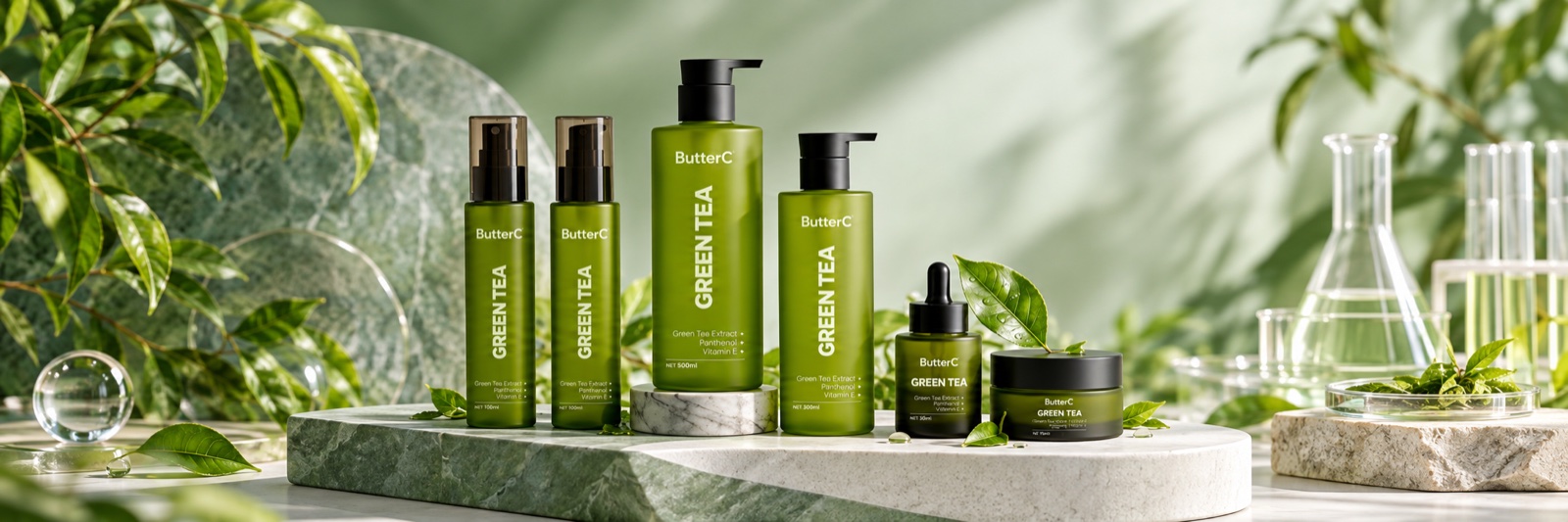
Toner, essence, serum and moisturizer are four steps commonly found in facial skin care routines, and they are also often confused. These names are mainly market categories based on texture and purpose: products that share the name “toner” may only hydrate, or may contain exfoliating acids. This article compares the four product groups, checks common claims against published data, and suggests how to simplify your routine.
1. The overall picture
| Product | Typical texture | Main role | Notes |
|---|---|---|---|
| Toner | Watery liquid | Adds humectants after cleansing; some types contain a mild exfoliating acid | An add-on step, not a substitute for moisturizer |
| Essence | Liquid, slightly thicker than toner | Usually rich in humectants such as glycerin and hyaluronic acid | Differs from toner mainly in viscosity and humectant content |
| Serum | Liquid or light gel | Delivers actives for one goal: hydration, helping even out skin tone, reducing the look of oiliness… | Acts on the surface and the stratum corneum |
| Moisturizer | Cream, lotion, gel-cream | Combines humectants, emollients and occlusives to reduce water loss | The step to keep if you choose only one |
The table describes how the terms are commonly used, not legal definitions.
2. Toner: an add-on step, not a required one
Yuanxi et al. (2016) directly compared a cream, a toner and spray water, measuring skin hydration for up to 8 hours. All skin areas that received a product were more hydrated than areas that received none. For normal skin, applying the cream and then reapplying the toner every 2 hours gave the largest increase in hydration. For dry skin, the cream alone gave results no different from the combinations. Reapplied toner hydrated better than reapplied spray water, while toner alone ranked last among the approaches compared. Toner therefore helps hydration when used together with a moisturizer, but it cannot replace a moisturizer.
“Balancing pH”: the skin does this itself
In a multicenter study of 330 people, Lambers et al. (2006) estimated the average “natural” skin surface pH at about 4.7; cleansing products, especially soap, clearly affect skin surface pH, and even tap water (usually around pH 8 in Europe) raises skin pH for up to 6 hours before it returns to its natural level. We found no study measuring skin pH that showed applying toner after cleansing brings pH back faster. “Balancing skin pH” is therefore an unsupported claim; what can be stated on a label is the measured pH of the product itself. A better use of effort is choosing a gentle cleansing step — see the article double cleansing.
“Tightening pores”
As explained in the article oily skin and pores, pore size is influenced by the amount of oil, the elasticity of the tissue around the pore, hair follicle volume, age, sex and hormones; cosmetics can help pores look smaller but do not change the structure of the hair follicle. Astringent toners containing alcohol also have a downside: the American Academy of Dermatology (AAD) advises people with acne-prone skin to avoid astringents and drying alcohol, because dry skin is irritated skin.
Exfoliating toners are active products
Toners containing AHAs (glycolic, lactic acid) or BHA (salicylic acid) are active products. Under ASEAN Annex III (Ref A6), for general-use skin products, glycolic and lactic acid combined may not exceed 10% calculated as acid, the finished product pH must be 3.5 or above, and at 2.5% or above without a sunscreen agent the label must warn of increased sun sensitivity; salicylic acid in toners and serums is limited to 2.0% (Ref 98). Start with a low frequency, do not layer another acid serum in the same session, and use sun protection every morning.
3. Essence: a thicker “hydrating water”
Essence sits between toner and serum: it is mostly a water-based solution rich in humectants such as glycerin, hyaluronic acid and panthenol, lightly thickened, sometimes with added ferments or plant extracts. Its difference from toner lies in viscosity and humectant content, not in a distinct mechanism.
The claim “restores skin after damage” deserves a second look. At the cosmetic level, “restore” should be understood only as helping the stratum corneum hold water and supporting the skin barrier; real skin damage — wounds, burns, skin after procedures — belongs to medical care. Even within cosmetics, “hydration” and “barrier support” are two different things: in a randomized, double-blind, crossover study on the forearms of 51 people with dry skin, followed for 12 hours after application, the glycerol component of a moisturizer increased stratum corneum hydration, whereas it was the petrolatum component that reduced transepidermal water loss (Vaillant et al., 2020 — one author was affiliated with a dermocosmetics company). An essence containing only humectants may help the skin become more hydrated, but that is not enough to say it supports the skin barrier.
4. Serum: concentrated actives, but still in the outer layer of the skin
A serum is usually a solution or a light gel carrying one or a few actives for one goal: hyaluronic acid for hydration, vitamin C or niacinamide to help even out skin tone, salicylic acid for acne-prone skin. Two common claims need correcting.
“The higher the concentration, the more effective”
Concentrations of actives in cosmetics are limited by regulations (section 2) and by the skin's tolerance. Some actives produce results at low concentrations: in 76 women applying products to the eye area, creams containing 0.1% hyaluronic acid at five molecular weights from 50 to 2,000 kDa all significantly improved skin hydration and elasticity compared with the base cream applied around the other eye after 60 days (Pavicic et al., 2011). See also the article hyaluronic acid in cosmetics (in Vietnamese).
“Works in the dermis”: at odds with the nature of cosmetics
The skin consists of the epidermis on the outside, whose outermost part is the stratum corneum, and the dermis below. Human data on where cosmetic actives remain are usually data from the stratum corneum. Grégoire et al. (2023), authors affiliated with a cosmetics company, sampled the stratum corneum by tape stripping in volunteers: after 7 days of applying a formula containing hyaluronic acid, the amount of hyaluronic acid in the stratum corneum was at least 31 times higher than before application; this method can quantify hyaluronic acid only in the stratum corneum and cannot measure it in the viable epidermis or the dermis. These are data on where the molecule is located, not yet on its effects.
The statement “the serum works in the dermis, with visible results in a short time” is therefore both unsupported and the language of drugs and procedures. Decree 342/2025/NĐ-CP (Nghị định 342/2025/NĐ-CP, Vietnam’s decree detailing the Law on Advertising), Article 4, Clause 2, provides that cosmetic advertising must not mislead people into thinking the product is a drug and must be consistent with the uses stated in the product notification. Appropriately measured wording is “hydrates”, “helps skin feel soft and smooth”, “helps even out skin tone”.
5. Moisturizer: reduces water loss, does not “lock in all the nutrients”
A moisturizer usually combines three groups: humectants (glycerin, urea…) hold water in the stratum corneum; emollients smooth the surface; occlusives (petrolatum, mineral oil) form a hydrophobic layer that reduces water evaporation. Humectants and occlusives contribute in two different ways (Vaillant et al., 2020), so a moisturizer needs to combine them. These three groups are covered in detail in the article dry skin and dehydrated skin.
The promise of “locking in all the nutrients from the previous steps” does not match the literature. The review by Lodén (2003) describes how, after application, ingredients may remain on the surface, be absorbed into the skin, be metabolized, or be lost through evaporation, shedding with corneocytes or transfer to other objects. Moisturizers also differ greatly from one another: some formulas improve the skin barrier, while others make it worse — for example, emulsifiers can weaken the barrier, whereas petrolatum helps restore the barrier directly on a stratum corneum that has lost its lipids. The proper role of a moisturizer is to reduce water loss and support the skin barrier; each formula needs to be evaluated on its own.
Oily skin still needs a moisturizer; only the texture differs: a light gel or gel-cream labeled “non-comedogenic” (AAD).
6. Order of use and how to simplify your routine
The familiar order goes from thin to thick: cleanser → toner → essence → serum → moisturizer, with sunscreen added as the last step in the morning. This is a practical convention, not a proven rule; in the study by Yuanxi et al. (2016), reversing the order of cream and toner hardly changed skin hydration. What matters more is choosing the products your skin actually needs and using them consistently.
| Need | Suggested minimal routine | Notes |
|---|---|---|
| Normal skin | Cleanser → moisturizer → sunscreen (morning) | Toner and essence are optional |
| Dry skin | Gentle cleanser → hydrating serum (optional) → lipid-rich moisturizer → sunscreen | A cream alone was already effective for dry skin (Yuanxi et al., 2016) |
| Oily, acne-prone skin | Gentle cleanser → one active product → light gel moisturizer → sunscreen | Avoid astringents and drying alcohol (AAD); see the article caring for acne-prone skin |
| Using AHAs, BHAs, retinol | One active product per session → moisturizer → sunscreen | AHA products at 2.5% or above that contain no sunscreen agent must carry a sun sensitivity warning |
Checklist when building a routine
- Add one product at a time, test it first on a small area of skin, and use it for a few weeks before adding another product.
- More layers do not mean more benefits: each extra layer adds more ingredients in contact with the skin.
- Do not layer several acid or retinol products in one session — see the article how skin feels when using actives (in Vietnamese).
- Be cautious with products promising to “balance skin pH”, “tighten pores” or “penetrate to the dermis”.
7. A formulation perspective
When developing a toner, a hydrating serum or a moisturizer, the Butter-C formulation team starts from the product’s place in the routine: toners and essences focus on humectants and skin feel; serums choose one clear goal, with concentrations within the limits of the ASEAN Annexes; moisturizers balance humectants, emollients and occlusives. Claims stop at “hydrates”, “helps skin feel soft and smooth”, “supports the skin barrier”.
Frequently asked questions
Do you have to use all four steps?
No. For dry skin, using only a moisturizer gave hydration no different from the combinations with toner (Yuanxi et al., 2016). Choose the remaining steps according to your skin’s needs.
Can toner replace a moisturizer?
It is not advisable. In the same study, toner alone gave the smallest increase in hydration among the approaches compared.
Is a more concentrated hyaluronic acid serum better?
Not necessarily. A cream containing 0.1% hyaluronic acid already improved skin hydration (Pavicic et al., 2011). A hydrating serum should be used together with a moisturizer.
References
- Yuanxi L et al. Comparison of skin hydration in combination and single use of common moisturizers (cream, toner, and spray water). J Cosmet Sci. 2016. PMID 29394018.
- Lambers H et al. Natural skin surface pH is on average below 5, which is beneficial for its resident flora. Int J Cosmet Sci. 2006. PMID 18489300.
- Pavicic T et al. Efficacy of cream-based novel formulations of hyaluronic acid of different molecular weights in anti-wrinkle treatment. J Drugs Dermatol. 2011. PMID 22052267.
- Grégoire S et al. Hyaluronic acid skin penetration evaluated by tape stripping using ELISA kit assay. J Pharm Biomed Anal. 2023. PMID 36549259.
- Vaillant L et al. Combined effects of glycerol and petrolatum in an emollient cream: A randomized, double-blind, crossover study in healthy volunteers with dry skin. J Cosmet Dermatol. 2020. PMID 31532576.
- Lodén M. Role of topical emollients and moisturizers in the treatment of dry skin barrier disorders. Am J Clin Dermatol. 2003. PMID 14572299.
- American Academy of Dermatology. 10 skin care habits that can worsen acne. https://www.aad.org/public/diseases/acne/skin-care/habits-stop
- Chính phủ. Nghị định 342/2025/NĐ-CP quy định chi tiết một số điều của Luật Quảng cáo, Điều 4. 2025. [Government of Vietnam. Decree 342/2025/ND-CP detailing a number of articles of the Law on Advertising, Article 4. 2025.]