 BUTTER-C
Managing pigmentation: melasma, freckles, brown spots, acne marks
Melasma, freckles and brown spots are all areas of darker skin, but their causes, course and care differ. Naming them correctly is the first step to choosing the right product, and to knowing when cosmetics are not the answer.
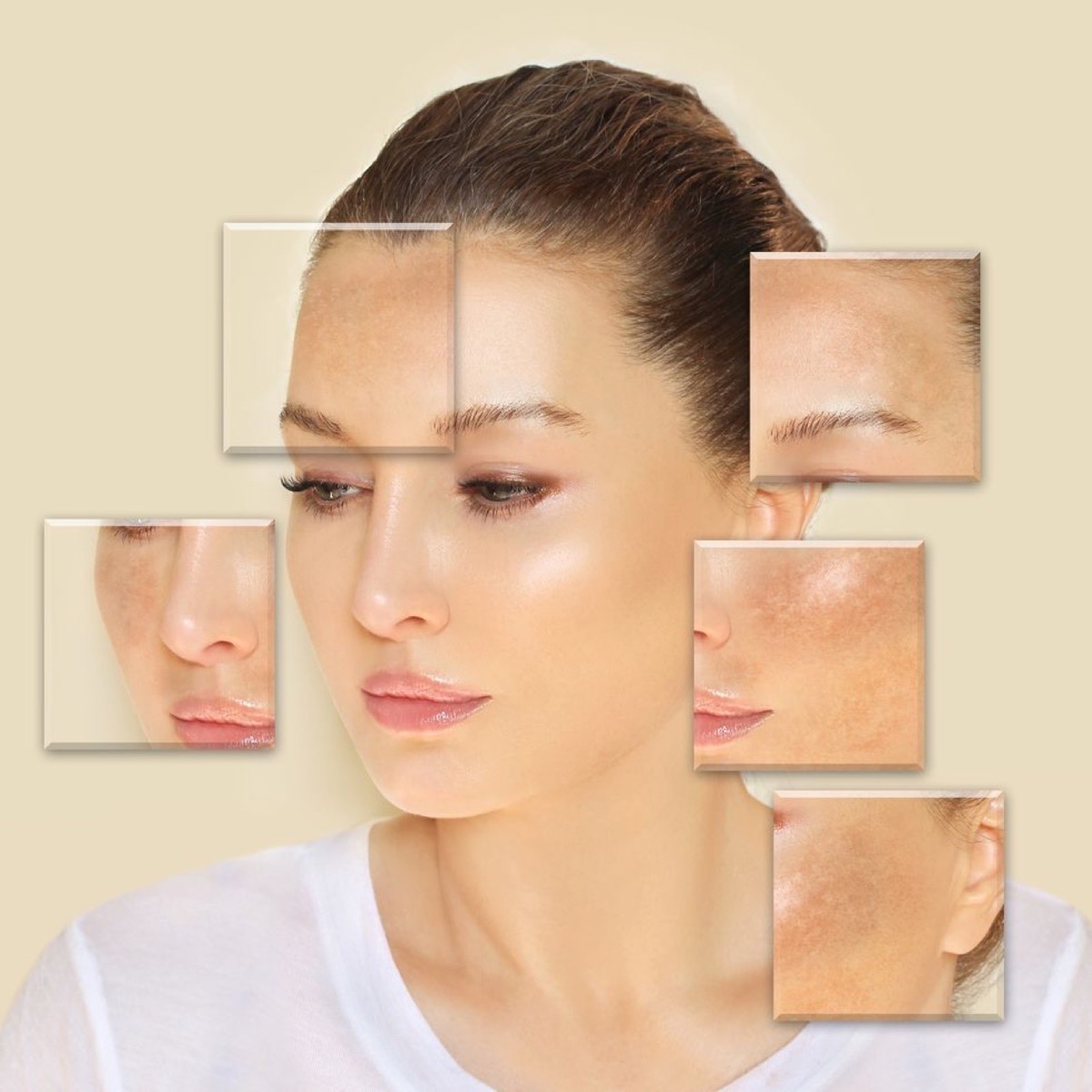
Skin color depends mainly on melanin, a pigment made by pigment cells (melanocytes) and then transferred to the surrounding keratinocytes. When more melanin is produced or it is distributed unevenly, darker areas appear on the skin. Melasma, freckles, sun-induced brown spots and post-acne marks all belong to this group, but their causes, course and care differ. Diagnosis and medication belong to doctors; cosmetics play only a supporting role.
1. Four common types of hyperpigmentation
| Type | Features | Associated factors | Course |
|---|---|---|---|
| Melasma | Light brown to dark brown patches with irregular borders, usually symmetrical on both sides of the face | Sunlight (UV and visible light), hormones, family history | Long lasting, recurs easily |
| Freckles (ephelides) | Small brown spots, linked to sunlight | Largely determined by genes but triggered by sunlight | Fade or become much lighter in winter |
| Sun-induced brown spots (solar lentigo) | Flat spots with well-defined borders and uniform color on exposed skin | Long-term UV exposure (Praetorius et al., 2014); common in middle-aged and older people | Persist year-round, may become darker in summer |
| Postinflammatory hyperpigmentation (PIH) | Brown marks at sites of previous inflammation, such as after acne | Inflammatory reaction, squeezing spots, UV rays | Usually fade gradually once the inflammation has resolved, sometimes over many months |
According to DermNet, sun-induced brown spots are also common in Asian people, often on the face; they are benign lesions and do not require intervention unless for cosmetic reasons. For post-acne marks, see our article post-acne marks: PIE and PIH.
2. Melasma: why it is difficult and recurs easily
According to DermNet, melasma is an acquired pigmentary disorder that is more common in women than in men, typically begins between the ages of 20 and 40, and is common in people who tan easily or have brown skin (phototypes III and IV). Besides sunlight and family history, associated factors include pregnancy, contraceptive pills containing estrogen/progesterone, thyroid disease, certain medicines, and scented soaps and cosmetics, which can cause a reaction to light.
By the location of the pigment, melasma is divided into the epidermal type (well-defined borders, dark brown, usually responds well), the dermal type (blurred borders, light brown to blue-gray, usually responds poorly) and the mixed type, which is the most common. Doctors distinguish these types using a Wood lamp and dermoscopy (DermNet).
Melasma responds slowly, especially when it has been present for a long time, and can return with summer sun exposure even after good improvement; DermNet emphasizes year-round sun protection and setting realistic goals.
3. Sun protection: the foundation for every type
For melasma care, the American Academy of Dermatology (AAD) recommends:
- Sun protection every day, including on cloudy days and after swimming or sweating; seeking shade, wearing a wide-brimmed hat and UV-protective sunglasses.
- A broad-spectrum, water-resistant sunscreen with SPF 30 or higher; apply it 15 minutes before going outdoors and reapply at least every two hours.
- Visible light also worsens melasma, especially in people with darker skin: use a tinted sunscreen containing iron oxides.
- Do not use tanning beds or sunlamps.
- Choose gentle, fragrance-free products; avoid rubbing, over-exfoliating and products that sting or burn, because irritation can make the spots darker.
See also our article on UVA, UVB and visible light and our contract-manufactured sunscreen.
4. Cosmetic actives that help even skin tone
Cosmetics should only claim "helps even skin tone" or "helps brown spots look less visible", not an effect on melasma as a disease. The actives below are permitted in ASEAN cosmetics under the conditions stated.
| Active | Data | Limits, notes |
|---|---|---|
| Niacinamide (in Vietnamese) | See the dedicated article | Not listed in the ASEAN restriction annexes |
| Vitamin C (in Vietnamese) | DermNet lists ascorbic acid among the topical agents used for melasma, usually in combination | Stability depends on the form and the formula |
| Tranexamic acid (in Vietnamese) | DermNet lists it among the topical agents used for melasma, usually in combination; the oral form is a prescription medicine (AAD) | Skin products, maximum 3.0%; not to be used in products that come into contact with mucous membranes (Annex III, Ref A10) |
| Kojic acid (in Vietnamese) | DermNet lists it among the topical agents used for melasma, usually in combination | Leave-on products for the face (neck) and hands, and rinse-off products, maximum 1.0%; body leave-on products, maximum 0.2% (Annex III, Ref 346) |
| Alpha-arbutin (in Vietnamese) | See the dedicated article | Not in the ASEAN annexes (June 2026 version). Do not confuse it with deoxyarbutin, a prohibited substance (Annex II, Ref 1657) |
| Glycolic, lactic acid (AHA) | Surface exfoliation; at peel concentrations, it is a procedure performed by a doctor | General use: total maximum 10% calculated as the acids, finished product pH 3.5 or higher; at 2.5% or more and without a sunscreen, the label must carry a warning about increased sensitivity to the sun (Annex III, Ref A6); irritation can make the spots darker |
Principles: add one active at a time, increase the frequency gradually, stop if redness and stinging persist, and always combine with sun protection. For melasma, according to the AAD, even when following a doctor's prescribed regimen correctly, it usually takes 3–12 months to see results.
Not cosmetics
Hydroquinone, tretinoin and topical corticosteroids are medicines, to be used only when prescribed by a doctor. In ASEAN, hydroquinone (except for artificial nail systems, Annex III) and tretinoin are prohibited in cosmetics (Annex II, Ref 1339 and Ref 375); azelaic acid is also listed in Annex II (Ref A1141). According to the AAD, medicines a doctor may prescribe for melasma include hydroquinone, tretinoin combined with a mild corticosteroid, and triple-combination cream; procedures such as chemical peels and lasers should be performed only by a dermatologist. These are decisions for a dermatologist.
5. What to avoid
- "Mixed" products of unknown origin. WHO warns that mercury-containing skin-lightening products are hazardous to health and have been banned in many countries but are still sold online.
- Using prescription medicines on your own, such as hydroquinone, tretinoin or topical corticosteroids, without being examined by a doctor.
- Doing strong peels, laser or pulsed-light procedures on your own. DermNet notes that peels and lasers can make melasma worse or cause postinflammatory hyperpigmentation; intense pulsed light and lasers carry a high risk of recurrence and require a qualified professional.
- Stopping hormonal medicines on your own when you suspect melasma caused by contraceptive pills or hormone therapy: talk to the doctor who is following your care.
6. When to see a dermatologist
- Darkened skin that spreads widely, when it is unclear whether it is melasma or another condition: according to the AAD, a doctor can diagnose it by looking at the skin, using a Wood lamp or dermoscopy, and sometimes a biopsy to rule out other diseases.
- Melasma that affects your mood or self-confidence, or does not improve despite consistent sun protection and care.
- A new spot, or a spot that looks clearly different from the others, changes in size, shape or color, itches or bleeds. The AAD suggests the ABCDE rule: asymmetry (A), irregular border (B), multiple colors (C), diameter usually over 6 mm but possibly smaller (D), and evolving over time (E).
DermNet notes that sun-induced brown spots can look like melanoma in situ and are an independent risk factor for melanoma: do not assume that every brown spot is a harmless "age spot".
7. A formulation perspective
For a brightening serum, Butter-C's formulation team balances active concentration and gentleness within the limits of ASEAN Annex III, checks stability when combining several actives, includes a recommendation to use the product together with a broad-spectrum sunscreen, and keeps the claim at the level of "helps even skin tone".
Frequently asked questions
Can melasma go away completely?
Melasma can fade once the trigger (pregnancy, medicines) is no longer present, but it can also last for many years (AAD) and returns easily with sun exposure (DermNet); long-term sun protection is needed.
How can I tell freckles from sun-induced brown spots?
Freckles are largely genetic and become much lighter in winter; sun-induced brown spots are common from middle age and persist year-round (DermNet; Praetorius et al., 2014). If you are not sure, have a dermatologist take a look.
What should I do if I develop melasma during pregnancy?
According to the AAD, melasma that begins during pregnancy may fade after giving birth. During pregnancy, prioritize sun protection and gentle products; ask your doctor before using any active that evens skin tone.
References
- Praetorius C et al. Sun-induced freckling: ephelides and solar lentigines. Pigment Cell Melanoma Res. 2014. PMID 24517859.
- DermNet. Melasma (facial pigmentation). https://dermnetnz.org/topics/melasma
- DermNet. Solar lentigo. https://dermnetnz.org/topics/solar-lentigo
- American Academy of Dermatology. Melasma: Diagnosis and treatment. https://www.aad.org/public/diseases/a-z/melasma-treatment
- American Academy of Dermatology. Melasma: Self-care. https://www.aad.org/public/diseases/a-z/melasma-self-care
- American Academy of Dermatology. What to look for: ABCDEs of melanoma. https://www.aad.org/public/diseases/skin-cancer/find/at-risk/abcdes
- World Health Organization. Mercury (fact sheet). https://www.who.int/news-room/fact-sheets/detail/mercury-and-health
- ASEAN. Annex II – List of substances which must not form part of the composition of cosmetic products (Version 2026-1, 22nd June 2026), Ref 375, 1339, 1657, A1141. https://asean.org/wp-content/uploads/2026/07/Annex-II-Release_22nd-June-2026-clean.pdf
- ASEAN. Annex III – List of substances which cosmetic products must not contain except subject to restrictions and conditions laid down (Version 2026-1, 22nd June 2026), Ref 14, 346, A6 and note (13), A10. https://asean.org/wp-content/uploads/2026/07/Annex-III_Release_22nd-June-2026-clean.pdf