 BUTTER-C
Hair structure: cuticle, cortex, medulla and why it gets damaged
Whether hair is shiny or dull, tangles easily or combs easily, all comes down to the structure of the hair fiber. Understanding its layers, its bonds and its surface lipid layer helps you choose sensible care and know what cosmetics can do.
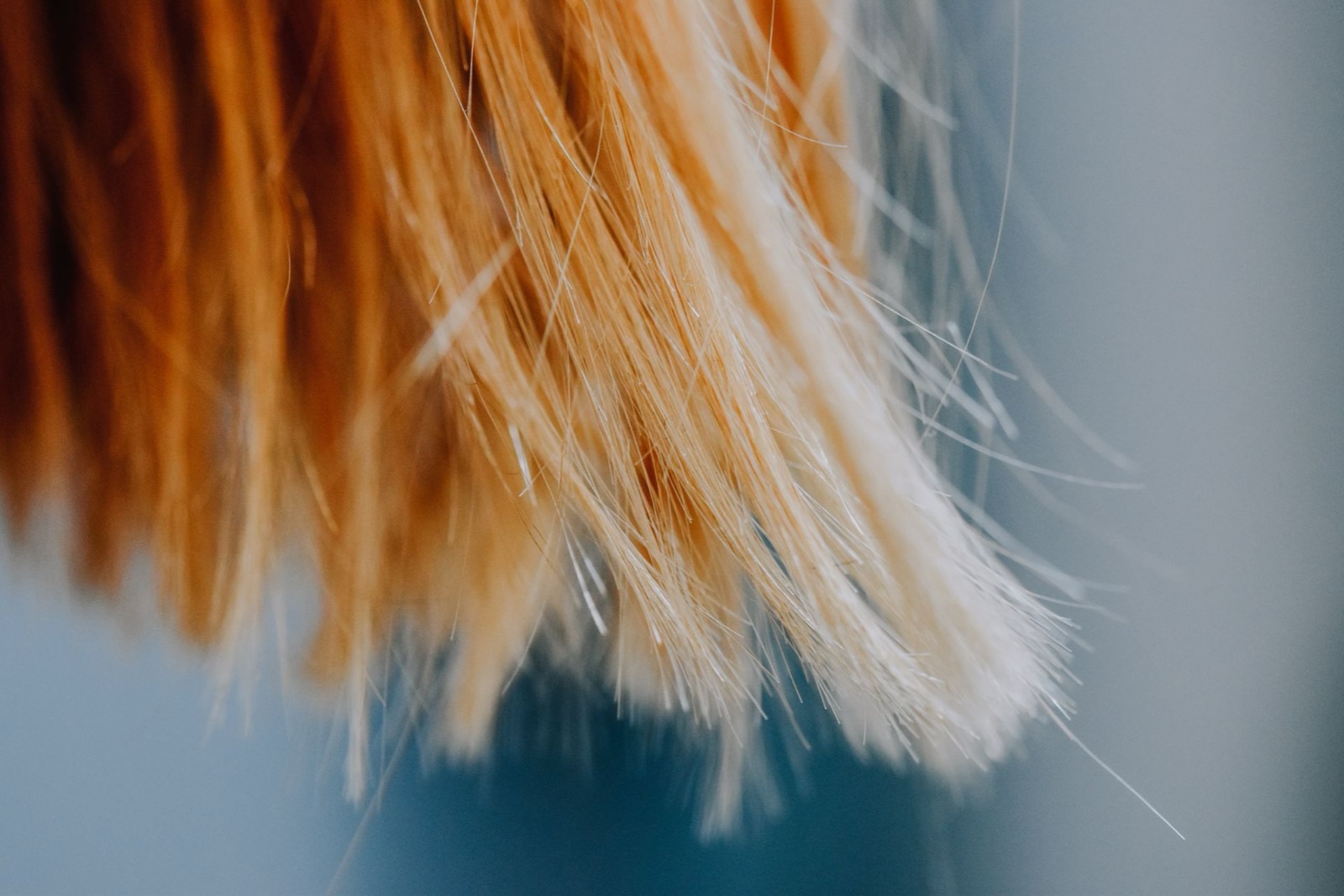
Hair structure explains why healthy hair is shiny and smooth, why bleached hair tangles easily, why wet hair breaks easily and why hair ends tend to split. The visible part of the hair (the hair shaft) is a keratinized multicellular tissue (Popescu and Höcker, 2009), made up of the cuticle on the outside, the cortex in the middle and the medulla at the center (Yang et al., 2014). The growth and shedding cycle of the hair follicle is covered in the article on hair loss and hair breakage.
1. The three layers of a hair fiber
Adult human hair fibers are about 20–180 µm wide. Cuticle cells are about 0.5 µm thick and 45–60 µm long; the outermost layer is the epicuticle membrane, about 10–14 nm thick, beneath which lie cysteine-rich layers and an endocuticle layer with less cysteine. The cells are joined together by the cell membrane complex (CMC) (Yang et al., 2014).
| Layer | Composition | Role | What damages it (according to the sources) |
|---|---|---|---|
| Cuticle | Flat cells overlapping like roof tiles; the surface is covered with lipids, including 18-MEA | A chemically resistant protective layer; determines friction and slipperiness | Vigorous scrubbing when washing, drying without protection, friction, sunlight, alkaline chemicals |
| Cortex | Spindle-shaped cells containing keratin filaments in a cystine-rich matrix; melanin granules | Most of the mass and mechanical strength; contains pigment | Becomes exposed and further damaged when the cuticle is lost, which can lead to breakage |
| Medulla | A loosely packed region at the center; present in thick hair, gray hair and beard hair; absent in the fine hair of children | The sources consulted do not state a clear role | May be a weak zone through which cracks propagate along the fiber |
| Cell membrane complex | Cell membranes and an intercellular “cement” | Binds the cells together | Bleaching, dyeing, relaxing, perming; friction during combing and washing |
Table compiled from Gavazzoni Dias (2015) and Yang et al. (2014). For dyes in the cortex, see the article on gray hair and gray coverage.
2. Keratin and the bonds that hold the hair fiber’s shape
Hair keratin comes in two types: type I is acidic and type II is basic. One chain of each type coils around the other to form a pair; the pairs assemble into intermediate filaments about 7.5–9 nm in diameter, embedded in a matrix of keratin-associated proteins (Yang et al., 2014). According to Popescu and Höcker (2009), the strength of hair comes from:
- Disulfide bridges between cysteine residues: strong (covalent) chemical bonds, which the authors emphasize as particularly important;
- Hydrogen bonds;
- Electrostatic interactions between oppositely charged groups (salt bonds);
- hydrophobic effects and mechanical interlocking between structures.
Chemical perming and relaxing rely on breaking the forces that hold the keratin coils together (Gavazzoni Dias, 2015).
3. The 18-MEA lipid layer and hydrophobicity
The cuticle surface is covered with lipids, including 18-methyleicosanoic acid (18-MEA), which is firmly attached by chemical bonds. 18-MEA makes the hair fiber hydrophobic; when this layer is lost, hair becomes more hydrophilic (Gavazzoni Dias, 2015).
According to a review by Weiand et al. (2025; with co-authors from industry), hair friction increases as hair ages and weathers, mainly because 18-MEA is gradually lost; bleaching, dyeing, heat styling tools and combing make this layer disappear faster. When the hair is stroked toward the root, the edges of the cuticle cells can interlock. Conditioner leaves a layer of material on the surface, bringing friction back close to the level of untreated hair, but only temporarily.
4. Surface charge and static electricity
The isoelectric point of hair is about pH 3.67; with products at a higher pH, the hair surface carries a negative charge and attracts positively charged substances. Bleached or chemically treated hair has more negatively charged sites and is more porous, so it takes up more conditioning agents. Anionic surfactants cleanse well but can increase the negative charge, increasing frizz and friction; charged hair fibers repel each other, causing flyaways. Conditioner neutralizes the negative charge with positively charged substances and smooths the cuticle (Gavazzoni Dias, 2015). For how amino silicones attach to hair, see the article on amodimethicone (in Vietnamese).
5. Porosity and wet hair
Hair is porous, and damaged hair is much more porous; absorbing water makes the hair fiber swell (Gavazzoni Dias, 2015), mainly in width, while lengthwise swelling is almost negligible (Popescu and Höcker, 2009).
“Porosity” as consumers understand it is the extent to which substances penetrate the hair fiber; laboratories can measure it as the contact angle between a water droplet and a hair tress. On highly coiled hair tresses, Sorrells et al. (2026) found that after 1 second, the contact angle of relaxed hair was clearly lower than that of untreated hair, while a conditioning regimen kept this angle comparable to untreated hair; bleached hair was even less hydrophobic than relaxed hair. For the glass-of-water test, see the Frequently asked questions.
Wet hair: when wet, untreated hair can stretch up to 30% of its length without damage; stretching by 30–70% causes irreversible changes; at 80% it breaks (Gavazzoni Dias, 2015). Water makes hair soft and pliable and lowers the force needed to break the fiber; in tress-combing experiments, compared with dry combing, wet combing reduced short-segment breakage but increased long-segment breakage, because higher friction made the hair snag higher up the tress (Robbins and Kamath, 2007). Tightly coiled hair takes less force to comb wet than dry, whereas straight to wavy hair is the opposite (Gavazzoni Dias, 2015).
6. Weathering from root to tip and split ends
Hair weathering is the gradual degradation from root to tip caused by daily washing, combing and styling. Heavily weathered and chemically treated hair shows cuticle lifting, loss of 18-MEA and cuticle cracking; once the cuticle is lost, the cortex is exposed and may break (Gavazzoni Dias, 2015).
Split ends are common in weathered hair and oxidized hair. Once the cuticle is lost, the cell membrane complex between cortical cells becomes a path for cracks to propagate along the fiber. Friction combined with twisting during combing and styling, together with sunlight, makes hair more prone to splitting (Gavazzoni Dias, 2015). Taylor et al. (2024) simulated tangles formed during combing, comparing hair from one person prone to split ends with that of one control person: in the less robust hair, splits started inside the fiber and propagated over a long distance; in the control hair, splits started at the surface and were short; after bleaching, the control hair split in the same way as the less robust hair. The study had only two hair donors and had co-authors from industry.
7. How straight and curly hair differ
A review by Daniels et al. (2023; one co-author from a consulting company) argues that classifying hair into three ancestry-based groups does not adequately reflect its diversity, and summarizes:
- The straighter the fiber, the rounder and larger its cross-section; the curlier the fiber, the flatter and smaller its cross-section.
- Cortical cells are distributed asymmetrically in curly hair and evenly in straight hair (Yang et al., 2014 also describes this).
- There are not enough data to show meaningful differences in amino acid composition.
- Straight hair has been reported to have higher tensile strength and fatigue resistance; curly hair breaks easily mainly because of knotting and cracks, not because of structural differences.
Curly and wavy hair tends to have an oily scalp but a dry hair shaft, because sebum has difficulty spreading along the fiber (Gavazzoni Dias, 2015). An X-ray diffraction study of hair from 12 people (straight, wavy, curly) found that the molecular structural features of keratin were present in all samples, regardless of sex, color or degree of curl; differences between individuals lay in the lipid composition of the cell membrane complex and appeared to be related to genetics (Yang et al., 2014).
8. Implications for hair care and formulation
A Butter-C checklist drawn from the sources above:
- Use conditioner after shampooing to reduce friction; bleached, dyed and relaxed hair needs more thorough conditioning.
- Detangle gently, especially when hair is wet; do not stretch the hair fibers.
- Limit bleaching, dyeing, perming, relaxing and heat styling tools.
- Cover your hair during prolonged sun exposure.
- Tightly coiled hair is usually easier to comb while still damp.
According to Gavazzoni Dias (2015), hair cosmetics can increase hydrophobicity and reduce charge and friction on the hair fiber; small molecules can reach the cortex, while large molecules act on the cuticle. Data on hydrolyzed keratin (in Vietnamese) come mainly from experiments on hair tresses. When manufacturing a keratin hair mask, Butter-C selects conditioning agents according to the condition of the target hair fiber and uses claims only when there are data measured on the finished product; for wording limits on hair products, see section 7 of the article on hair loss and hair breakage.
Frequently asked questions
Can damaged hair be “restored” to its original state?
You should not expect that. The hair shaft is a keratinized tissue (Popescu and Höcker, 2009). Conditioners and hair masks leave a layer of material on the surface that makes hair smooth and reduces friction, but only temporarily (Weiand et al., 2025), so they need to be used regularly.
Should you test hair porosity with a glass of water?
Butter-C has not found any verified study showing that this test is reliable; laboratories use measurements such as contact angle (Sorrells et al., 2026). Knowing whether your hair has been bleached, dyed or relaxed is a more practical guide, because chemically treated hair is more porous (Gavazzoni Dias, 2015).
Why does hair stand up and fly away after washing?
Strongly cleansing shampoos make hair prone to building up a negative charge, so the fibers repel each other; conditioner neutralizes the charge and smooths the surface (Gavazzoni Dias, 2015; see section 4).
References
- Gavazzoni Dias MF. Hair cosmetics: an overview. Int J Trichology. 2015. PMID 25878443
- Yang FC et al. The structure of people's hair. PeerJ. 2014. PMID 25332846
- Popescu C, Höcker H. Chapter 4. Cytomechanics of hair basics of the mechanical stability. Int Rev Cell Mol Biol. 2009. PMID 19766969
- Weiand E et al. Understanding and controlling the friction of human hair. Adv Colloid Interface Sci. 2025. PMID 40782659
- Robbins C, Kamath Y. Hair breakage during combing. III. The effects of bleaching and conditioning on short and long segment breakage by wet and dry combing of tresses. J Cosmet Sci. 2007. PMID 17728947
- Sorrells L et al. Methods adapted to evaluate products for textured hair: Shine, curl shrinkage, flexibility and consumer-perceived hair porosity. Int J Cosmet Sci. 2026. PMID 42971783
- Taylor D et al. The biomechanics of splitting hairs. Interface Focus. 2024. PMID 39081627
- Daniels G et al. How different is human hair? A critical appraisal of the reported differences in global hair fibre characteristics and properties towards defining a more relevant framework for hair type classification. Int J Cosmet Sci. 2023. PMID 36374002