 BUTTER-C
Using sunscreen correctly: amount, reapplying and choosing a type
Many people apply sunscreen more thinly than the amount used in SPF testing and rarely reapply it. A few simple habits — applying enough, at the right time, reading the label correctly and combining sunscreen with shade and clothing — help the protective layer come closer to the number on the label.
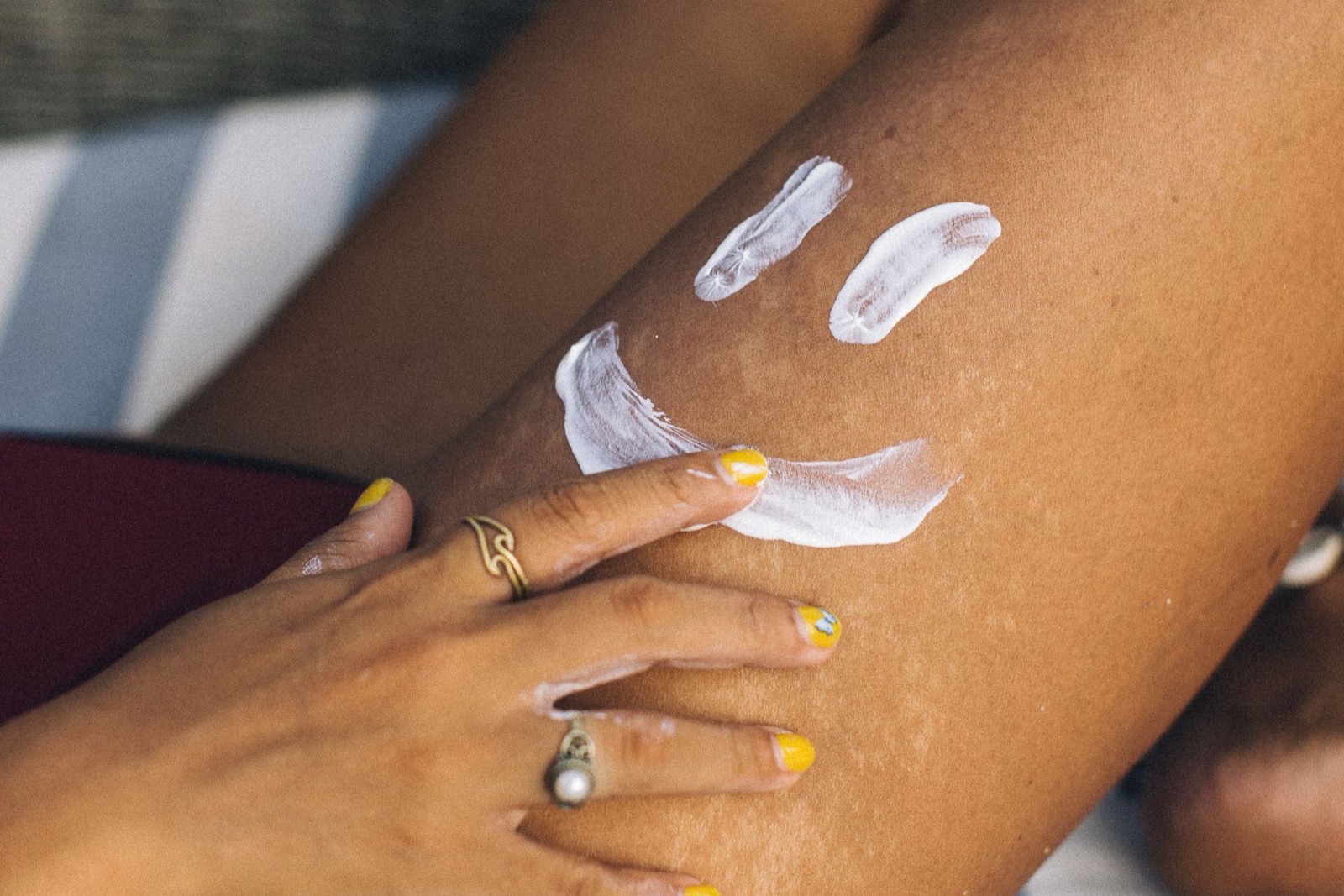
Using sunscreen correctly matters just as much as choosing a high SPF. The SPF on the label is determined at an application amount of 2 mg/cm² (see the article SPF: what it means and how it is tested (in Vietnamese)), whereas in real life people usually apply a thinner layer, miss areas of skin and rarely reapply. This article focuses on practice, based on recommendations from the American Academy of Dermatology (AAD), the UK National Health Service (NHS), several studies and ASEAN guidelines. For the effects of each band of light, see the article light and the skin.
1. How much to apply: the part most often lacking
The review by Petersen and Wulf (2014) notes that under natural conditions, users apply only about 0.39–1.0 mg/cm², which considerably reduces the level of protection; missing areas of skin and being in the sun before applying also clearly reduce the effect. The AAD states that many people apply only about 20–50% of the amount needed to reach the SPF on the label; choosing a higher SPF partly compensates for applying too little.
| Skin area | Suggested amount | Source |
|---|---|---|
| Face | At least 1 teaspoon — about the amount of sunscreen squeezed along the full length of the index and middle fingers | AAD |
| Exposed skin on the whole body, adults | At least about 1 ounce (approximately 30 ml), about enough to fill a shot glass; people with a larger body may need more | AAD |
| Whole body, adults | About 6–8 teaspoons | NHS |
| Lips | Lip balm with SPF 30 or higher | AAD |
Commonly forgotten areas: the neck, ears, tops of the feet and, in people with thin hair, the scalp. For sprays, the AAD advises spraying until the skin glistens and then rubbing the product in evenly, not spraying around the face or into the wind, and not using it near a flame.
2. When to apply and reapply
The AAD advises applying sunscreen to dry skin about 15 minutes before going outdoors. The NHS advises that if you plan to be out in the sun long enough to risk burning, you should apply it twice: 30 minutes before going out and just before going out. Petersen and Wulf (2014) suggest applying sunscreen before going into the sun and reapplying it once within 1 hour.
After that, the AAD advises reapplying about every 2 hours when outdoors, even on cloudy days, and right after swimming or sweating; the NHS adds: after towel drying or when the sunscreen may have rubbed off. A high SPF does not extend the time between applications (AAD).
3. “Water-resistant” and wording not to trust
The AAD stresses that no sunscreen is “waterproof” or “sweatproof”; in the US, manufacturers are not allowed to use these two terms because they are misleading. The NHS notes that sunscreen must be reapplied straight after being in water, even if the label says “water-resistant”.
The ASEAN sunscreen labeling guideline (Appendix X, Revision 02 of 18 November 2025), which applies to products whose main function is sun protection, requires that no claim imply complete protection against UVA and UVB, or imply that reapplication is unnecessary (for example, “all-day protection”). The restriction on the word “Sunblock” applies only in Malaysia; the restriction on “waterproof” and “sweatproof” applies only in Malaysia and Thailand. Mandatory warning statement (this guideline and ASEAN Annex VII): do not stay in the sun too long, even while using a sunscreen product.
4. Reading the label: SPF, broad spectrum, PA
- SPF 30 or higher, broad spectrum: the AAD and the NHS both recommend a minimum SPF of 30. “Broad spectrum” means protection against both UVA and UVB; the AAD also recommends a water-resistant product. Under the ASEAN guideline, an SPF above 50 may be labeled “SPF 50+”; higher numbers are not recommended.
- PA: a way of labeling the level of UVA protection with “+” signs, set by the Japan Cosmetic Industry Association — it is an industry standard, not a national regulation; PA++++ is the highest level of the PA scale in Japan (Mizuno, 2013 — the author works in the research laboratory of a cosmetics company).
- Other UVA symbols: the UK uses a UVA star rating (choose 4 stars or more); the letters “UVA” in a circle mean the product meets the European standard (NHS). The ASEAN guideline does not specify a separate UVA symbol.
On texture, the AAD suggests creams for dry skin and the face, gels for oily skin, and sticks around the eyes; the right product is the one you will use again and again. Tinted sunscreens containing iron oxides add protection against visible light, which is helpful for people with brown spots (AAD).
5. Mineral or organic filters
According to the AAD, sunscreens containing titanium dioxide, zinc oxide or both are “physical” (mineral) sunscreens; sunscreens without these two ingredients are “chemical” sunscreens; products combining both groups are called “hybrid”. Any type protects effectively if it is broad spectrum, water-resistant and SPF 30 or higher. Dermatologists recommend mineral sunscreens for sensitive skin; a common drawback is a white cast, and a tinted sunscreen that matches the skin tone helps avoid it (AAD).
On safety, the AAD reports that the FDA (in the US, sunscreens are regulated as over-the-counter drugs) is requesting more data on 12 organic UV filter active ingredients; this does not mean that these ingredients are unsafe, and the FDA has not asked the public to stop using them. FDA page (updated 16 October 2026): in June 2026, the FDA added bemotrizinol to the list of permitted active ingredients; on 10 September 2026, it issued an order removing PABA and trolamine salicylate from the over-the-counter sunscreen drug monograph because their risks outweigh their benefits. Being absorbed into the bloodstream also does not mean causing harm (AAD). In ASEAN, sunscreens are cosmetics; UV filters must be listed in Annex VII, within the limits set for each substance. For safety data on individual UV filters, see the ingredient articles, for example titanium dioxide (in Vietnamese).
Limits for the two mineral UV filters under ASEAN Annex VII (version 2025-2, 12 December 2025):
- Zinc oxide (Ref A29) and its nano form (Ref A29a): maximum 25%; when both forms are used, the total must not exceed 25%; not to be used in applications that may lead to inhalation into the user's lungs.
- Titanium dioxide (Ref 27) and its nano form (Ref 27a): maximum 25%, with the total of both forms not exceeding 25%; the nano form must not be used in applications that may lead to inhalation into the lungs; powder forms containing 1% or more of particles with an aerodynamic diameter ≤ 10 µm must comply with Annex III, Ref 338.
6. Moisturizers and makeup with SPF
The AAD notes that moisturizers and makeup with SPF are convenient, but when you are outdoors you still need to reapply about every 2 hours. In a laboratory study simulating real-life use (Kim et al., 2021 — three of the five authors work at the research center of a cosmetics company), when each product was applied in the amount typical of users, its SPF was much lower than the labeled value; layering sunscreen and then makeup clearly increased the actual SPF compared with using either product alone.
So apply enough sunscreen as the base layer, and regard the SPF in makeup as an extra.
7. Sunscreen is only one part, and the question of vitamin D
The NHS advises not relying on sunscreen alone. The AAD advises seeking shade, especially from about 10 a.m. to 2 p.m.; wearing a long-sleeved shirt, lightweight long pants, a wide-brimmed hat and UV-protective sunglasses; and taking extra care near water and sand because they reflect the sun's rays. For babies under 6 months, the AAD prioritizes shade and clothing and limits sunscreen use — see the article the skin of newborns and young children. People with skin conditions need to take extra care in the sun (NHS) and should ask a dermatologist.
Vitamin D. The AAD acknowledges that sun protection may reduce the amount of vitamin D the skin makes, and advises healthy adults to get vitamin D from a diet that includes foods naturally rich in vitamin D and/or foods and beverages fortified with vitamin D. The open-label randomized Sun-D trial in Australia (Tran et al., 2025) included 639 people aged 18–70 who did not regularly apply sunscreen or take vitamin D: applying SPF 50+ sunscreen on every day with a forecast UV index of 3 or higher, for about one year, lowered 25(OH)D levels by about 5.2 nmol/L compared with the discretionary-use group; the proportion with vitamin D deficiency (below 50 nmol/L) was 45.7% versus 36.9%. The authors still recommend applying sunscreen regularly and suggest that regular users may need vitamin D testing or supplementation — this should be discussed with a doctor (according to the conflict-of-interest statement, some authors are linked to organizations that receive revenue or funding from sunscreen).
Checklist for every time you go out in the sun
- SPF 30 or higher, broad spectrum; water-resistant if you swim or sweat a lot.
- Face: at least 1 teaspoon; whole body: about 1 ounce, close to 30 ml (AAD), or 6–8 teaspoons (NHS).
- Apply 15–30 minutes before going out; remember the neck, ears, tops of the feet and lips.
- Reapply about every 2 hours and right after swimming, sweating or towel drying.
- Do not leave sunscreen bottles in the sun or in a hot car; discard products that are expired or have changed color or texture (AAD).
8. A formulation perspective
When manufacturing sunscreen, the Butter-C formulation team pays attention to a texture that spreads easily and leaves little white cast, states the SPF and water-resistance claims only according to test results on the finished product, and prints the mandatory warning statement and clear reapplication instructions.
Frequently asked questions
Do I need to apply sunscreen on cloudy days?
Yes, if you go outside: according to the AAD, up to 80% of UV rays can pass through clouds.
Does SPF 50 let me stay in the sun longer?
No. According to the AAD, a high SPF still needs to be reapplied about every 2 hours, just like a low SPF.
What should I do if I get sunburned?
The AAD advises getting out of the sun, taking a cool shower or bath, applying a gentle moisturizer and drinking extra water. The NHS advises seeing a doctor if you feel tired, or if your skin is very swollen or blistered.
References
- American Academy of Dermatology. Sunscreen FAQs. https://www.aad.org/media/stats-sunscreen
- NHS. Sunscreen and sun safety. https://www.nhs.uk/live-well/seasonal-health/sunscreen-and-sun-safety/
- U.S. Food and Drug Administration. Sunscreen: How to Help Protect Your Skin from the Sun (updated 16 October 2026). https://www.fda.gov/drugs/understanding-over-counter-medicines/sunscreen-how-help-protect-your-skin-sun
- Petersen B, Wulf HC. Application of sunscreen--theory and reality. Photodermatol Photoimmunol Photomed. 2014. PMID 24313722
- Kim MA et al. Layering sunscreen with facial makeup enhances its sun protection factor under real-use conditions. Skin Res Technol. 2021. PMID 33660348
- Tran V et al. Effect of daily sunscreen application on vitamin D: findings from the open-label randomized controlled Sun-D Trial. Br J Dermatol. 2025. PMID 40927943
- Mizuno M. Current Conditions of Sun Protection Test Methods for Sunscreen Products (article in Japanese, with an English abstract). Journal of Society of Cosmetic Chemists of Japan. 2013;47(4):271–277. https://www.jstage.jst.go.jp/article/sccj/47/4/47_271/_article/-char/en
- ASEAN. ASEAN Sunscreen Labeling Guideline — ASEAN Cosmetics Directive, Technical Document, Appendix X, Revision 02 (18 November 2025). https://file.go.gov.sg/asean-sunscreen-labelling-guideline.pdf
- ASEAN. Annex VII – List of UV filters which cosmetic products may contain (Version 2025-2, 12th December 2025). https://asean.org/wp-content/uploads/2026/04/Annex-VII_Release_12th-December-2025-clean.pdf