 BUTTER-C
Dandruff and oily scalp: mechanisms, differences, how to wash
Dandruff is a common scalp condition that is not harmful and not contagious, but it is easily confused with seborrheic dermatitis, psoriasis or tinea capitis. Understanding the mechanism helps you choose a suitable shampoo and washing routine, and know when to see a doctor.
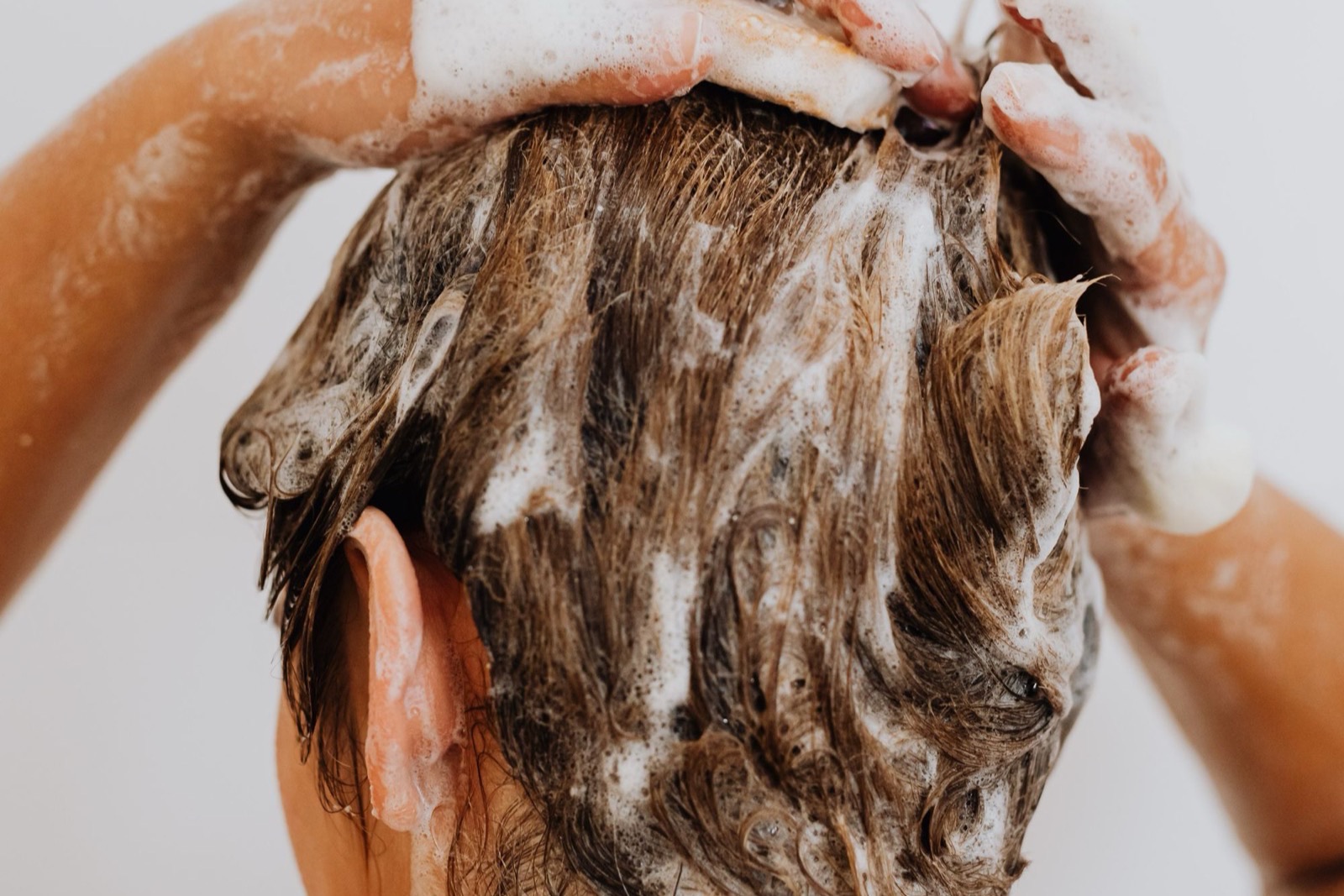
Dandruff and oily scalp often go together: sebum is one of the three factors described in the mechanism of dandruff formation, alongside Malassezia yeasts that live naturally on the skin and individual susceptibility (DeAngelis et al., 2005). According to the NHS (the UK National Health Service), dandruff is a common condition that is not harmful and not contagious.
Diagnosing scalp diseases and prescribing medicines for them is the role of a dermatologist; this article does not replace medical advice.
1. Sebum and Malassezia yeasts
The scalp is a sebaceous (sebum-secreting) area of the body (Borda and Wikramanayake, 2015). Sebum is a mixture of lipids that includes triglycerides; how sebum is secreted is explained in the article on oily skin and enlarged pores.
Malassezia is a lipophilic (lipid-loving) yeast that is also present on healthy scalps, so it is not sufficient on its own to cause dandruff (Turner et al., 2012). DeAngelis et al. (2005; authors affiliated with a company) found that Malassezia numbers did not correlate with the presence or severity of dandruff, and described the mechanism through metabolic products: the yeast releases irritating free fatty acids from sebum triglycerides. Individual susceptibility to these fatty acids (represented by oleic acid) is the third factor, which helps explain why, with the same oil and yeast present, some people get dandruff and others do not. The authors considered Malassezia the most easily controlled factor: fewer yeasts means fewer free fatty acids, less flaking and less itching — the basis of anti-dandruff shampoos (section 4).
2. Why the scalp flakes
On a scalp with dandruff, the stratum corneum sheds in visible flakes. A review by Turner et al. (2012; authors affiliated with a company) summarizes the evidence on the stratum corneum of the dandruff scalp:
- structural lipids are depleted and less well organized;
- transepidermal water loss is increased, indicating a weakened barrier;
- there is subclinical inflammation, and the scalp is more susceptible to irritants.
The authors propose that barrier disruption may disturb the maturation of the stratum corneum and make the skin more susceptible to Malassezia metabolites; this is a hypothesis that has not been fully proven. According to the same review, dandruff may affect up to half of the world’s post-pubertal population; we do not yet have verified figures for people in Vietnam.
3. Telling dandruff from seborrheic dermatitis, psoriasis and tinea capitis
Borda and Wikramanayake (2015) regard dandruff and seborrheic dermatitis as a continuous spectrum: dandruff is confined to the scalp, with itching and flaking without visible inflammation; seborrheic dermatitis involves inflammation and redness and can occur in other sebaceous areas. The table below summarizes suggestive signs according to the NHS and DermNet; it is not a self-diagnosis tool.
| Condition | Suggestive signs | What to do |
|---|---|---|
| Ordinary dandruff | White flakes of skin on the scalp, in the hair and on the shoulders of clothing; the scalp may be dry and itchy (NHS) | Wash regularly; an anti-dandruff shampoo can be used |
| Seborrheic dermatitis of the scalp | Red, scaly, itchy patches on the scalp, face and other areas (NHS) | See a dermatologist |
| Scalp psoriasis | Red, flaky, crusty, sore patches covered with silvery scales (NHS) | See a dermatologist |
| Scalp ringworm (tinea capitis) | Red or silvery rash, sometimes with patchy hair loss (NHS); mainly in children before puberty, most often between 3 and 7 years of age; contagious via people, combs, hats, towels and pets (DermNet) | See a dermatologist; medicines as prescribed |
DermNet describes a form of tinea capitis with only diffuse, dandruff-like scaling and subtle or no hair loss. For this reason, a young child with “dandruff”, especially with patchy hair loss, should be examined by a doctor rather than simply switching shampoos.
4. What cosmetic shampoos can do
Shampoos remove sebum and skin flakes; anti-dandruff shampoos also deliver active ingredients to the scalp. Claims appropriate at the cosmetic level are “cleanses dandruff” and “helps reduce dandruff”, when supported by testing on people. The ASEAN cosmetic claims guideline (Appendix 03-MP [Phụ lục 03-MP] of Circular 06/2011/TT-BYT [Thông tư 06/2011/TT-BYT]) does not accept the claim “permanently eliminates dandruff”; cosmetics also must not refer to effects on fungi or on scalp diseases.
| Active ingredient | ASEAN Annex (version 2026-1) | Limits relevant to shampoos |
|---|---|---|
| Climbazole | III, Ref 326 | Rinse-off anti-dandruff shampoo 2.0%; rinse-off anti-dandruff conditioner 0.5% |
| Piroctone olamine | VI, Ref 35 (+) | As a preservative: rinse-off 1%, other products 0.5%; the (+) sign: may be used at other concentrations for other purposes apparent from the presentation of the product, for example to cleanse dandruff in shampoos |
| Salicylic acid | III, Ref 98 | Rinse-off hair products 3.0%; this level is inclusive of any use of salicylic acid in the product (as a preservative: Annex VI, Ref 3); not to be used in preparations for children under three years of age |
| Zinc pyrithione | III, Ref 101 | Rinse-off hair products 1.0%, leave-on hair products 0.1%. Banned in the EU (Annex II, entry 1670) since 1 March 2022 |
| Selenium disulphide | III, Ref 49 | Anti-dandruff shampoos only, 1%; the label states "Contains selenium disulphide", "Avoid contact with eyes or damaged skin". Selenium and its other compounds: Annex II, Ref 297 |
| Ketoconazole | II, Ref 1528 | Must not be present in cosmetics; it is a drug substance, used on a doctor’s advice |
Regulatory maximum levels are not recommended levels. Efficacy and safety data for each active ingredient are in the linked articles (in Vietnamese); salicylic acid mainly helps loosen flakes.
5. How to wash an oily scalp with dandruff
According to the American Academy of Dermatology (AAD), mild dandruff can usually be controlled at home by washing the hair regularly. A checklist based on the AAD and the NHS:
- Follow the instructions on the label; work up a lather on the scalp, not just on the hair strands.
- Some shampoos need to stay on the scalp for up to 5–10 minutes before rinsing (AAD).
- Fine or straight hair, or an oily scalp: wash often, for example daily, and use an anti-dandruff shampoo twice a week (AAD).
- Coarse, naturally curly hair: wash when needed and use an anti-dandruff shampoo about once a week if tolerated, applying it only to the scalp because the active ingredients can dry out the hair (AAD).
- Use it for up to 4 weeks, then assess; you may need to try more than one product (NHS), or alternate shampoos with different active ingredients (AAD).
6. Common misconceptions
“Dandruff means you are not clean”
The NHS states that dandruff is not caused by poor hygiene, although it may be more noticeable if you wash less often. Stress and cold weather can make dandruff worse.
“Washing your hair often makes the scalp produce more oil”
We have found no verified source supporting this. Punyani et al. (2021) carried out two studies in Asian people without scalp disease: in the epidemiological study, overall satisfaction with hair and scalp was reached with washing 5–6 times a week; in the controlled study, daily washing was better than washing once a week on all criteria, and no objective harm to the hair was seen. Two authors are employees of a company, which funded all costs; the abstract does not give the sample size or report sebum measurements separately. The evidence is limited, but it is consistent with the AAD’s recommendation of frequent washing for oily scalps.
“Applying oil to the scalp gets rid of dandruff” or “makes dandruff worse”
Neither claim is supported by solid evidence. In theory, Malassezia converts triglycerides into irritating free fatty acids (DeAngelis et al., 2005). On the other hand, a study of 140 Indian women (70 with healthy scalps, 70 with dandruff; 12 weeks of coconut oil application followed by 4 weeks without) found that on dandruff scalps certain microorganisms increased, including Malassezia globosa, and these were negatively correlated with dandruff scores (Saxena et al., 2021; some authors affiliated with a company; the abstract does not describe a control group or report the size of the change in dandruff). The evidence is limited; if applying oil causes itching, greasiness or more dandruff, stop.
7. When to see a dermatologist
The NHS advises seeing a doctor when:
- dandruff persists after at least 4 weeks of using an anti-dandruff shampoo;
- there is a lot of dandruff or the scalp is very itchy;
- the scalp is red or swollen;
- there are itchy, flaky patches on the face or other parts of the body.
Patchy hair loss, painful scaly patches (NHS), or symptoms in a young child or in several people in the same household (tinea capitis is contagious, according to DermNet) are also reasons to see a doctor early. According to the AAD, a dermatologist can determine whether dandruff is a sign of seborrheic dermatitis, psoriasis, tinea capitis or eczema. Prescription medicines should be used only as prescribed by a doctor; cosmetic shampoos only support care.
8. A formulation perspective
When developing an anti-dandruff shampoo, Butter-C’s pharmacist team selects active ingredients according to the target market (no zinc pyrithione for products sold in the EU), checks concentrations against the ASEAN Annexes, assays the active ingredient in every batch and adds conditioning agents, because people with dandruff often wash their hair several times a week.
Frequently asked questions
Is dandruff contagious?
Ordinary dandruff is not contagious (NHS). Tinea capitis is contagious (DermNet), so scalp scaling with patchy hair loss, especially in children, should be examined by a doctor.
How long should I use an anti-dandruff shampoo before assessing it?
The NHS suggests using it for up to 4 weeks. Dandruff can come back after you stop, because the effect of cosmetics is not permanent.
Are dandruff and seborrheic dermatitis the same thing?
The two conditions belong to the same spectrum, but seborrheic dermatitis involves inflammation and redness and can extend beyond the scalp (Borda and Wikramanayake, 2015). Seborrheic dermatitis needs to be diagnosed and monitored by a dermatologist.
References
- DeAngelis YM et al. Three etiologic facets of dandruff and seborrheic dermatitis: Malassezia fungi, sebaceous lipids, and individual sensitivity. J Investig Dermatol Symp Proc. 2005. PMID 16382685.
- Turner GA et al. Stratum corneum dysfunction in dandruff. Int J Cosmet Sci. 2012. PMID 22515370.
- Borda LJ, Wikramanayake TC. Seborrheic Dermatitis and Dandruff: A Comprehensive Review. J Clin Investig Dermatol. 2015. PMID 27148560.
- Punyani S et al. The Impact of Shampoo Wash Frequency on Scalp and Hair Conditions. Skin Appendage Disord. 2021. PMID 34055906.
- Saxena R et al. Longitudinal study of the scalp microbiome suggests coconut oil to enrich healthy scalp commensals. Sci Rep. 2021. PMID 33790324.
- NHS. Dandruff. https://www.nhs.uk/conditions/dandruff/
- American Academy of Dermatology. How to treat dandruff. https://www.aad.org/public/everyday-care/hair-scalp-care/scalp/treat-dandruff
- DermNet. Tinea capitis. https://dermnetnz.org/topics/tinea-capitis