 BUTTER-C
Hair oils and essential oils: penetration, rosemary, allergy
In experiments on cut hair, coconut oil gets into the hair fiber; rosemary essential oil is rumored to “grow hair like a medicine.” The real evidence is much narrower: hair oils care for the hair shaft, while essential oils need diluting because they can cause allergies.
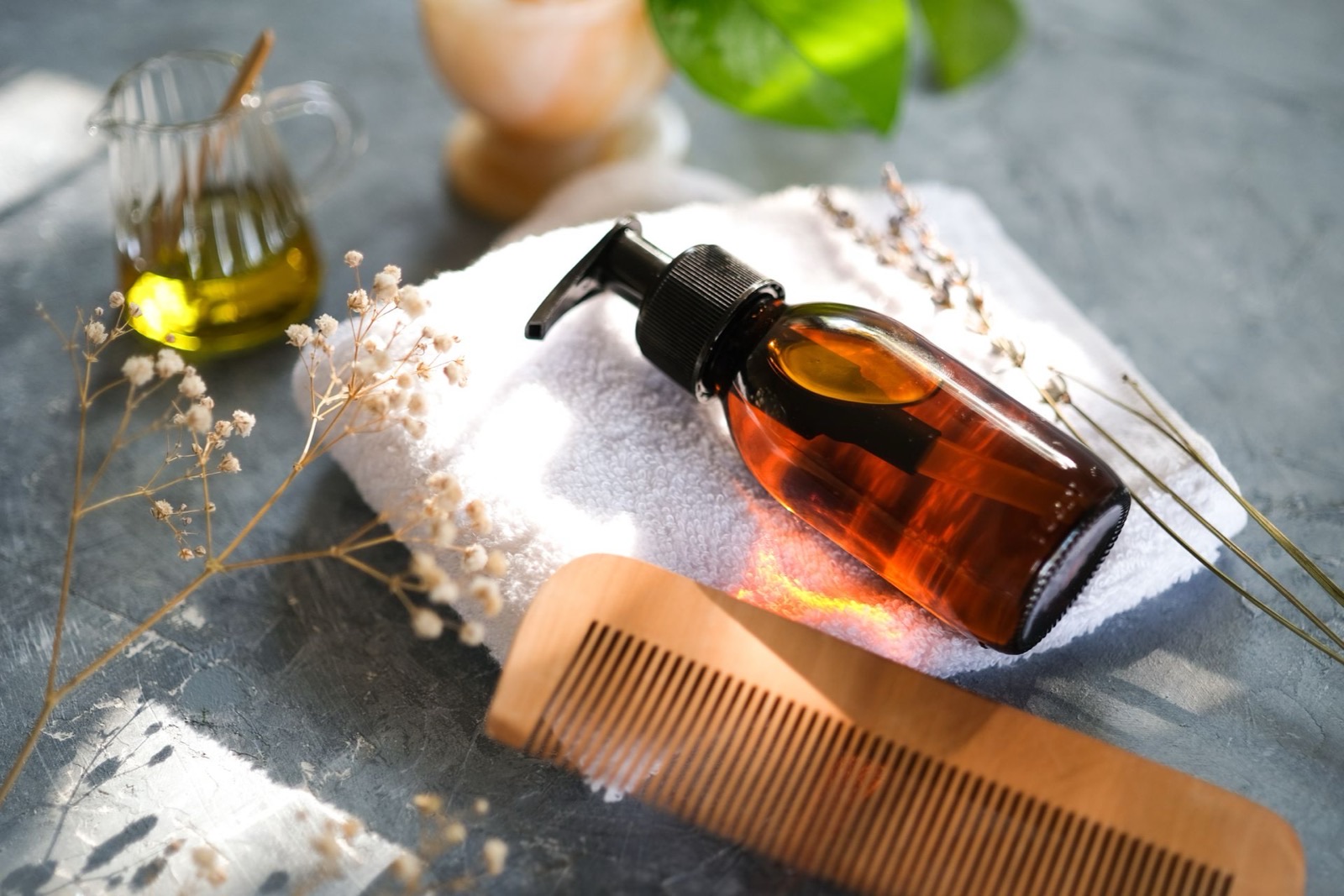
Hair oils and essential oils are two different groups. Hair oils are carrier oils (coconut oil, argan oil, sunflower oil, mineral oil…) applied to the hair shaft to make hair soft, smooth and easy to comb. Essential oils are the volatile fraction distilled from plants (rosemary, lavender, tea tree…); they have a strong scent, are used in small amounts and need to be diluted when applied to the skin. On social media, both are often promoted as making hair “grow.”
Heavy or prolonged hair loss needs to be examined by a dermatologist; this article does not replace medical advice.
1. Which oils get into the hair fiber
Oil applied to hair can stay as a film on the surface or partly penetrate into the hair fiber (Keis et al., 2005).
Ruetsch et al. (2001) analyzed cross-sections of hair fibers: coconut oil penetrated the hair shaft, mineral oil did not. In the experiment by Rele and Mohile (2003), only coconut oil clearly reduced protein loss in both undamaged and damaged hair, when used before or after washing; sunflower oil and mineral oil did not. The authors explained that coconut oil (a triglyceride of lauric acid) has small, straight-chain molecules, which allow it to penetrate the hair shaft.
Keis et al. (2005) recorded that the adhesion force between hair fibers decreased over time with coconut oil, olive oil and sunflower oil but not with mineral oil, and took this to mean that the oils had been absorbed into the fiber. Marsh et al. (2024; some authors are industry-affiliated) found that pure triglycerides of every chain length tested penetrated hair, more so with short chains and unsaturated fatty acids; coconut oil, camellia oil (Camellia oleifera) and safflower oil all penetrated the cell membrane complex (the lipid layer that binds the cells inside the hair fiber together) and increased the fatigue resistance of the hair fiber.
| Oil | Result on cut hair (laboratory) | Source |
|---|---|---|
| Coconut oil | Penetrates the hair shaft; reduces protein loss when used before or after washing | Ruetsch 2001; Rele 2003 |
| Sunflower oil | Did not reduce protein loss (2003); signs of gradual absorption (2005) | Rele 2003; Keis 2005 |
| Camellia oil, safflower oil | Penetrate the cell membrane complex; increase fatigue resistance | Marsh 2024 |
| Argan oil | Applied before oxidation, helps reduce protein loss; remains after washing | Sharifi 2022 |
| Mineral oil | Does not penetrate the hair shaft; does not reduce protein loss | Ruetsch 2001; Rele 2003 |
Note: these are all experiments on cut hair; most of the coconut oil data come from authors affiliated with a hair oil manufacturer; none of the studies measured the hair follicle or hair growth.
2. Oiling hair before washing
Ruetsch et al. (2001) regard the swelling of the hair fiber when wet and its shrinking when dry as one cause of damage (“hygral fatigue”), recorded that oil limits the degree of swelling, and hypothesized that coconut oil protects hair better than mineral oil. This is the basis for the habit of applying oil before washing, but there are no human trials showing how long to leave it on or what the real-world benefit is. On cut hair, heating increases oil absorption (Keis et al., 2005), but high heat damages hair (see the article on hair loss and hair breakage).
The American Academy of Dermatology (AAD) recommends using conditioner after shampooing: for fine or straight hair, apply it to the ends; for dry or curly hair, apply it along the whole length. Butter-C suggests applying the same principle to hair oils (a practical inference):
- Fine, straight hair that gets greasy easily: a small amount, mainly on the ends.
- Dry, thick, curly hair: can be applied evenly along the hair shaft.
- Applying oil to the scalp: there is no solid evidence either way, beneficial or harmful, for dandruff (see the article on dandruff and oily scalp).
3. Argan oil: evidence is still scarce
The systematic review by Phong et al. (2022) of 22 articles concluded: coconut oil has clinical evidence for brittle hair and head lice, while evidence for hair growth is limited; castor oil has weaker evidence for hair shine; argan oil has no significant evidence for hair growth, hair quality or managing lice. In the cut-hair experiment by Sharifi et al. (2022), tresses coated with argan oil before exposure to an oxidizing agent lost significantly less protein. Argan oil is one option for conditioning the hair shaft, like other plant oils; there is no evidence that it helps hair grow.
4. Rosemary essential oil and the “hair growth” claim
The study most often cited is the trial by Panahi et al. (2015): 100 people with androgenetic alopecia were randomized to a rosemary oil preparation (50 people) or a 2% topical medicine approved for this condition (50 people) for 6 months. According to the abstract, at month 3 the hair count did not change significantly in either group; at month 6, both groups showed a significant increase from baseline, with no significant difference between the groups; scalp itching increased in both groups, more so in the medicine group.
According to the review by Gupta et al. (2025), the participants were men; each applied 1 mL of a lotion containing 3.7 mg 1,8-cineole/mL twice daily; the mean hair count rose from 122.8 to 129.6 (rosemary) and from 138.4 to 140.7 (medicine); the size and location of the counting area were not reported. The authors consider that further controlled trials with larger sample sizes are needed.
Limitations:
- A single trial, in men with a medical condition, i.e., a medical context.
- No placebo group; “no significant difference” does not mean “equally effective.”
- The test product was a lotion with a quantified 1,8-cineole content, not neat essential oil dropped onto the scalp.
- According to Bin Rubaian et al. (2024), the promising results come from literature reviews, one study in men and one study in mice; more research is needed.
An analysis of online misinformation about hair loss placed rosemary oil among the unfounded alternative therapies (Finnegan et al., 2025). For the composition of the essential oil, see the article on rosemary essential oil in cosmetics (in Vietnamese).
5. Essential oils must be diluted: the risk of contact allergy
According to de Groot and Schmidt (2016), nearly 80 essential oils have caused contact allergy; of 55 oils patch tested in people with suspected contact dermatitis, nine gave positive rates above 2%, including tea tree, orange, citronella, ylang-ylang and clove. Most reactions occurred when neat essential oils or high-concentration products were applied.
NCCIH (United States) describes essential oils as usually inhaled or applied to the skin in diluted form. The European Medicines Agency (EMA) monograph on rosemary oil, written for herbal medicines rather than cosmetics, states: do not apply to broken or irritated skin; avoid the eyes and mucous membranes; may cause contact dermatitis and asthma due to hypersensitivity; not recommended for people under 18 years of age or for pregnant or breastfeeding women because of a lack of data.
- Do not drop neat essential oil onto the scalp; prefer finished products that have already been diluted and safety-assessed (this article does not give ratios for home dilution).
- Do not use when the scalp is scratched, red or irritated (EMA).
- People with suspected fragrance allergy, trying a new scented leave-on product: DermNet suggests applying a dot to the same spot on the forearm or inner arm twice a day for two weeks; if a rash appears, do not use it.
- Known fragrance allergy: read the ingredient list carefully (see the article on fragrance and allergy).
- Children, pregnant or breastfeeding women: ask a doctor first.
- Itching, redness, burning or blisters: stop using the product and see a dermatologist; difficulty breathing, swelling of the lips or face: seek emergency care.
6. Why “stimulates hair growth” is not a cosmetic claim
Appendix 03-MP (Phụ lục số 03-MP) of Circular 06/2011/TT-BYT (Thông tư 06/2011/TT-BYT) lists claims that are not accepted for hair care products, including “Stimulates hair growth”, “Prevents hair loss”, “Restores hair cells/hair follicles” and “Thickens the hair strands”; the list is not exhaustive, and the final decision rests with the regulatory authority. A full reading is given in section 7 of the article on hair loss and hair breakage. Trial results in patients cannot become a “hair growth” claim on the label of a hair oil containing rosemary essential oil; a suitable claim describes an effect on the hair shaft, for example “helps hair feel soft and smooth.”
7. A formulation perspective
When manufacturing hair oil, Butter-C uses essential oils only at fragrance levels. Rosemary essential oil has no entry of its own in the ASEAN annexes. However, methyleugenol, a substance that may occur naturally in the essential oil, is restricted in Annex II, Ref 451: in the finished product, no more than 0.001% in rinse-off products and 0.0002% in other leave-on products; the essential oil level is calculated from the certificate of analysis of each batch.
Frequently asked questions
Is coconut oil better for hair than other oils?
On cut hair, coconut oil penetrates the hair shaft, but so do many other plant oils. The sources cited include no human trials directly comparing different oils.
Does putting drops of rosemary essential oil on the scalp every day make hair grow?
There is not yet sufficiently strong evidence. The trial most often cited used a ready-made lotion in men with androgenetic alopecia and had no placebo group. Neat essential oil also increases the risk of allergy.
Do hair oils reduce hair loss?
There is no such evidence. Hair oils care for the hair shaft. Heavy, prolonged or patchy hair loss needs a dermatologist to find the cause.
References
- Rele AS, Mohile RB. Effect of mineral oil, sunflower oil, and coconut oil on prevention of hair damage. J Cosmet Sci. 2003. PMID 12715094
- Ruetsch SB et al. Secondary ion mass spectrometric investigation of penetration of coconut and mineral oils into human hair fibers: relevance to hair damage. J Cosmet Sci. 2001. PMID 11413497 · Keis K et al. Investigation of penetration abilities of various oils into human hair fibers. J Cosmet Sci. 2005. PMID 16258695
- Marsh JM et al. Penetration of oils into hair. Int J Cosmet Sci. 2024. PMID 38922913
- Phong C et al. Coconut, Castor, and Argan Oil for Hair in Skin of Color Patients: A Systematic Review. J Drugs Dermatol. 2022. PMID 35816075 · Sharifi N et al. Argan oil as a pretreatment of human hair before exposure to oxidative damage: Attenuated total reflectance and protein loss studies. J Cosmet Dermatol. 2022. PMID 35226791
- Panahi Y et al. Rosemary oil vs minoxidil 2% for the treatment of androgenetic alopecia: a randomized comparative trial. Skinmed. 2015. PMID 25842469 · Gupta AK et al. Do Non-Prescription Products Help in Managing Androgenic Alopecia? Skin Appendage Disord. 2025. PMID 40475103 · Bin Rubaian NF et al. An Overview of Commonly Used Natural Alternatives for the Treatment of Androgenetic Alopecia, with Special Emphasis on Rosemary Oil. Clin Cosmet Investig Dermatol. 2024. PMID 39524109
- Finnegan P et al. A Qualitative Review of Misinformation on Alopecia. Skin Appendage Disord. 2025. PMID 40176994
- de Groot AC, Schmidt E. Essential Oils, Part IV: Contact Allergy. Dermatitis. 2016. PMID 27427818 · EMA (HMPC). European Union herbal monograph on Rosmarinus officinalis L., aetheroleum (EMA/HMPC/513893/2021, Revision 1). https://www.ema.europa.eu/en/documents/herbal-monograph/final-european-union-herbal-monograph-rosmarinus-officinalis-l-aetheroleum-revision-1_en.pdf · NCCIH. Aromatherapy. https://www.nccih.nih.gov/health/aromatherapy · DermNet. Fragrance allergy. https://dermnetnz.org/topics/fragrance-allergy
- American Academy of Dermatology. Tips for healthy hair. https://www.aad.org/public/everyday-care/hair-scalp-care/hair/healthy-hair-tips · Bộ Y tế. Thông tư 06/2011/TT-BYT, Phụ lục số 03-MP (văn bản hợp nhất) [Ministry of Health. Circular 06/2011/TT-BYT, Appendix 03-MP (consolidated text)]: https://dav.gov.vn/upload_images/files/07_%20VBHN%20BYT%20h%E1%BB%A3p%20nh%E1%BA%A5t%20Th%C3%B4ng%20t%C6%B0%20quy%20%C4%91%E1%BB%8Bnh%20v%E1%BB%81%20qu%E1%BA%A3n%20l%C3%BD%20m%E1%BB%B9%20ph%E1%BA%A9m%20PDF.pdf · ASEAN Cosmetic Claims Guidelines (2007): https://file.go.gov.sg/appendix-iii-asean-cosmetic-claims-guidelines.pdf · ASEAN Cosmetic Directive, Annex II (version 2026-1, June 22, 2026), Ref 451.