 BUTTER-C
Gray hair and gray coverage: why hair grays, safer dyeing
Gray hair starts in the hair follicle, where pigment cells stop making melanin; cosmetics only add color to the hair shaft. Understanding how hair dyes work and why PPD calls for a test before every dyeing helps make gray coverage safer.
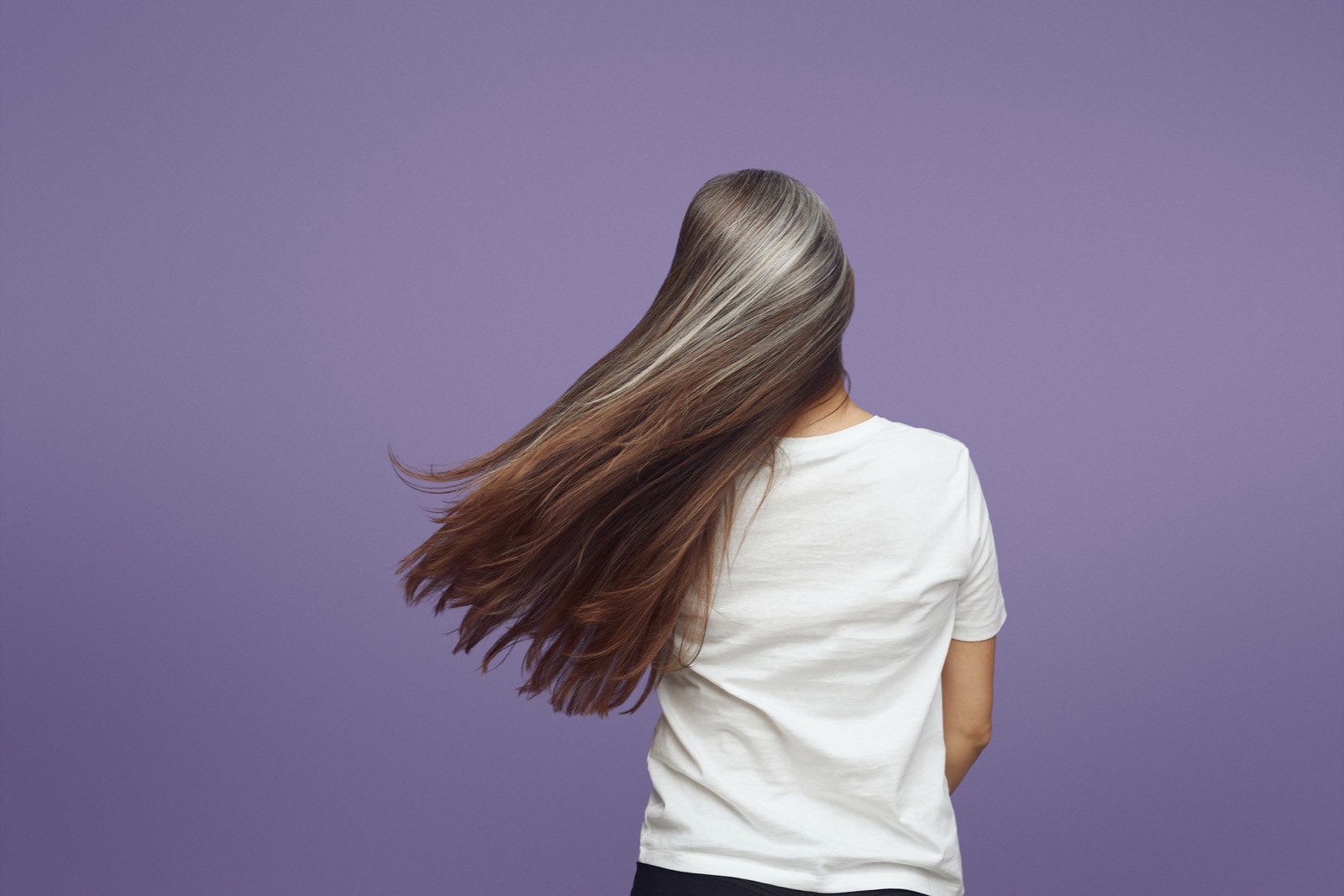
Graying is a change almost everyone experiences with age, and covering gray with hair color cream or gray coverage shampoo is the choice of a great many people. This article explains why hair turns gray, when to see a doctor, the groups of hair dyes and how to dye more safely with p-phenylenediamine (PPD), a common contact allergen. Diagnosing and managing allergic reactions is the role of a doctor.
1. Why hair turns gray
Hair color is determined by the type and amount of melanin. Melanin is produced by pigment cells (melanocytes) in the hair follicle: eumelanin gives brown and black shades; pheomelanin gives red and yellow shades. Gray hair appears when the melanocytes in the hair follicle reduce or stop melanin production. According to a review by Desai et al. (2025), the associated factors include:
- Age: expression of melanin-producing genes gradually declines with age.
- Genetics: genome-wide studies have identified several variants associated with graying, for example in the IRF4 gene.
- Oxidative stress: together with genetic factors, a key endogenous driver.
- External factors: smoking, nutritional deficiencies.
2. Premature graying: when to see a doctor
Premature graying is defined by age cut-offs: before age 20 in white people, before 25 in Asian people and before 30 in Black people. Family history is a recognized factor. The review also lists associated health conditions (Desai et al., 2025):
- vitiligo;
- autoimmune thyroid disease and hypothyroidism — some studies have reported an association, but the evidence is still limited;
- vitamin B12 deficiency — the data come from a few small studies, many conducted in India, so the evidence is limited.
This list is for awareness only. If you have a lot of gray hair at a young age, or gray hair together with patches of skin that have lost their color, see a doctor. Testing and micronutrient supplementation, if needed, are decided by the doctor.
3. What cosmetics can do about gray hair
According to Desai et al. (2025), no medical intervention is known to reverse or prevent premature graying; the common approach is to cover it.
Appendix 03-MP (Phụ lục 03-MP) of Circular 06/2011/TT-BYT (in Vietnamese) states that cosmetics produce non-permanent effects and lists “Restores hair cells/hair follicles” among the unacceptable claims in the “Hair care” group. The Appendix does not mention “gray hair” specifically; in Butter-C’s reading, claims such as “naturally darkens hair”, “gets rid of gray hair” or “stops gray hair from growing back” imply a lasting effect on the hair follicle and therefore fall outside the scope of cosmetics. The wording Butter-C uses: “covers gray hair with black or brown color”.
4. Groups of hair dyes
Synthetic hair dyes are classified by how well the color withstands shampooing (de Souza et al., 2025); the gray coverage shampoo row was added by Butter-C:
| Group | How the color develops | Durability |
|---|---|---|
| Temporary | Colorants adhere to the outer surface of the hair; no oxidizing agent needed | A few days; washes out with shampooing |
| Semi-permanent | Contains no hydrogen peroxide, so it does not lighten hair; darkens by up to about three shades; penetrates shallowly into the hair cortex | About 6–12 shampoos |
| Permanent (oxidative) | Primary intermediates (such as PPD), couplers and hydrogen peroxide are mixed in an alkaline medium (pH 8–10); the color-forming reaction takes place inside the hair cortex | Long-lasting; new growth at the roots is still gray |
| Gray coverage shampoo | Two parts (oxidative dye; hydrogen peroxide) mixed immediately before use and applied like a shampoo | Same as oxidative dyes |
The boundaries are not fixed: permanent dyes are more often linked with adverse effects (Desai et al., 2025), but according to the NHS some semi-permanent products also contain PPD. Read the ingredient list.
Gray coverage shampoo, even with herbal extracts, is still an oxidative hair dye product, so the warnings in section 6 apply in full (see the page on gray coverage shampoo manufacturing). Among plant dyes, henna gives a red tint and sometimes turns gray hair orange (Desai et al., 2025); indigo leaf, Indigofera tinctoria, is listed in ASEAN Annex III, Ref 335, for use only in non-oxidative hair dye products, at a maximum of 25%.
5. PPD and contact allergy
Hair dye allergy is a delayed-type contact allergy; according to the NHS, symptoms (stinging, burning, itchy rash, dry and tight skin, blisters) can appear up to 72 hours after dyeing. The mechanism and patch testing are explained in the article on contact dermatitis from cosmetics. The two large datasets below both involve patients referred for patch testing, not the general population:
- Europe: the ESSCA network, 63 departments in 12 countries, 2002–2012: the prevalence of PPD sensitization was about 4% and did not decline over time (Schuttelaar et al., 2016).
- North America: of 54,917 patients patch-tested with PPD by the NACDG between 1994 and 2018, 3,095 (5.6%) were allergic; hair dye was the most frequently identified source of exposure (73.5%); allergy was associated with female sex and age over 40 (Warshaw et al., 2023).
“Black henna”
“Black henna” used for temporary tattoos is henna mixed with PPD. According to a review by de Groot (2013), red henna is generally safe, with rare allergy, whereas black henna tattoos are estimated to induce PPD sensitization in about 2.5% of people tattooed. Sensitized people may develop dermatitis when they later dye their hair with PPD-containing products, and they often cross-react with other hair dyes, textile dyes and rubber chemicals.
6. Mandatory warnings under ASEAN Annex III
According to Annex III (version 2026-1, 22 June 2026):
- Ref 8a — p-Phenylenediamine and its salts: for use only in oxidative hair dye products; after mixing, the concentration applied to the hair must not exceed 2% calculated as free base; must not be used to dye eyelashes or eyebrows.
- Ref 9a — Toluene-2,5-Diamine and its sulfate: after mixing, not more than 2% calculated as free base or 3.6% calculated as the sulfate salt; the same restriction on eyelashes and eyebrows.
- Ref 12 — Hydrogen peroxide, hair products: maximum 12% H2O2 (40 volumes); the label states "Wear suitable gloves", "Contains hydrogen peroxide. Avoid contact with eyes."…
For Ref 8a, the statement "wear suitable gloves" must appear on the label or in the instructions leaflet; the label must print the mixing ratio and, verbatim:
"Hair colourants can cause severe allergic reactions. Read and follow instructions. This product is not intended for use on persons under the age of 16. Temporary "black henna" tattoos may increase your risk of allergy. Do not colour your hair if: - you have a rash on your face or sensitive, irritated and damaged scalp, - you have ever experienced any reaction after colouring your hair, - you have experienced a reaction to a temporary "black henna" tattoo in the past. Contains phenylenediamines. Do not use to dye eyelashes or eyebrows."
Ref 9a uses a similar statement, reading "Contains phenylenediamines (toluenediamines)". Note: Annex III contains no mandatory statement to “test for a reaction 48 hours beforehand”; the requirement is "Read and follow instructions". The testing step comes from manufacturers’ instructions and medical recommendations; in the United States, “coal-tar” hair dyes qualify for a legal exemption only when the label carries a caution statement and the product comes with instructions for a skin test (FDA).
7. Testing for a reaction and dyeing safely at home
A checklist compiled from the NHS, the FDA and Annex III:
- Do not dye your hair if you have ever reacted to hair dye or a black henna tattoo, or if you have a rash on your face or an irritated or damaged scalp; do not use on people under 16.
- Test at least 48 hours before dyeing, following the instructions on the pack; the NHS suggests testing on a strand of hair, or using a home test kit if you think you might be allergic; this step does not replace diagnostic patch testing at a dermatology clinic.
- Test again before every dyeing: the FDA explains that sensitization can develop after repeated exposure, formulas can change, and a negative test still does not rule out a reaction.
- Wear gloves and do not leave the dye on longer than the recommended time (NHS).
- Never use hair dye on eyelashes or eyebrows: the FDA has recorded eye injuries caused by hair dyes, including blindness.
- If you notice a reaction while dyeing: immediately wash the hair and scalp thoroughly with a mild shampoo (NHS).
When to get medical help
According to the NHS, reactions are usually mild and severe reactions are rare. See a doctor if symptoms get worse. Call emergency services immediately (the NHS gives 999 in the UK; in Vietnam the number is 115) if the lips, mouth, tongue or throat suddenly swell, or if there is difficulty breathing, a tight throat, difficulty swallowing, skin or lips turning blue or pale, confusion, drowsiness or fainting. Medicines, if needed, are prescribed by a doctor. The FDA notes that allergic reactions to dyes can be accompanied by hair loss; in that case you should also see a doctor. Dry, brittle hair after dyeing is damage to the hair shaft (see the article on hair loss and hair breakage).
8. A formulation perspective
For dye products, Butter-C’s formulation team calculates the concentration of each dye after mixing against the Annex III limits, prints all mandatory warnings, and includes gloves and instructions for testing before use. Herbal extracts do not replace dyes, and there is no basis for saying that they reduce the risk of allergy.
Frequently asked questions
Is there a product that turns gray hair dark again from the root?
According to Desai et al. (2025), no medical intervention is known to reverse or prevent premature graying. Cosmetics only add color to the hair shaft.
Is herbal gray coverage shampoo gentler than hair color cream?
Do not assume so. A two-part product containing oxidative dyes such as PPD belongs to the oxidative dye group and carries the same allergy warnings.
I have dyed my hair for years without problems — do I still need to test again?
Yes. According to the FDA, sensitization can develop after repeated exposure, and formulas can change.
References
- Desai DD et al. Premature hair graying: a multifaceted phenomenon. Int J Dermatol. 2025. PMID 39697103.
- de Souza JC et al. Comprehensive Review of Hair Dyes: Physicochemical Aspects, Classification, Toxicity, Detection, and Treatment Methods. ACS Omega. 2025. PMID 40686939.
- Schuttelaar ML et al. ESSCA results with the baseline series, 2002-2012: p-phenylenediamine. Contact Dermatitis. 2016. PMID 27199097.
- Warshaw EM et al. Patch Testing to Paraphenylenediamine: The North American Contact Dermatitis Group Experience (1994-2018). Dermatitis. 2023. PMID 37523239.
- de Groot AC. Side-effects of henna and semi-permanent 'black henna' tattoos: a full review. Contact Dermatitis. 2013. PMID 23782354.
- NHS. Hair dye reactions. https://www.nhs.uk/conditions/hair-dye-reactions/
- U.S. Food and Drug Administration. Hair Dyes. https://www.fda.gov/cosmetics/cosmetic-products/hair-dyes
- ASEAN. Annex III – List of substances which cosmetic products must not contain except subject to restrictions and conditions laid down (Release Version 2026-1, 22nd June 2026). https://asean.org/wp-content/uploads/2026/07/Annex-III_Release_22nd-June-2026-clean.pdf