 BUTTER-C
Hair loss and hair breakage: how to tell them apart and care
Hair on your pillow is not necessarily hair that has fallen out: it may be a strand that has broken along its shaft. Understanding the hair cycle helps you know when changing your hair care is enough and when to see a doctor.
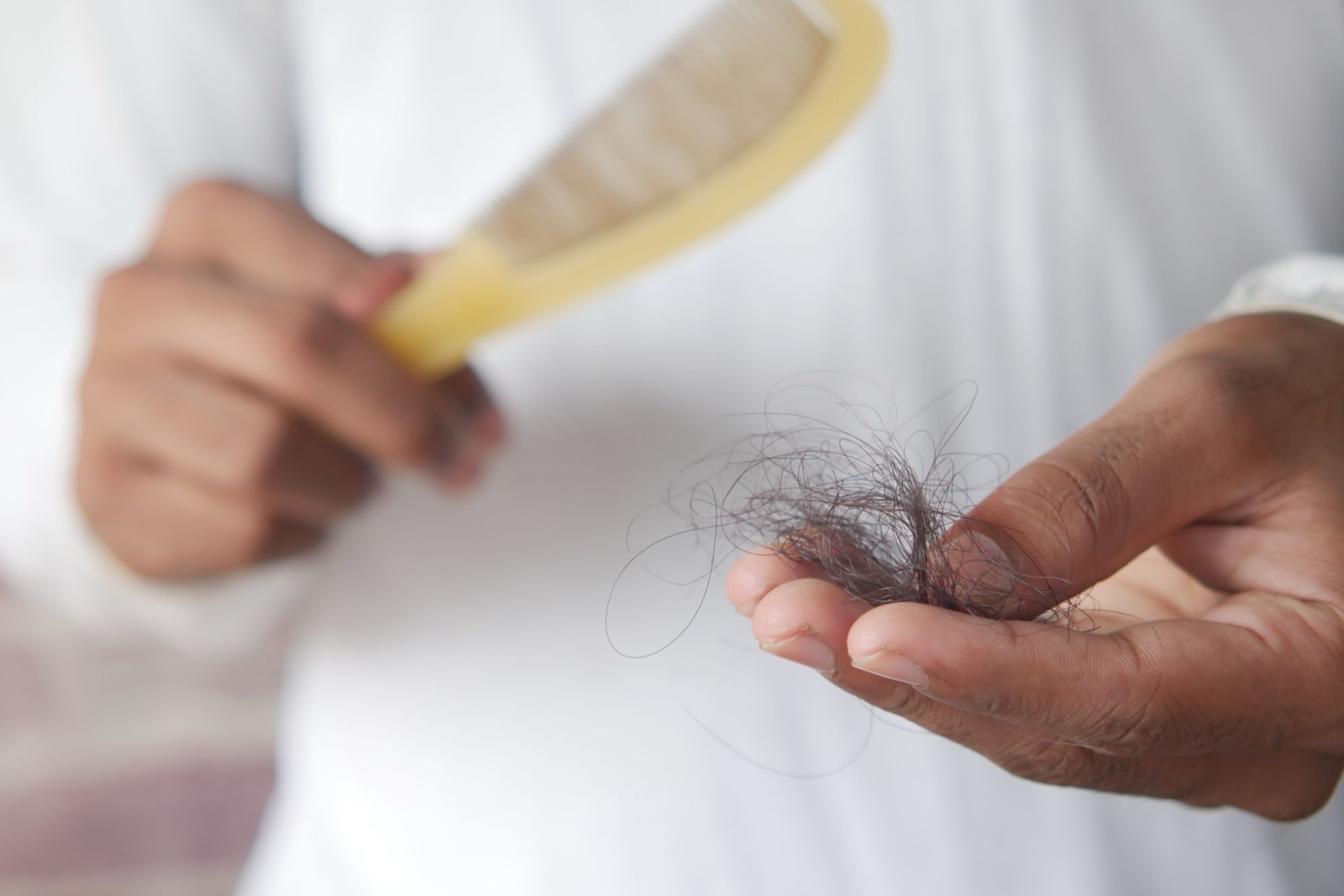
Hair on your pillow or comb can come from two different phenomena: hair loss is when a strand leaves the follicle together with its root, whereas hair breakage is when the hair shaft snaps while the root stays in the follicle. Breakage is mostly related to how hair is cared for and styled; heavy, prolonged or patchy hair loss needs a doctor to find the cause. This article does not replace medical advice.
1. The life cycle of a hair
Hair follicles go through cycles throughout life: rapid growth (anagen), regression (catagen) and relative “rest” (telogen). Abnormalities in this cycle underlie many human hair growth disorders (Oh et al., 2016).
| Phase | What happens | In a healthy scalp (DermNet) |
|---|---|---|
| Anagen | The follicle produces the hair shaft; the hair grows longer | About 85% of follicles; lasts about 4 years |
| Catagen | The follicle regresses; the hair stops growing | A small number of follicles |
| Telogen | The hair stays in place; a new hair growing underneath pushes the old one out | About 15% of follicles; lasts about 4 months |
Losing some hair every day is therefore normal. According to the American Academy of Dermatology (AAD), shedding 50 to 100 hairs a day is normal. A telogen hair is called a club hair because of the shape of its root (DermNet).
2. Hair loss or hair breakage: how to tell
The AAD distinguishes “hair shedding”, when noticeably more hairs than normal fall out each day, from “hair loss”, when something stops the hair from growing. Breakage is different again: damaged hair becomes brittle and breaks easily; prolonged damage can make hair thin and even cause bald patches (AAD).
| Sign | Suggests hair loss | Suggests breakage |
|---|---|---|
| Fallen strands | Full length, with a club-shaped root at one end | Pieces of uneven length, without a root |
| On the head | Diffuse thinning, thinning in one area, or patches | Frayed, split ends; many short hairs along the hair shafts |
| Circumstances | A few months after childbirth, high fever, surgery, major weight loss, stress | After bleaching, coloring, perming or straightening; heat styling; tying hair tightly; vigorous brushing |
This table was compiled by Butter-C as an inference from descriptions by the AAD and DermNet and from the experiments of Robbins and Kamath (2007); it is for orientation only and not for self-diagnosis.
3. Types of hair loss to recognize that warrant a doctor’s visit
Telogen effluvium
After a “shock” to the body, up to 70% of growing hairs can shift into the resting phase; shedding increases noticeably about 2–4 months after the event, with diffuse thinning and no scarring (DermNet). Triggers include childbirth, high fever, serious illness, surgery, major weight loss, stress and stopping birth control pills (AAD; DermNet). After childbirth, shedding peaks about four months after delivery, and hair usually returns to its normal fullness within 6–9 months (AAD). A chronic form with no clear trigger is common in healthy women aged 30–60 and can last for years (DermNet). Causes such as thyroid disorders or iron deficiency need a doctor to test for and manage them (DermNet). If you suspect a medicine is causing hair loss, ask your doctor; do not stop the medicine on your own (AAD).
Hereditary hair loss (androgenetic alopecia)
According to the AAD, women usually notice gradual thinning; men usually have a receding hairline or a bald spot that starts in the middle of the crown.
Patchy hair loss (alopecia areata)
The AAD describes this as a disease that occurs in healthy people and can cause round bald patches on the scalp, diffuse shedding and, rarely, loss of all hair. In children, patchy hair loss with a scaly scalp can also be tinea capitis — see the article on dandruff and oily scalp.
Diagnosing these types is the role of a dermatologist. The AAD notes that effective interventions exist for many types of hair loss, and the earlier they start, the better the outlook; these are prescription medicines or procedures ordered by a doctor, outside the scope of cosmetics.
4. Four groups of causes of hair breakage
Heat
The AAD advises letting hair air-dry when possible, choosing the lowest heat setting, and reducing how long and how often you use hot combs and curling irons. On cut hair tresses that were shampooed and dried 30 times, the hair surface tended to be more damaged as the temperature increased, while the cell membrane complex (the material that binds the cells of the hair together) was damaged only in the naturally dried group. The authors concluded that although using a hair dryer causes more surface damage than air-drying, drying at a distance of 15 cm while keeping the dryer moving continuously causes less damage than air-drying (Lee et al., 2011 — laboratory data). The common point: avoid high heat and heat sources held too close to the hair.
Chemicals
Coloring, perming and straightening can all damage hair. The AAD advises leaving more time between sessions and having only one service at a time. In the tress-combing experiments of Robbins and Kamath (2007), bleaching increased both short-segment and long-segment breakage.
Pulling
The AAD advises wearing hair loosely tied and limiting hair extensions and braids pulled tight against the scalp. Prolonged tension can cause traction alopecia: a review by Billero and Miteva (2018) reported this condition in one third of women of African descent who wore traumatic hairstyles for long periods; in late stages it can become irreversible scarring hair loss if the hairstyle is kept.
Brushing and friction
With dry combing, short-segment breakage increased with the number of combing strokes because hair ends became progressively damaged; with wet combing, there was less short-segment breakage but more long-segment breakage, because of higher friction and the lower strength of wet hair (Robbins and Kamath, 2007, experiments on hair tresses). The AAD advises letting straight hair become partly dry before combing, and combing tightly curled hair while it is still damp, using a wide-tooth comb.
5. Checklist to reduce hair breakage
Based on AAD recommendations:
- Massage shampoo into the scalp; when rinsing, let the lather flow through the lengths of the hair rather than rubbing the whole length.
- Use conditioner after every shampoo.
- Wrap hair in an absorbent towel instead of rubbing it with the towel.
- Brush only when styling, brush gently and detangle without yanking; brushing 100 strokes a day is a myth.
- Tie hair loosely, use coated hair ties and vary your hairstyle.
6. What cosmetics can and cannot do
What they can do: care for the hair shaft. In the experiments of Robbins and Kamath (2007), a commercial conditioner reduced both short-segment and long-segment breakage when combing tresses. Conditioner makes hair slippery and reduces combing force (see the article on cetearyl alcohol (in Vietnamese)). From this it can be inferred that conditioners, hair masks and hair serums help limit breakage during combing and detangling; the effectiveness of each formula needs to be measured on the finished product.
What they cannot do: change the hair follicle cycle. Telogen effluvium, hereditary hair loss and alopecia areata originate in the hair follicle and in internal causes. Ingredients often advertised for hair growth have limited evidence: for caffeine, the hair data come from experiments on cultured hair follicles and an open-label trial in men with androgenetic hair loss, i.e. a medical context (see the article on caffeine in cosmetics (in Vietnamese)); for topical ginger and biotin, there are no controlled trials in humans on hair growth.
7. Hair product claims under Appendix 03-MP
Appendix 03-MP (Phụ lục số 03-MP) of Circular 06/2011/TT-BYT (Thông tư 06/2011/TT-BYT) lists claims that are not accepted for hair care products: “Permanently eliminates dandruff”, “Restores hair cells/hair follicles”, “Thickens the hair strands”, “Prevents hair loss”, “Stimulates hair growth”; the list is not exhaustive, and the final decision rests with the regulatory authority. The Appendix has no accepted example claims specifically for hair; it only states: “The above functions may be toned down and made more cosmetic in nature” (translated from the Vietnamese; the English version reads: “claims can be softened i.e. made less functional and more cosmetic in nature by the use of modifiers”). The English version (Appendix III, 2007) lists “Hair loss can be arrested or reversed” as unacceptable, but includes “Hair loss” among the examples of “acceptable secondary claim areas”, which the Vietnamese version does not. See the page on Circular 06/2011/TT-BYT (in Vietnamese).
| Do not use (Appendix 03-MP) | Wording proposed by Butter-C (practice, not wording from the document) |
|---|---|
| “Prevents hair loss” | “Helps reduce breakage from combing and detangling”, “helps reduce breakage when combing” — when breakage has been tested on the finished product |
| “Stimulates hair growth”, “Restores hair cells/hair follicles” | “Cleanses hair and scalp”, “cares for the scalp” |
| “Thickens the hair strands” | “Helps hair look thicker” — when measured on the finished product |
Cationic surfactants in conditioners have limits in ASEAN Annex III: cetrimonium chloride and steartrimonium chloride (individually or combined) at a maximum of 2.5% in rinse-off hair products and 1.0% in leave-on hair products (Ref 286); behentrimonium chloride (individually or combined with the two substances above) at a maximum of 5.0% in rinse-off and 3.0% in leave-on products, while the sum of cetrimonium chloride and steartrimonium chloride must still not exceed the levels in Ref 286 (Ref 287). When manufacturing conditioner, Butter-C focuses on slip, detangling and not weighing hair down, and uses breakage claims only when there are data measured on the finished product.
8. When to see a dermatologist
The signs below are suggestions compiled by Butter-C from the sources cited, not diagnostic criteria:
- Hair falling out in patches on the scalp or in the beard area.
- Heavy shedding that lasts longer than about 6–9 months (a cut-off inferred from the usual recovery time according to the AAD and DermNet), or with no clear preceding event.
- Gradually thinning hair, a widening part or a receding hairline.
- A red, painful scalp, thick scales or pustules; hair loss with fatigue or weight loss.
- No improvement after changing your hair care — according to the AAD, hair care may not be the underlying cause.
Frequently asked questions
How many hairs a day is it normal to shed?
According to the AAD, 50 to 100. What matters is a clear change from your usual amount, or hair falling out in patches.
Should I worry about hair loss after childbirth?
The AAD considers it normal and temporary; hair usually returns to its normal fullness within 6–9 months. Inferred from this time frame: if heavy shedding lasts longer than 6–9 months, see a doctor.
Do shampoos and conditioners make hair loss go away?
No. Conditioner helps reduce breakage when combing and detangling; hair loss from internal causes needs a doctor’s diagnosis.
References
- Oh JW et al. A Guide to Studying Human Hair Follicle Cycling In Vivo. J Invest Dermatol. 2016. PMID 26763421
- Lee Y et al. Hair shaft damage from heat and drying time of hair dryer. Ann Dermatol. 2011. PMID 22148012
- Robbins C, Kamath Y. Hair breakage during combing. III. The effects of bleaching and conditioning on short and long segment breakage by wet and dry combing of tresses. J Cosmet Sci. 2007. PMID 17728947
- Billero V, Miteva M. Traction alopecia: the root of the problem. Clin Cosmet Investig Dermatol. 2018. PMID 29670386
- American Academy of Dermatology. Do you have hair loss or hair shedding? https://www.aad.org/public/diseases/hair-loss/insider/shedding
- American Academy of Dermatology. How to stop damaging your hair. https://www.aad.org/public/diseases/hair-loss/insider/stop-damage
- DermNet. Telogen effluvium (hair shedding). https://dermnetnz.org/topics/telogen-effluvium
- Bộ Y tế. Thông tư 06/2011/TT-BYT, Phụ lục số 03-MP (văn bản hợp nhất) [Ministry of Health. Circular 06/2011/TT-BYT, Appendix 03-MP (consolidated text)]: https://dav.gov.vn/upload_images/files/07_%20VBHN%20BYT%20h%E1%BB%A3p%20nh%E1%BA%A5t%20Th%C3%B4ng%20t%C6%B0%20quy%20%C4%91%E1%BB%8Bnh%20v%E1%BB%81%20qu%E1%BA%A3n%20l%C3%BD%20m%E1%BB%B9%20ph%E1%BA%A9m%20PDF.pdf · ASEAN Cosmetic Claims Guidelines (2007): https://file.go.gov.sg/appendix-iii-asean-cosmetic-claims-guidelines.pdf